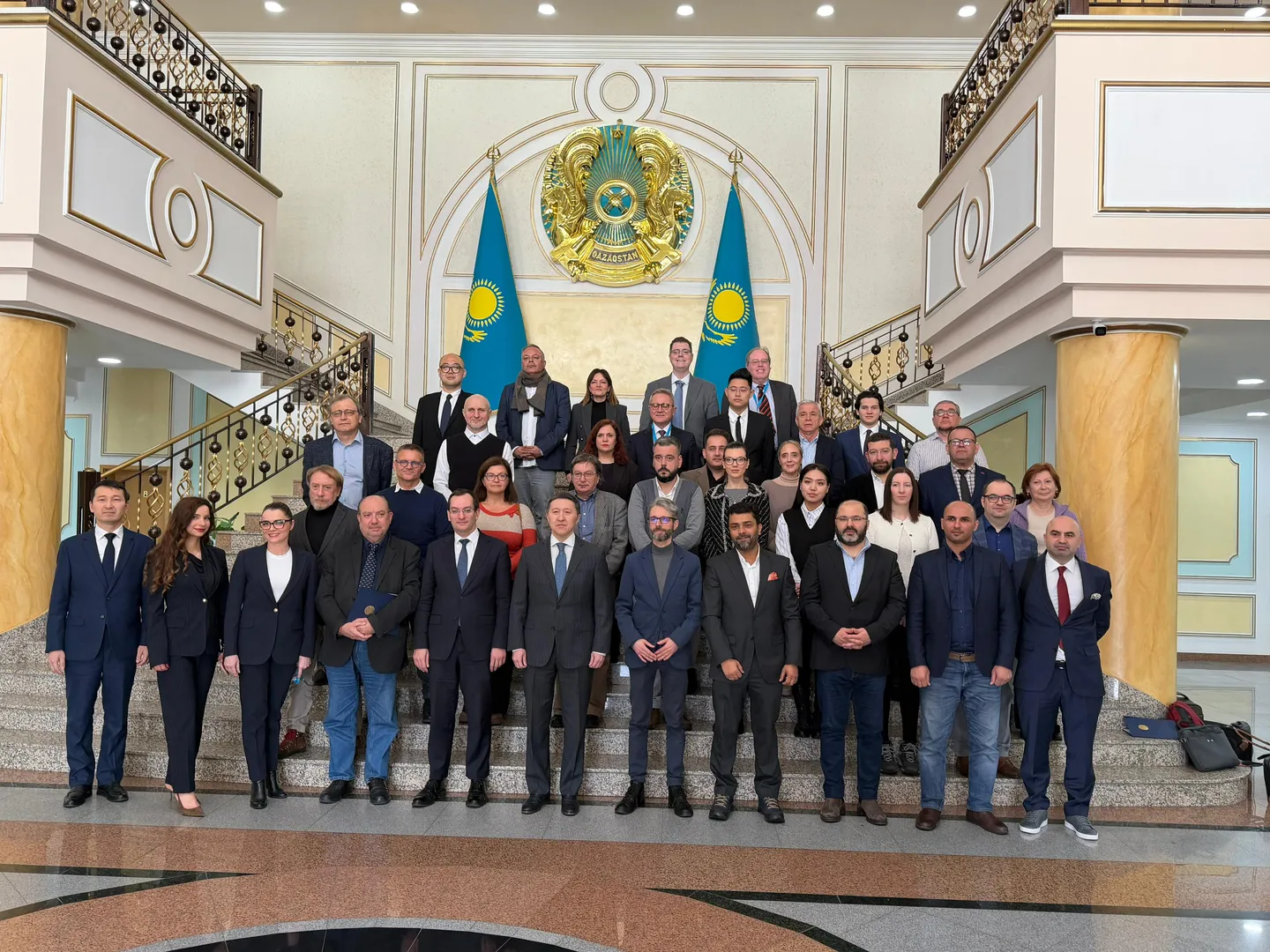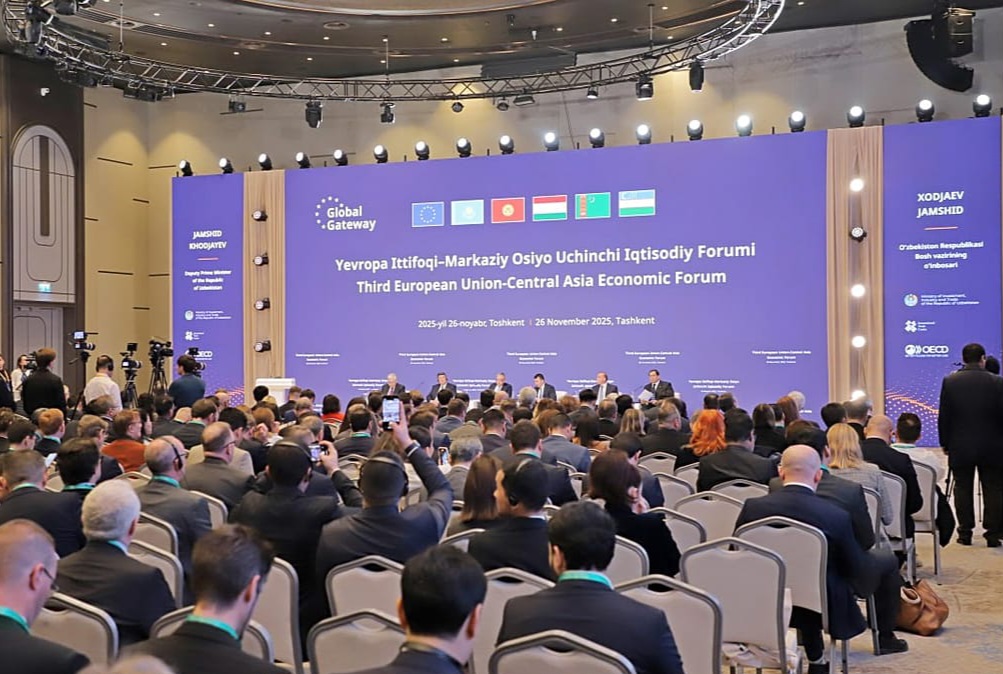
On November 26, Tashkent became the center of a major international dialogue as it hosted the third European Union–Central Asia Economic Forum. The event brought together representatives of the European Commission, senior officials from all five Central Asian countries, and delegates from finance and economic ministries to discuss trade, investment, and sustainable development.
A Kazakh delegation led by Deputy Prime Minister Galymzhan Koishybayev joined the forum, alongside prominent speakers such as Jamshid Xodjayev (Uzbekistan), Yozef Sikela (EU Commissioner for International Cooperation), Hokim Xoliqzoda (Tajikistan), Bakyt Torobayev (Kyrgyzstan), and Babanyaz Yalakov (Turkmenistan).
Opening Remarks: A Platform for Cooperation
In his keynote, Jamshid Xodjayev, Deputy Prime Minister of Uzbekistan, emphasized the growing importance of the forum:
“With more partners joining, more sectors involved and more projects moving forward, this forum has already proven to be a broad and practical platform to deepen cooperation, address pressing challenges, and generate real solutions. Today we host more than 400 foreign guests from 32 countries, demonstrating the growing importance of this dialogue.”
He highlighted the challenges of fragmentation, protectionism, and climate change, while stressing that collaboration and trust between regions lead to faster growth and stronger resilience.
EU Perspective: Pragmatism and Partnership
Yozef Sikela, EU Commissioner, underlined the pragmatic case for partnership:
“Central Asia is home to abundant natural resources. Your population is young, skilled, dynamic, and increasingly independent. Geographically, you stand at the crossroads of East and West. The EU, in turn, is the world’s largest trading group, offering cutting-edge technological expertise, strong investment capacity, and positive experience in regional integration.”
He pointed to the Enhanced Partnership and Cooperation Agreements (EPCA) as a cornerstone of EU–Central Asia relations, noting that Kazakhstan’s EPCA has already delivered substantial increases in trade and investment. Agreements with Uzbekistan, Tajikistan, and Kyrgyzstan are now advancing, opening new avenues for diversification and long-term prosperity.
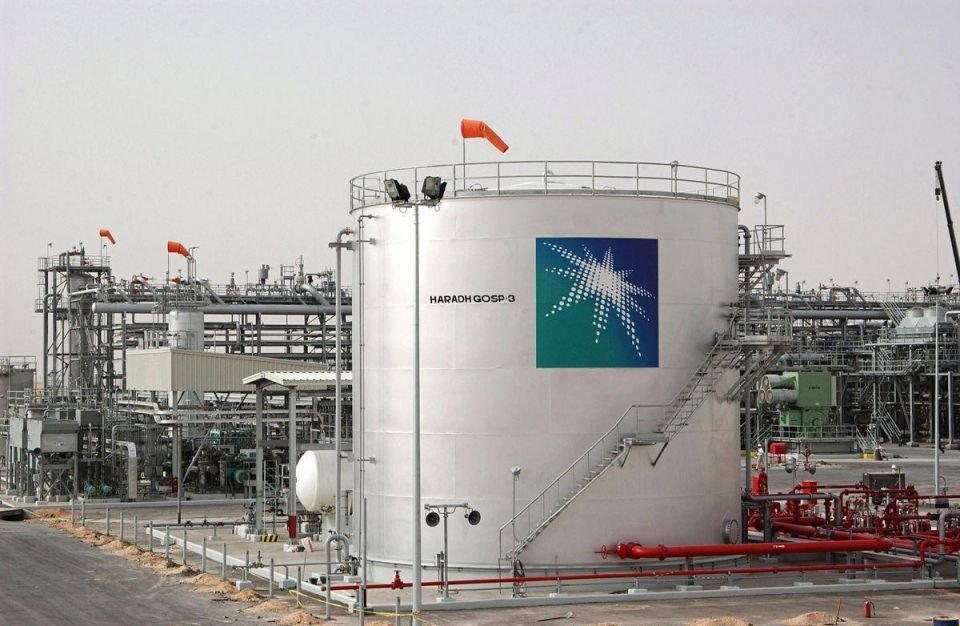
Sikela also stressed infrastructure as a second pillar of cooperation, citing the €12 billion Global Gateway investment package focused on transport connectivity, critical raw materials, digital connectivity, and the water-energy-climate nexus.
Kazakhstan’s Vision: Investment and Innovation
Representing Kazakhstan, Deputy Prime Minister Galymzhan Koishybayev highlighted the country’s role as a regional leader and investment hub:
“A significant milestone in the development of Kazakhstan–EU relations was the Enhanced Partnership and Cooperation Agreement, the 10th anniversary of which we celebrate this year. The EU accounts for nearly half of Kazakhstan’s foreign trade and investments. Today, approximately 5,000 enterprises with European capital operate successfully in Kazakhstan.”
He outlined Kazakhstan’s ambitious goals:
Attract $150 billion in foreign direct investment by 2029.
Implement large-scale reforms under the National Development Plan 2029.
Advance logistics through projects like the Trans-Caspian International Transport Route (Middle Corridor).
Provide incentives via special economic zones and the Astana International Financial Centre, offering legal stability for up to 25 years.
Koishybayev also emphasized Kazakhstan’s push toward digital transformation and artificial intelligence, citing the opening of the Alem-AI International Center in Astana as a step toward becoming a fully digital nation.
Strategic Themes: Green Growth and Connectivity
Throughout the forum, several themes emerged:
Green energy and climate resilience: Central Asia’s potential in renewable energy, hydrogen, and low-carbon industries.
Critical raw materials: Moving from extraction to local processing and value-added production.
Infrastructure and connectivity: Strengthening transport corridors like the Middle Corridor to link Central Asia with Europe.
Financial institutions: The EBRD and EIB announced record investments in sustainable projects, underscoring Central Asia’s rising importance in the global economy.
A Shared Future
The forum built on momentum from the first EU–Central Asia Summit in Samarkand, marking a new phase in relations. Both sides reaffirmed their commitment to long-term strategic cooperation, with Europe recognizing Central Asia as a vital partner in trade, energy, and innovation.
As Jamshid Xodjayev concluded: “Economies that collaborate grow faster. Regions that trust each other become more productive. Partnerships built on long-term goals deliver the strongest impact. This is exactly why the EU–Central Asian Dialogue is so crucial today.”
Conclusion
The EU–Central Asia Economic Forum in Tashkent showcased the region’s transformation from a transit crossroads into a rising engine of innovation, connectivity, and sustainable growth. With ambitious investment targets, green strategies, and enhanced cooperation frameworks, Central Asia is positioning itself as a strategic partner for Europe and the global economy.
The message from Tashkent was clear: this is not just about dialogue, but about action. The forum laid the foundation for concrete projects, deeper trust, and shared prosperity, ensuring that both Europe and Central Asia can navigate global challenges together while seizing new opportunities for growth.

Historian and environmental management expert on Central Asia and researcher on Central Asia post-Soviet period. Journalist for EuReporter and EuReflect and Special Director of “The Gulf Observer” for Europe and Central Asia.