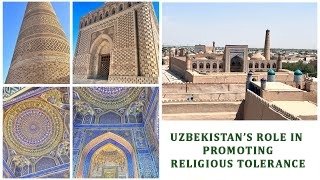
Uzbekistan is a land of diverse cultures and faiths; a land where different cultures, religions, and civilizations have met and coexisted. When we go through the history we come to know that the Silk Road was the world’s center of cultural exchange while Uzbekistan was its beating heart. The very central part of Eurasia, all roads lead to ancient Uzbekistan. The Silk Road was a web of trade routes that connected the East and West, enabling the exchange of goods, ideas, and culture between ancient civilizations. Uzbekistan’s strategic location at the heart of the ancient Silk Roads made it a natural hub for the people with diverse backgrounds. Uzbekistan was at the vital crossroads drawing merchants, traders, faiths, ideas, and cultures both from East and West. This diversity is also reflected in Uzbekistan’s diverse architecture, vibrant marketplaces, and holy places. The same historical experience has shaped Uzbekistan’s approach toward religious tolerance and peaceful coexistence.
In recent years, under the “New Uzbekistan Reforms Agenda”, Uzbekistan has placed strong emphasis on promoting religious harmony, mutual respect, and inter-civilizational dialogue both at home and internationally. Amidst ongoing global challenges to religious freedom, intolerance, and cultural misunderstandings, Uzbekistan presents a positive example of how diversity can be managed through dialogue, education, and inclusive policies.
Historical Foundations of Religious Tolerance in Uzbekistan
Uzbekistan’s tradition of religious tolerance is deeply rooted in its history. From the time of the Great Silk Road, the region’s cities such as Samarkand, Bukhara, and Khiva served not only as trade hubs but also as centers of spiritual communication between East and West. Scholars, traders, and travelers from different regions and faiths used to interact peacefully, exchanging ideas and knowledge. Here, Islam, Christianity, Judaism, Buddhism, and Zoroastrianism coexisted for centuries, shaping a unique model of religious tolerance that continues to define Uzbekistan’s cultural identity today. Critics might argue that over 90% population of Uzbekistan is Muslim but it should be kept in mind that Islam flourished in the region but the leadership of Uzbekistan inculcated the respect for other beliefs and cultures in its people.
Bukhara, located in modern-day Uzbekistan, often referred as the holiest city in Central Asia, has preserved the legacy of those past times when caravans carried not only goods but also ideas and beliefs across the Great Silk Road, one of the most important trade routes in the history. As a major city along the ancient Silk Road, Bukhara served as a hub for trade, intellectual exchange, and the development of Islamic scholarship. It was a center of Islamic learning and culture while also hosting Jewish and Christian communities. This historical coexistence helped form a social culture based on mutual respect and understanding. Religious practices were often linked with values such as moderation, compassion, and knowledge, rather than exclusion or extremism.
This religious harmony rooted in the history of Uzbekistan lays down the foundation for modern Uzbekistan’s contemporary policies. By highlighting its past as a place of peaceful interaction among civilizations, Uzbekistan reinforces the idea that tolerance is not a new concept, but a natural part of its national identity.
Domestic Policies Supporting Religious Harmony
Uzbekistan supports religious tolerance through state policies, legal frameworks, and social initiatives. The constitution defines Uzbekistan as a secular state, separating religion and state, and prohibiting state interference in religious affairs. The government guarantees freedom of religion while emphasizing the importance of harmony and respect among different faiths. Various religious communities, including Muslims, Christians, Jews, and others, practice freely and contribute to the country’s social life. Currently, more than 130 nationalities, 16 religious confessions and more than 2,200 religious organizations are there in Uzbekistan, living in peace and harmony, adhering to the principles of religious tolerance.
Education plays a key role in promoting tolerance whether its religious tolerance or cultural. To ensure both, Uzbekistan has invested in academic and research institutions that study religious history, ethics, and interfaith relations. Centers such as the International Islamic Academy of Uzbekistan and the Imam Bukhari International Research Center focus on promoting enlightened interpretations of religion that emphasize peace, knowledge, and moral values.
In order to prevent extremism government promotes education and inclusion rather than confrontation or marginalization. Uzbekistan does not view religion as a source of division. In Uzbekistan, religion is treated as as a cultural and spiritual resource that can strengthen social unity. Public discussions, academic conferences, and cultural events help build awareness about shared human values across religions.
Uzbekistan’s International Engagement in Inter-Civilizational Dialogue
As discussed earlier, Uzbekistan promotes religious harmony and interfaith dialogue not only inside the country but also beyond the borders. It actively promotes inter-civilizational and interfaith dialogue through diplomacy and international cooperation. The country has also raised these issues at global platforms, particularly at the United Nations. Notable initiatives include Uzbekistan’s support for UN resolution for the International Day for Dialogue among Civilizations, co-hosting the Dialogue of Declarations, Samarkand Solidarity Initiative, and so on. All these efforts are aimed at promoting religious tolerance, cultural understanding, freedom of belief, enlightenment, mutual respect, and building trust.
Uzbekistan positions itself as a bridge between civilizations by hosting international forums and conferences like the Fergana Peace Forum, Central Asia-GCC Think Tank Forum, Peace Forum, TermezDialogue, and U.S.-Central Asia Think Tank Forum, fostering intellectual exchange and policy solutions. These events bring together scholars, religious leaders, and policymakers from different countries, and focus on themes such as peaceful coexistence, the role of education in preventing extremism, and dialogue between cultures.
In addition, the country’s engagement with organizations like the Organization of Islamic Cooperation (OIC) further strengthens its role in promoting moderate and inclusive views within the Islamic world. Uzbekistan emphasizes that Islam, like other religions, supports peace, learning, and cooperation. This message resonates internationally, especially at a time when misunderstandings about religion are widespread.
Uzbekistan’s diplomatic efforts show that inter-civilizational dialogue is not only for cultural exchange and understanding. It is also about how the nations with diverse religions, cultures, and civilizations can contribute to global peace and stability. By encouraging harmony and dialogue instead of conflict and confrontation, the country supports a more balanced and respectful international order.
Final Analysis
Taken together, Uzbekistan’s role in promoting religious tolerance and inter-civilizational dialogue has roots in its history, supported by its domestic policies, and expanded through international engagement. The country demonstrates that diversity can become a source of strength when guided by education and dialogue. By investing in education, protecting religious freedom, and engaging constructively on the global stage, Uzbekistan offers a positive example of peaceful coexistence in a complex world.
Today’s era is marked by cultural tensions and ideological conflicts, and in such complex world Uzbekistan’s approach highlights the importance of understanding, respect, and cooperation among civilizations.
Uzbekistan is a model for the world in terms of religious tolerance and interreligious dialogue. Citizens living in Uzbekistan, regardless of their religion, culture and race, work together for the sake of peace and tranquility, for the development of the country. In Uzbekistan, the legal framework for freedom of conscience is being improved. Today in Uzbekistan all conditions have been created for people of different religions to practice their religion without any obstacles.
Hence, Uzbekistan’s efforts contribute not only to national harmony but also to broader international peace, making Uzbekistan an important voice for dialogue and tolerance in global affairs. By supporting open dialogue and responsible religious education, Uzbekistan creates a social environment where differences are respected and radical extremist ideologies find little or no space to grow.

Executive Director, Pakistan Research Center for a Community with Shared Future (PRCCSF).