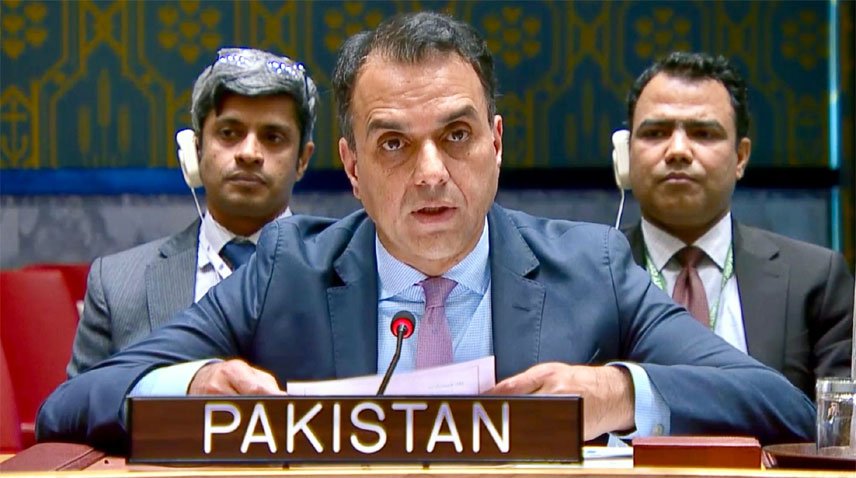
United Nations, January 21, 2026 – The Europe Today: A senior Pakistani diplomat has warned that India has created an unprecedented crisis for Pakistan’s water security and regional stability by unilaterally holding in abeyance the 1960 Indus Waters Treaty, which governs water sharing between the two countries.
Speaking at a roundtable discussion on global water scarcity co-hosted by the United Nations University (UNU) and the Canadian Mission to the UN on Tuesday, Ambassador Usman Jadoon, Acting Permanent Representative of Pakistan to the United Nations, said India’s actions amounted to the deliberate “weaponization” of water.
“This is not nature’s doing; this is a nation-state deliberately weaponizing water,” Ambassador Jadoon said, citing material breaches that he said followed India’s decision regarding the six-decade-old treaty. These included unannounced disruptions of downstream water flows and the withholding of hydrological information.
He stressed that Pakistan’s position on the treaty is clear and firm. “Pakistan’s position is unequivocal; the Treaty remains legally intact and permits no unilateral suspension or modification,” he said.
The event was held following the release of a flagship report by UN researchers on “Global Water Bankruptcy,” which calls for a fundamental reset of the global water agenda amid warnings of irreversible damage to major river basins.
Ambassador Jadoon highlighted the critical importance of the Indus River Basin, noting that it sustains one of the world’s largest contiguous irrigation systems, provides more than 80 percent of Pakistan’s agricultural water needs, and supports the lives and livelihoods of over 240 million people. He said the Indus Waters Treaty has long ensured equitable and predictable management of shared waters.
Describing Pakistan as a semi-arid, climate-vulnerable, lower-riparian country, the envoy said the country faces multiple challenges, including floods, droughts, accelerated glacier melt, groundwater depletion and rapid population growth, all of which are placing immense strain on already stressed water systems.
He said Pakistan is working to strengthen its water resilience through integrated planning, flood protection, irrigation rehabilitation, groundwater recharge and ecosystem restoration. He highlighted national initiatives such as “Living Indus” and “Recharge Pakistan” as part of efforts to address growing water challenges.
However, Ambassador Jadoon emphasized that national efforts alone are insufficient to manage systemic water risks in shared river basins. “Predictability, transparency and cooperation in transboundary water governance are matters of survival for downstream populations,” he said.
Looking ahead to this year’s UN Water Conference, the Pakistani envoy called for the recognition of water insecurity as a systemic global risk. He urged that cooperation and respect for international water law be placed at the center of shared water governance, and that international commitments result in tangible protection for vulnerable downstream communities.