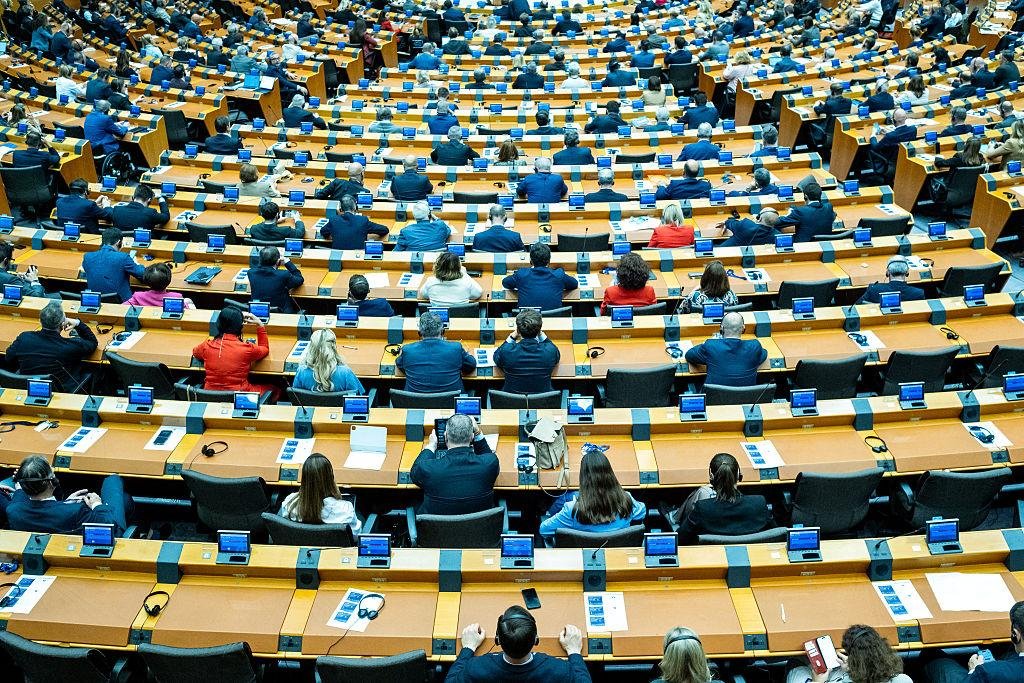
Brussels, February 23, 2026 – The Europe Today: The European Parliament on Monday paused the ratification process of a major trade agreement with the United States, citing growing uncertainty following the Supreme Court of the United States decision to overturn most of President Donald Trump’s tariffs.
The move came after an emergency meeting in Brussels, where lawmakers expressed concerns about the reliability of Washington’s commitments under the agreement.
“The U.S. side of the deal is now so uncertain,” media reports quoted trade committee chief Bernd Lange as saying. “Nobody knows what will happen … and it’s unclear if there will be additional measures or how the United States will really guarantee its end of the agreement.”
As the announcement was being made, Trump took to his social media platform to warn that “any country that wants to ‘play games’ with the ridiculous Supreme Court decision” could face “a much higher tariff.” He concluded his post with the words, “BUYER BEWARE!!!”
The combined uncertainty and renewed tariff threats rattled financial markets. The Dow Jones Industrial Average fell more than 710 points, or over 1.4 percent, while the S&P 500 dropped 1 percent and the Nasdaq declined 1.3 percent.
In Europe, the pan-European Stoxx 600 index slipped 0.2 percent. Benchmark indexes in Germany, Norway, Switzerland, Belgium and Sweden also traded in negative territory.
The trade agreement had been reached last July between Trump and Ursula von der Leyen, President of the European Commission. The White House described the deal as eliminating “trade barriers” across multiple sectors for American exporters and hailed it as a “generational modernization of the transatlantic alliance.”
For the European Union, von der Leyen said at the time that the agreement created “certainty in uncertain times” and offered “stability and predictability, for citizens and businesses on both sides of the Atlantic.”
Under the terms of the deal, most U.S. tariffs on imports from the EU would have been capped at 15 percent. Tariffs were also set to be reduced to zero on aircraft and parts, generic pharmaceuticals, semiconductor equipment, selected agricultural products, and certain critical raw materials not available in the United States.
With ratification now on hold, the future of the transatlantic trade agreement remains uncertain, adding further volatility to already fragile global markets.