Distinguished Faculty Members,
Respected Guests,
Dearest Students,
Ladies and Gentlemen,
Assalaamu’alaikum Warahmatullaahi Wabarakaatuh,
And a very good morning.
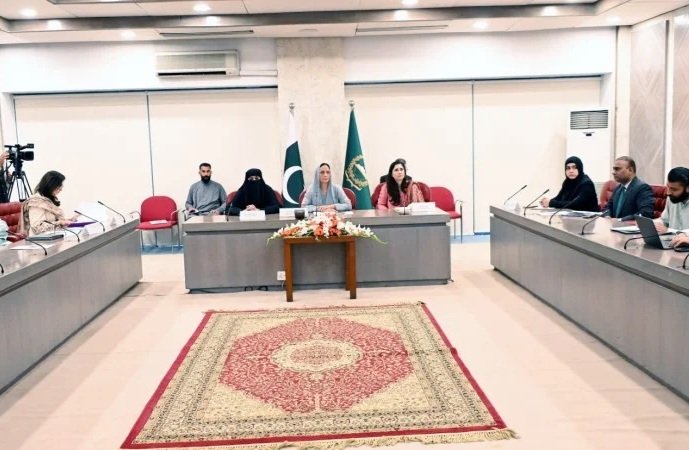
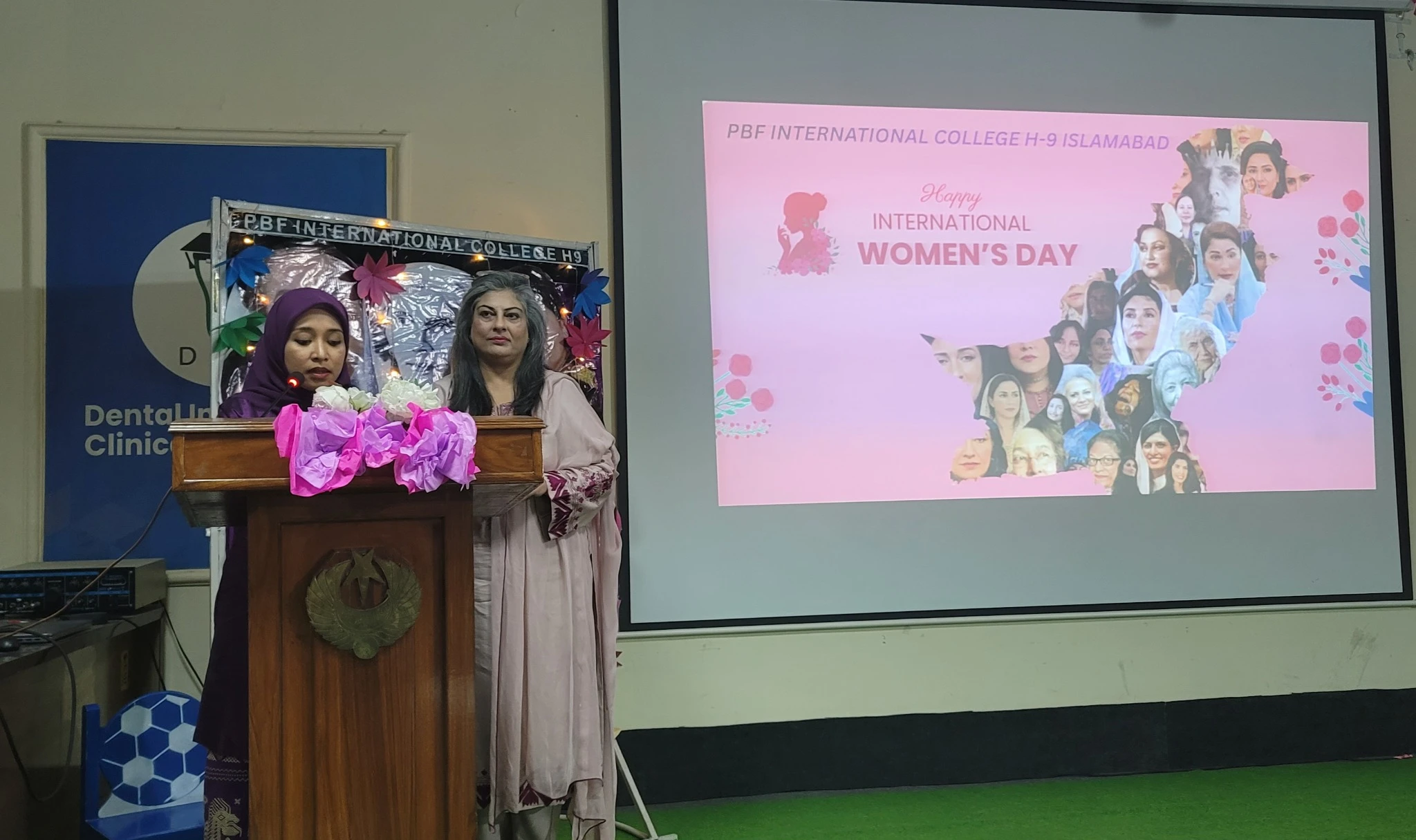
It is a great honor and pleasure for me to stand here today at the Pakistan Broadcasting Foundation College in Islamabad as we celebrate International Women’s Day 2026.
The theme of this year’s Women’s Day celebration, “GIVE TO GAIN” is timely, as the spirit of Ramadhan also highly underscores the power of giving. Allah SWT gives us a golden time during the Holy Month in the form of multiplying rewards when we sincerely give to our fellows.
Ladies and Gentlemen,
Indonesia and Pakistan are currently the two largest Muslim countries in the world. We must be proud of this status, while at the same time, let us show to the world that the two great fraternal nations have a good track record in equally treating the boys and girls, the men and women. The composition of our male-female population is almost similar, 50:50. Please keep in our minds, both male and female are huge energy of the development. Neglecting women’s role means losing half of the energy.
Ladies and Gentlemen,
For thousands of years, women left their mark on their societies, changing the course of history at times, and influencing significant spheres of life at others. In Muslim Civilization, extraordinary women from different faiths and backgrounds worked alongside men to advance their communities. Their inspiring stories, charismatic personalities and determination to contribute to the development of their environment make them beacons that guide young women and men today.
Women at the time participated in all fields of life. There were women who championed educational and cultural efforts, others who excelled in mathematics, the medical field, administration and management, philosophy and the arts. Others played key political roles and ruled important territories in the Muslim Civilization.
Ladies and Gentlemen,
Women’s empowerment in Indonesia has witnessed a blend of progressive Islamic feminism and structural support, aiming to boost economic, social, and political roles within the framework of Islamic values embedded in our cultures.
Instead of avoiding religious aspects, Indonesia involves religious elements especially Islam in shaping women empowerment. Islamic feminism in Indonesia is active in policy advocacy, notably in addressing sexual violence.
The Congress of Indonesian Women Ulama and other movements continue to shape the dialogue on gender justice, supported by the two largest Islamic organizations in the country like Muhammadiyah and Nahdlatul Ulama.
By early 2026, the Indonesian Ministry of Women’s Empowerment and Child Protection has planned to deploy female Hajj officers by 33% to support pilgrims. Around 55% of them are female Hajj pilgrims.
Ladies and Gentlemen,
In this very special occasion, please allow me to further present the development of women empowerment in Indonesia.
In Political life,
The Indonesian General Election Commission noted that the number of prospective legislative candidates from 18 political parties participating in the 2024 election was 38%, higher than the minimum percentage stipulated in our regulation.
Women’s representation in Indonesian politics was 22.06% by 2024, up from 20.5% by 2019.
The 2024 simultaneous regional head elections have raised regional leaders from Indonesian female candidates.
Based on the results of the local elections (governors, regents, mayors), there are 2 governors, 34 regents, and 9 mayors elected out of 149 female candidates. This means that there are 30.20% of female candidates who won the contest.
However, out of 545 regions, consisting of provinces, regencies, and cities, there are only 45 women elected as heads of local government. This means the number is still very small, or 8.26% compared to male local heads.
But keep in our minds that all positions are equally and hardly contested by male and female candidates.
Ladies and Gentlemen,
In the field of Economic Empowerment, studies show that Islamic marketing and services, combined with technological innovation, are driving the economic empowerment of women-led Micro, Small, and Medium Enterprises (MSMEs). Islamic financial instruments and Waqf (endowments) are increasingly used to support women’s livelihoods in various projects.
In economic fields, the data shows:
More than 32% of managerial positions in Indonesia are led by women, around 21% of State-Owned Companies are led by women, and at least 27% of executives in healthcare are led by women.
Ladies and Gentlemen,
Alhamdulillah. Indonesia has all the preconditions for women empowerment.
First, Indonesia is a country with male clerics who consistently uphold religious moderation.
Second, Indonesia has a constitution in which the clerics also participated in formulating it. There is no discrimination at all between men and women.
Third, all independence movements in Indonesia, including those of Islamic organizations, always have women’s wing organizations.
For sure, challenges are still there. Despite progress, women in some areas in Indonesia still face conservative interpretations of Islam that limit their roles, particularly in rural or deeply religious areas.
Ladies and Gentlemen,
Education institutions like PBF College Islamabad play a crucial role in this journey in Pakistan. Media and communication are also powerful tools that shape public opinion, influence social change, and amplify voices that need to be heard. When women enter the fields of journalism, broadcasting, and digital media, they bring perspectives that help create a more inclusive and balanced narrative.
Dearest students,
You represent the future of Pakistan and the future of the Pakistan–Indonesia friendship. In today’s interconnected world, collaboration between young people from our countries can strengthen our partnership even further. Through education, cultural exchange, and dialogue, we can build bridges that connect our societies more closely.
Women’s empowerment is not only a women’s issue — it is a human development issue. Investing in women means investing in peace.
To the young women here today, I would like to say: believe in your capacities and abilities, pursue your education with strong determination, and never underestimate your power.
And to the young men present here, your support and partnership are essential. Gender equality can only be achieved when men and women work together as partners in progress.
Never underestimate women, since you were born by great women — your mothers.
For sure, Indonesia is not yet a role model of women empowerment. But I would humbly say Indonesia is an example of it, especially in the Muslim world.
Bohot Shukriya.
Happy International Women’s Day!
Indonesia-Pakistan Dosti Zindabad!
Wassalaamu’alaikum Warahmatullaahi Wabarakaatuh.