Uzbekistan at the Heart of Eurasia
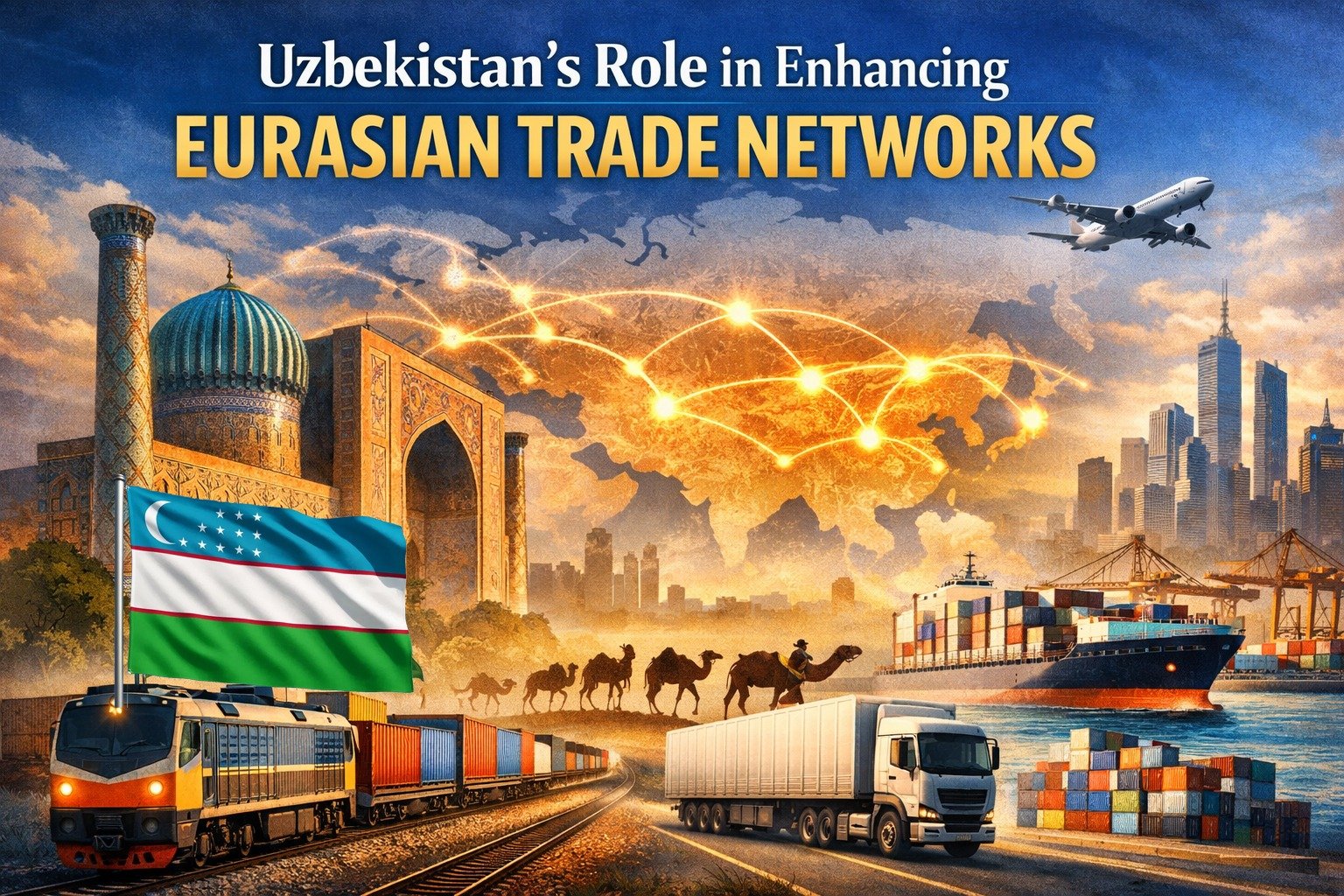
All the Central Asian countries are landlocked and resource rich in nature but Uzbekistan occupies a particularly unique and challenging position. It is one of the only two double landlocked countries in the world which means that to reach sea or ocean, borders of at least two other countries must be crossed. Also, Uzbekistan lies at the heart of Central Asia. All four Central Asian states border it. It is the most populous Central Asian country which makes it the largest potential market in Central Asia. History tells us that Uzbekistan was the heart of the ancient Silk Road since Silk Road traversed several of Uzbekistan’s major cities that were key trading posts and resting points for merchants travelling to Venice or Egypt, Persia or China. Today, Uzbekistan plays a central role in fostering connectivity between Europe and Asia. To revive this Silk Road legacy, Uzbekistan has now become an important player in regional and global trade networks. Under the leadership of H.E. President Shavkat Mirziyoyev, Uzbekistan has turned its geography into opportunity and started its journey from landlocked country to a land-linked country. To further strengthen its position in the center of Eurasia, the government of Uzbekistan has taken some significant steps such as improving infrastructure, strengthening partnerships, and promoting economic cooperation. Modern infrastructure, open-door economic policy, proactive domestic and foreign policy, and regional integration are few such examples that reflect the vision of H.E. President Shavkat Mirziyoyev of making Uzbekistan a central player in the region. Through all these measures, Tashkent has sought to position the country as a strategic crossroads at the heart of Eurasia. At the same time, these efforts are helping the country connect with China, Russia, Türkiye, and other major economies of the world. This is how Uzbekistan has become a key trading hub in Central Asia and beyond.
Strategic Location and Infrastructure Development
Uzbekistan’s central location is its greatest advantage. Since it shares borders with all the Central Asian republics which means that all the goods moving across the region pass through Uzbekistan, making it a natural transit point. To further utilize this strategic location, the government of Uzbekistan has made huge investments to develop new transportation infrastructure and to improve the existing ones. New railways, highways, and logistics centers are being developed to make trade faster and more efficient. The examples include: China–Kyrgyzstan–Uzbekistan (CKU) Railway, Trans-Afghan Railway, CASCA+ Corridor, and even multimodal freight corridor was also launched.
The China–Kyrgyzstan–Uzbekistan (CKU) Railway is also known as Kashgar–Andijan railway line. It is an international railway project that aims to connect Kashgar (China) with Andijan (Uzbekistan) via Kyrgyzstan. It is often referred as the “project of the century” and is a strategic infrastructure component if BRI. It is expected to cut travel distance to Europe by 900 km, reducing delivery times by 7–8 days, and linking Central Asia directly to the China-Pakistan Economic Corridor (CPEC). The Trans-Afghan Railway is a proposed 573–774 km railway connecting Uzbekistan, Afghanistan, and Pakistan, connecting Central Asia to the Arabian Sea. It is one of Uzbekistan’s top transport projects. Its significance lies in the fact that it connects Uzbekistan to ports in Pakistan, thereby creating a new logistic corridor that brings Russia and Central Asia closer to South Asia. It is also a part of China’s Belt and Road Initiative with the support from Russia. Similarly, the CASCA+ Corridor is a multimodal transport corridor designed to connect Central Asia, the South Caucasus, Anatolia (Turkey), and eventually Southeast Asia with Europe. The “+” shows the openness of the project to accept new participants interested in joining the project. The main goal of CASCA+ is to boost trade and logistics by enabling efficient movement of goods through road, sea, rail, and air routes across these regions. In addition, the multimodal freight corridor moving cargo from China through Kyrgyzstan, Uzbekistan, and Turkmenistan to the Caspian Sea, demonstrates the potential of emerging east–west transport networks. All these projects facilitate the access of Uzbek goods to global markets.
Frome above discussion, one thing is quite clear that Uzbekistan is actively participating in the China’s Belt and Road Initiative, thereby enhancing connectivity with China and other countries. These routes are not only helping in bypassing conventional trade routes but also reducing travel times and cost while increasing efficiency.
Trade Reforms and Regional Cooperation
To expand trade networks in Eurasian region, Uzbekistan’s efforts are not limited to infrastructure development only. It has made significant changes in country’s economic policies also. These changes are meant to boost trade.
Uzbekistan traditionally pursued a protectionist trade policy but since H.E. President Shavkat Mirziyoyev assumed the office in 2016, he gradually reformed the economy. It stayed under the state control in a bid to promote free trade, draw foreign investment, and modernize key industries. It has made easier for businesses to operate and trade. Uzbekistan has diversified export routes, liberalized the economy, and accelerated the WTO accession. The WTO accession is likely to enhance investors’ confidence, transparency, and attract FDI in key sectors. Further measures taken by Tashkent to expand Eurasian trade networks include EU’s GSP+ status and the new Enhanced Partnership and Cooperation Agreement (EPCA). It has also enhanced logistical connections to South Asia that increased the trade turnover with the EU 2 times and improved market access.
These reforms have increased the trade with neighboring countries. Uzbekistan has improved its ties with Tajikistan and Kyrgyzstan; border issues are resolved that have opened new trade routes. At the same time, recent years have witnessed spike in Uzbekistan-Kazakhstan trade also. In addition, Uzbekistan is also working actively with SCO, EEU, and other such regional organizations. Uzbekistan is not a full member of these organizations but its cooperation and involvement help in keeping a check on trade policies and improve regional stability.
Economic Growth and Future Potential
The efforts of Uzbekistan aimed at enhancing trade networks is bearing fruit now. Foreign investors are showing interest in Uzbekistan. Country’s exports have increased. Local vendors have access to more international markets now. For example: Uzbek cotton and textiles are now reaching more international markets due to improved logistics. Similarly, fruits and vegetables produced in Uzbekistan are being exported to countries across Eurasia. These developments are helping local businesses grow and create jobs. Uzbekistan’s large population is also an asset to the country. Among all the Central Asian states, Uzbekistan has the largest number of able-bodied men. Due to large labor and increasing skills set, the country has strong potential for industrial development. It again makes Uzbekistan an attractive destination for investors looking to expand their businesses in Central Asia. In future, Uzbekistan plans to become a major logistics hub in Eurasia. With further investment in infrastructure and strong partnerships, it can easily achieve this goal and become a connecting point of different regions. Similarly, the leadership of Uzbekistan makes sure that the country’s political environment remains stable and the proactive government policies make Uzbekistan a reliable trade partner. The revised policies of openness and liberalization, and the continued commitment to regional cooperation helps earn trust of the partners.
Conclusion
Hence, we come to the conclusion that Uzbekistan is playing a crucial role in enhancing Eurasian trade networks. The location in the heart of Eurasia, modern infrastructure, better logistics, and economic reforms make it a vital trade center. By connecting regions like East Asia, Central Asia, and South Asia, Uzbekistan is helping create faster and more efficient trade routes. Thus, country’s efforts not only benefiting its own economy but also supporting regional development and cooperation. Uzbekistan has the potential to become a key player in Eurasian trade, it just needs smart policies, sustained investment, and a dedicated leadership is already there.

Executive Director, Pakistan Research Center for a Community with Shared Future (PRCCSF).