Paris, December 13, 2025 – The Europe Today: Scientists have announced the discovery of a long-submerged wall estimated to be around 7,000 years old beneath the sea off the western coast of France, marking one of the most significant underwater archaeological finds in the country to date.
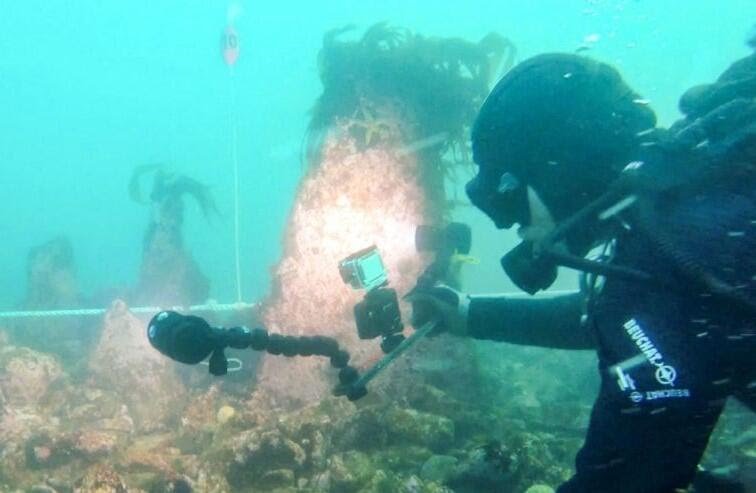
The structure, measuring nearly 400 feet in length, was discovered off the Île de Sein in the Brittany region, along with around a dozen smaller manmade structures from the same period. Researchers confirmed that the granite constructions date back to between 5,800 and 5,300 BC, a time when sea levels were significantly lower than they are today. The remains are currently located approximately nine meters below sea level.
“This is a very interesting discovery that opens up new prospects for underwater archaeology, helping us better understand how coastal societies were organized,” said Yvan Pailler, Professor of Archaeology at the University of Western Brittany, who co-authored a study on the findings published in the International Journal of Nautical Archaeology.
The structures were first identified in 2017 by retired geologist Yves Fouquet while examining laser-generated seabed maps. Subsequent diving missions carried out between 2022 and 2024 confirmed the presence and remarkable preservation of the granite wall and associated constructions. According to Fouquet, archaeologists were surprised to find such well-preserved remains in what is considered a harsh marine environment.
Researchers believe the structures may have functioned as fish traps built along the ancient foreshore or as defensive walls designed to protect coastal settlements from rising sea levels. The study highlights that the construction reflects advanced technical skills and social organization, capable of extracting, transporting, and erecting stone blocks weighing several tons—comparable to the mass of later Breton megaliths.
Notably, this level of technical expertise predates the earliest known megalithic constructions in the region by several centuries. Scholars also suggest that the submerged site may have inspired local Breton legends of sunken cities, including the mythical city of Ys, believed to have existed in the nearby Bay of Douarnenez.
“The submersion of a territory developed by a highly structured society must have left a lasting impression on collective memory,” the study notes, adding that rapid sea-level rise likely led to the abandonment of fishing structures, protective works, and habitation sites.
The discovery follows another major underwater archaeological find earlier this year, when researchers uncovered the remains of a 16th-century merchant ship more than 1.5 miles underwater off southern France, the deepest such discovery ever recorded in the region.