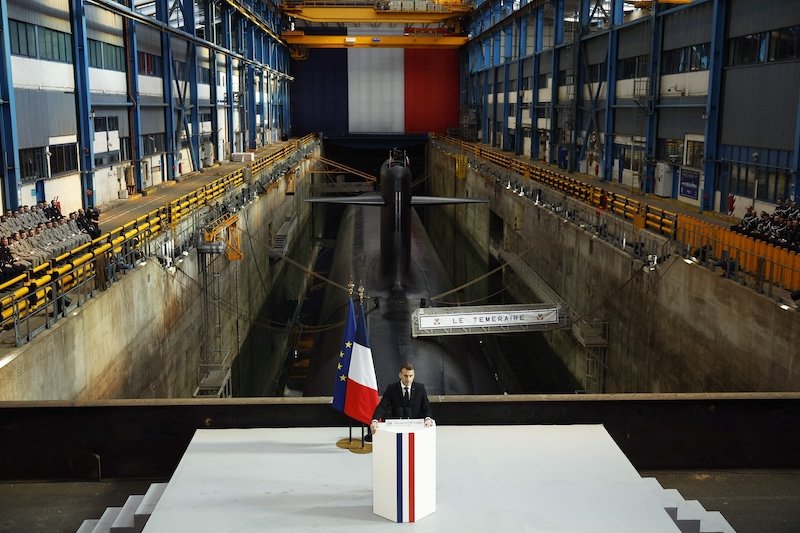
Paris, March 4, 2026 – The Europe Today: French President Emmanuel Macron has ordered an expansion of France’s nuclear arsenal and outlined plans to involve European allies more closely in the country’s deterrence strategy amid rising global security concerns.
Speaking at the Île Longue Naval Base, home to France’s ballistic missile submarines, Macron said the evolving security environment required stronger nuclear capabilities. Delivering his remarks in front of the nuclear-powered submarine Le Téméraire, the French president said increasing the country’s nuclear arsenal was “indispensable.”
While Macron did not disclose the number of additional warheads planned, France is currently estimated to possess between 290 and 300 nuclear warheads, making it the world’s fourth-largest nuclear power after the United States, Russia, and China. France remains the only European Union member state with nuclear weapons, while the United Kingdom, which left the EU, also maintains its own nuclear arsenal.
Macron said the decision was driven by shifting geopolitical realities, including Russia’s war in Ukraine, the weakening of global arms control agreements, and evolving defence priorities in the United States.
“To be free, one must be feared, and to be feared, one must be powerful,” Macron said, emphasizing the need to reinforce France’s nuclear deterrent in the face of multiple threats.
Despite the expansion, the French president stressed that the authority to deploy nuclear weapons would remain solely with the French head of state, with France continuing to independently define its “vital interests.”
Macron also proposed an “advanced deterrence” model aimed at strengthening cooperation with European partners. Countries involved in discussions include Germany, Poland, Netherlands, Belgium, Greece, Sweden, Denmark, and the United Kingdom.
Under the proposal, allied states could participate in nuclear deterrence exercises and host temporary deployments of French nuclear-capable aircraft, including squadrons of Dassault Rafale fighter jets.
Macron said the initiative would be coordinated with the United Kingdom and conducted transparently with the United States, adding that France’s nuclear forces would complement NATO’s existing nuclear mission rather than replace it.
France and Germany have also established a joint nuclear steering group to coordinate defence doctrine and balance conventional forces, missile defence systems, and French nuclear capabilities. German Chancellor Friedrich Merz said Berlin and Paris aim to take concrete steps before the end of the year, including German participation in French nuclear exercises.
Meanwhile, Polish Prime Minister Donald Tusk confirmed that Warsaw was discussing an advanced deterrence programme with France and other allies. Swedish Prime Minister Ulf Kristersson said Stockholm was willing to join discussions but emphasized that Sweden does not intend to host nuclear weapons in peacetime.
France currently maintains both sea-based and air-based nuclear deterrent forces. At least one of its four ballistic missile submarines is on patrol at all times. Macron noted that a single submarine carries strike power comparable to the total tonnage of bombs dropped on Europe during the Second World War.
The French president rejected suggestions that the move signals an arms race, stating that France’s goal is to ensure that any potential adversary understands the certainty of devastating retaliation if the country were attacked.