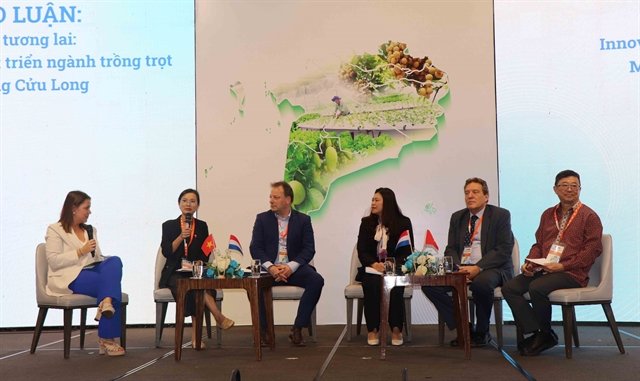
Cần Thơ, January 21, 2026 – The Europe Today: A forum on Việt Nam–Netherlands cooperation to address saltwater intrusion affecting crop production in the Mekong Delta was held in Cần Thơ City on Wednesday. The event was co-organised by the Embassy of the Netherlands and Cần Thơ University.
The forum brought together Vietnamese and Dutch stakeholders from the public and private sectors to deepen understanding of saltwater intrusion in the Mekong Delta, strengthen bilateral cooperation, and promote exchanges on innovative solutions and technical expertise to mitigate its impacts on agricultural production.
Participants were informed that around 70 per cent of the Mekong Delta’s land area, equivalent to approximately 2.5 million hectares, is used for crop cultivation, with rice accounting for about 60 per cent of total farming activities. The region is home to nearly 10 million farming households and more than 2,500 agricultural cooperatives, representing around 13 per cent of Việt Nam’s total.
The Mekong Delta plays a crucial role in national food security and rural livelihoods. It contributes about 50 per cent of Việt Nam’s rice output and 95 per cent of rice exports, 65 per cent of aquaculture production and 60 per cent of fish exports, as well as nearly 70 per cent of the country’s total fruit output.
However, a study by the Netherlands’ Ministry of Agriculture, Fisheries, Food Security and Nature identified small-scale and fragmented production as a major challenge for agricultural exports from the region. Scattered farming plots make it difficult to meet large export orders, complicate procurement for enterprises and limit farmers’ access to advanced technologies, leading to higher costs, inconsistent quality and restricted market access.
The forum also addressed climate change-related challenges, including saltwater intrusion, soil acidification, pests and diseases, flooding, drought and land subsidence, which pose serious threats to agricultural productivity in the Delta.
Vinod Ahuja, Representative of the Food and Agriculture Organisation of the United Nations (FAO) in Việt Nam, said saltwater intrusion directly results in lower yields, uneven quality, higher production costs and unstable supply, while increasing operational, market and credit risks for farmers.
Associate Professor Dr Văn Phạm Đăng Trí, Director of the Mekong Institute at Cần Thơ University, stressed the importance of strengthening linkages between science, policy and practice, promoting cross-border cooperation, and enhancing knowledge-sharing to support long-term, evidence-based and socially inclusive adaptation pathways for the Delta.
Experts at the forum agreed that rather than attempting to completely prevent salinity, a more effective approach is to manage it and adapt to saline conditions. Areas that successfully develop profitable farming systems under such conditions are expected to gain long-term competitive advantages.
Ahuja noted that farmers in the Mekong Delta are already adapting, with production systems shifting and new technologies being tested to support more sustainable agriculture. He recommended investment in early salinity warning systems using low-cost sensors and digital modelling, as well as the adoption of precision drip irrigation and smart fertilisation to help crops meet international standards. He also called for priority infrastructure investments, including community reservoirs, strengthened irrigation canals and data-driven sluice gate systems.
Raïssa Marteaux, Consul General of the Netherlands in HCM City, reaffirmed that crop production and the Mekong Delta have long been central to bilateral cooperation. She said the Netherlands remains committed to sharing knowledge and technology and to working closely with Việt Nam for mutual economic and environmental benefits.