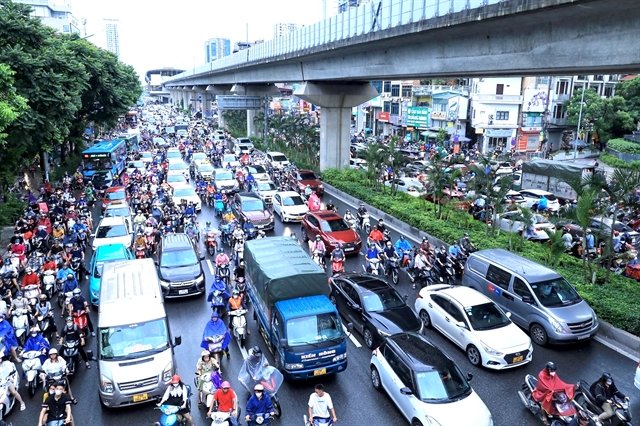
Hanoi, February 5, 2026 — The Europe Today: Facing mounting traffic congestion driven by surging private vehicle ownership and heavy commuter flows from neighbouring provinces, Hà Nội is implementing a series of strategic solutions aimed at easing urban congestion, cutting emissions, and improving residents’ quality of life.
The city’s Department of Construction outlined its plans at a recent briefing, emphasizing that traffic bottlenecks have become a direct obstacle to the capital’s socio-economic development and investment attractiveness.
According to experts, Hà Nội’s population of 8.7 million is growing at a mechanical population growth rate of 1.96 per cent per year, while transport infrastructure development has lagged behind. Inter-district road networks currently cover only 43.51 per cent of planned targets, and land allocated for transport infrastructure has increased by just 0.3–0.35 per cent annually. In contrast, the city’s total vehicle fleet exceeds 9.2 million units, with motorcycles accounting for 72.3 per cent.
Daily travel patterns place further pressure on the city, with 27 per cent of trips concentrated during two peak hours—7:30–8:30 a.m. and 5:30–6:30 p.m. Deputy Director of the Department of Construction, Đào Việt Long, said traffic congestion drives logistics costs up to 16.8 per cent of GDP, constraining labour productivity and competitiveness.
Hà Nội also absorbs around 1.45 million daily trips from neighbouring provinces, 22 per cent of which cover distances of 50–80 km, primarily from Bắc Ninh, Hưng Yên, and Vĩnh Phúc. With interregional infrastructure operating below 50 per cent of planned capacity, these flows frequently paralyse ring roads during peak hours.
Public transport faces challenges as well. Bus punctuality remains low, with journeys on certain routes taking up to 43 minutes, compared to 20 minutes by motorcycle, discouraging commuters from switching to sustainable modes. Despite 70.6 per cent of inner-city trips being under six kilometres, motorcycles remain the preferred choice due to convenience, while inadequate walking access to bus stops limits ridership.
Freight transport inefficiencies also exacerbate congestion. Up to 70 per cent of container trucks return empty, with limited hubs linking long-haul and short-haul operations, forcing trucks into urban gateways and further straining road capacity.
Integrated, technology-driven solutions have been identified as critical to easing congestion. Proposed measures include:
- Developing an integrated traffic data platform and deploying intelligent traffic signals to optimise flows.
- Introducing interoperable electronic ticketing and an integrated mobility service linking metro lines, buses, taxis, ride-hailing services, and public bicycles through a single digital platform.
- Establishing core zones restricting private vehicles via emission-based rules or congestion charges.
- Piloting public bicycle schemes and shared electric motorbikes around metro stations and high-density areas.
- Implementing feeder bus systems connecting neighborhoods to metro and BRT corridors.
- Introducing dedicated bus lanes on major radial roads and Ring Roads 1, 2, and 3 to improve speed and punctuality.
The Department of Construction also stressed the need for a unified legal framework for traffic data sharing and transport management, alongside continued refinement of the city’s master plan prioritising green transport infrastructure and transfer hubs.
“A breakthrough mechanism is to promote transit-oriented development (TOD), using public transport as the backbone of urban growth while reinvesting urban resources into transport infrastructure,” Long said. “Large-scale projects should also be required to conduct traffic impact assessments to ensure sustainable urban development.”
The city aims for these measures to shift commuter behaviour, optimise urban mobility, and create a more sustainable, efficient, and livable Hànội.