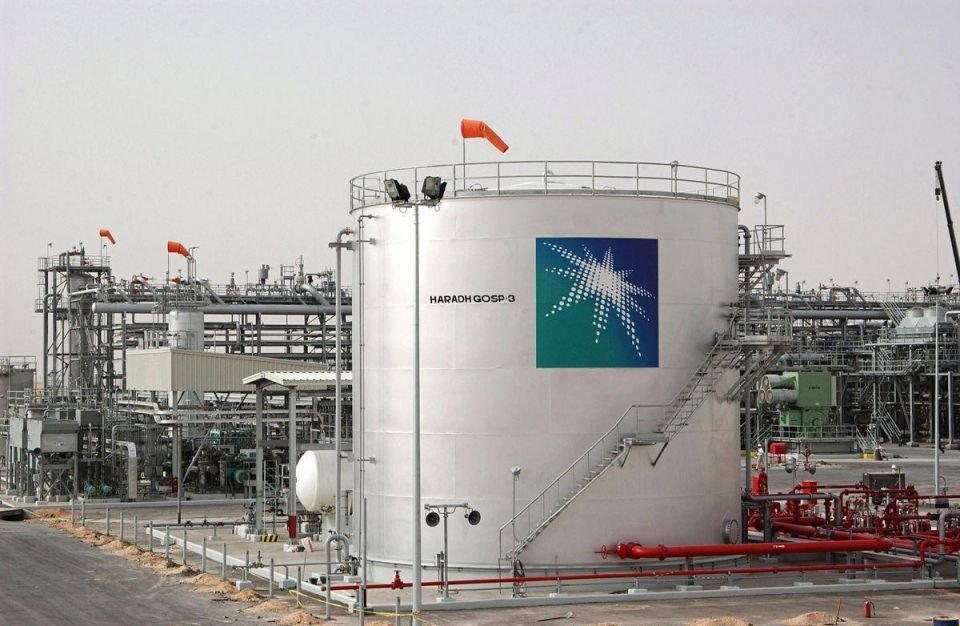
As of March 2026, Saudi Aramco dominates the global energy sector with a market capitalization of $1.74 trillion, far ahead of competitors. U.S. companies hold strong positions, with Exxon Mobil ($665.30 billion) and Chevron ($403.32 billion) ranking second and third, alongside GE Vernova and Nextera Energy, which highlight the growing role of renewables and technology. Europe’s Shell ($254.34 billion) and TotalEnergies ($191.06 billion) remain key players, while China’s PetroChina ($338 billion) and CNOOC ($190.47 billion) underscore Asia’s influence. Despite overall negative price movements, Exxon Mobil and ConocoPhillips showed gains. GE Vernova stands out with the highest share price at $851.07. Overall, the data reflects a shifting energy landscape where traditional oil giants coexist with emerging renewable-focused firms, intensifying competition between East and West.
The energy sector consists of an extensive network of companies covering the extraction, production, and distribution of energy sources, including oil, natural gas, and renewables. In other words, the energy sector represents a comprehensive structure made up of numerous directly and indirectly interconnected companies that provide the energy necessary for the economy to function, while supporting both production and transportation. Although the companies within this sector vary in terms of expertise and scope, they converge on the common goal of delivering energy to the market.
The traditional core roles of energy companies which ensure that homes stay warm, lights stay on, and industries continue to operate involve extracting, processing, and distributing energy in various forms, such as electricity, fossil fuels, and increasingly, renewable sources. These companies undertake the critical responsibility of meeting the ever-growing energy demands of populations and industries alike. This cycle involves a complex chain of activities, including the exploration of new energy sources, the construction and maintenance of infrastructure such as pipelines, power plants, and transmission lines, and the ultimate distribution of energy to consumers.
Today, the companies managing the links of this chain have evolved into financial powerhouses, distinguished not only by their operational strength but also by their massive market capitalizations within the global economy. As of March 2026, the current data clearly illustrates which actors dominate this vast ecosystem and where capital is most concentrated. In this hierarchy reshaped particularly by technological transformation and geopolitical balances the competition among global energy giants has entered a new dimension.
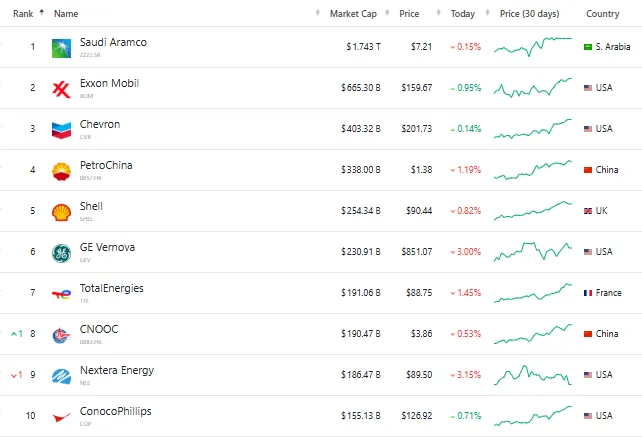
Table 1. The Largest Energy Companies by Market Capitalization (March 2026)
Source: Largest Energy Companies by Market Cap, https://companiesmarketcap.com/energy/largest-companies-by-market-cap/, 23.03.2026.
Table 1 presents the world’s largest energy companies by market capitalization. According to the data, Saudi Aramco maintains an undisputed lead with a massive market valuation of $1.74 trillion. Following this Saudi Arabian giant to round out the top three are U.S.-based Exxon Mobil ($665.30 billion) and Chevron ($403.32 billion). China’s significant weight in the sector is evident with PetroChina ($338 billion) in fourth place and CNOOC ($190.47 billion) in eighth.
Among European-based energy players, the UK’s Shell ranks fifth with $254.34 billion, while France’s TotalEnergies sits in seventh place with $191.06 billion. Other notable names on the list include U.S. based GE Vernova ($230.91 billion), which focuses on technology and renewable energy, and Nextera Energy ($186.47 billion), known for its clean energy investments. ConocoPhillips holds the tenth spot with a valuation of $155.13 billion. While the list is highlighted by the strong presence of U.S. companies holding five of the top ten spots it generally exhibits negative price movements. In particular, the declines of over 3% in Nextera Energy and GE Vernova are noteworthy, whereas Exxon Mobil and ConocoPhillips are among the few companies that closed the day in positive territory. In terms of share price, GE Vernova stands out with the highest unit cost at $851.07.
In conclusion, the March 2026 data points to a period in global energy markets where giants are shifting positions and strategic investments are coming to fruition. While Saudi Aramco solidifies its throne by maintaining a vast gap over its competitors, U.S. based Exxon Mobil and Chevron continue to uphold the energy leadership of the Western world. The rise of technology heavy players like GE Vernova, which focuses on renewable energy and grid solutions, serves as a tangible indicator of the transition from traditional fossil fuels to technology-driven infrastructure echoing through financial corridors. Furthermore, the strong presence of China’s PetroChina and CNOOC signals that the energy competition between East and West will intensify even further in the second quarter of 2026.
Bibliography
James Chen, Types of Companies in the Energy Sector: A Comprehensive Guide, Investopedia, https://www.investopedia.com/terms/e/energy_sector.asp, 20.03.2026.
Largest Energy Companies by Market Cap, https://companiesmarketcap.com/energy/largest-companies-by-market-cap/, 23.03.2026.
Sustainability Directory, What Role Do Energy Companies Play?, https://energy.sustainability-directory.com/question/what-role-do-energy-companies-play/, 20. 03. 2026.