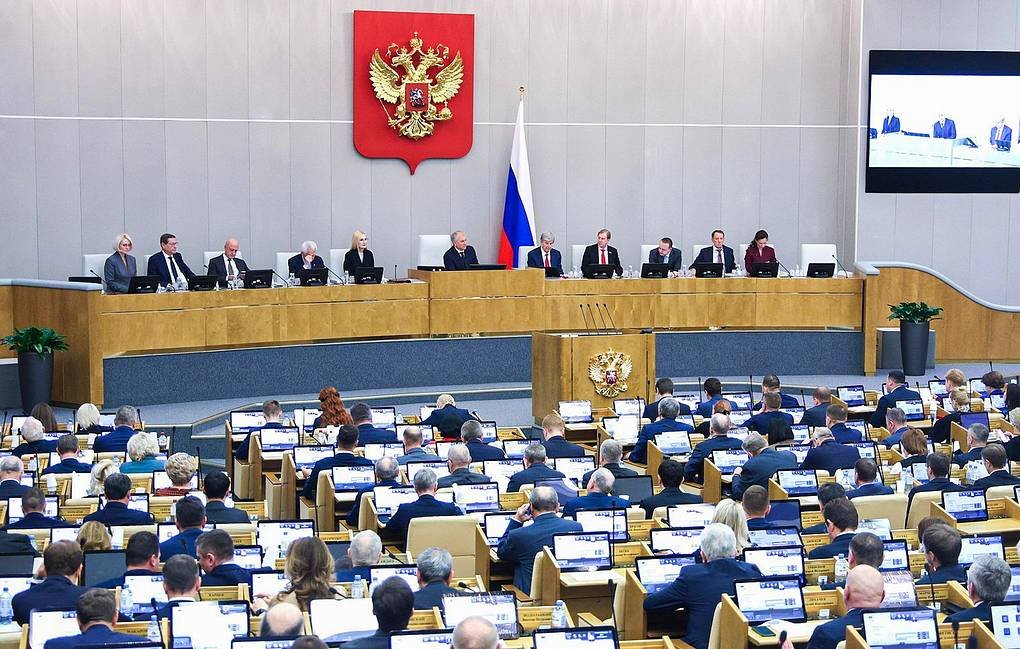
Moscow, November 24, 2026 – The Europe Today: Russia has approved its spending plan for the next three years. The State Duma passed the Russia federal budget 2027 law in its third and final reading. It covers 2027 and the planning period of 2028–2029, and spending is set to keep outpacing revenue in every year.
Under the law, federal spending will reach 48.7 trillion rubles ($593 billion) in 2027. Revenue is projected at 43.3 trillion rubles ($527 billion). That leaves a deficit of 5.4 trillion rubles ($65 billion) in the first year alone.
A Three-Year Deficit Roadmap
The Russia federal budget 2027 shows a deficit in every year of the plan. Revenue is projected at 45.8 trillion rubles in 2028 and 48.6 trillion rubles in 2029. Spending rises faster, to 50.9 trillion rubles in 2028 and 53.9 trillion rubles in 2029.
The deficit is projected at:
2027: 5.4 trillion rubles ($65 billion)
2028: 5.1 trillion rubles
2029: 5.3 trillion rubles
Spending is planned to grow by more than 10 percent over the period, from 48.7 trillion to 53.9 trillion rubles. The gap between income and spending never falls below 5 trillion rubles.
Oil and Gas Now Fund Only About One-Sixth of Revenue
One of the most important points in the law is how little of Russia’s income is expected to come from energy. Oil and gas revenue is projected at 7 trillion rubles ($85 billion) in 2027. It then rises to 7.633 trillion rubles in 2028 and 7.726 trillion rubles in 2029.
That means oil and gas will make up only about 16 percent of total federal revenue in 2027. For a country long seen as an energy-driven economy, this is a big change.
Non-oil and gas revenue carries the rest. It is expected to reach 36.293 trillion rubles ($442 billion) in 2027, then 38.201 trillion rubles in 2028 and 40.894 trillion rubles in 2029. This shows how heavily Moscow now relies on taxes and other income from outside the energy sector to fund the state.
External Debt Ceiling Set to Fall
The law also sets upper limits on Russia’s state external debt, and the ceiling goes down each year:
January 1, 2028: $66.4 billion (56.8 billion euros)
January 1, 2029: $64.8 billion (55.4 billion euros)
January 1, 2030: $60.9 billion (51.6 billion euros)
A falling ceiling on foreign borrowing, while deficits stay above 5 trillion rubles, points to Moscow covering the gap mainly through domestic sources.
Inflation Target Held at 4 Percent
The budget plans for 4 percent inflation in each year from 2027 to 2029. Whether that target holds will be closely watched, since inflation affects household incomes, interest rates and the real value of the planned spending.
National Wealth Fund Expected to Grow
The law also forecasts growth in Russia’s National Wealth Fund (NWF), the country’s main financial reserve. The fund is projected at 13.216 trillion rubles ($161 billion) at the start of 2027, 14.43 trillion rubles in 2028 and 15.07 trillion rubles in 2029. That is an increase of about 14 percent over the period. A bigger NWF gives the government more room to absorb shocks, including swings in energy prices.
What Happens Next
With the Duma’s final vote done, the law now goes to the Federation Council, the upper house of parliament. After that, it is sent to the President for signature.
Why It Matters
The Russia federal budget 2027 shows a state that plans to spend heavily and run steady deficits. It depends less on oil and gas income than before, while trying to cut foreign debt and build up its reserves. For Europe and global markets, these figures give a clear picture of Moscow’s financial plans to the end of the decade.