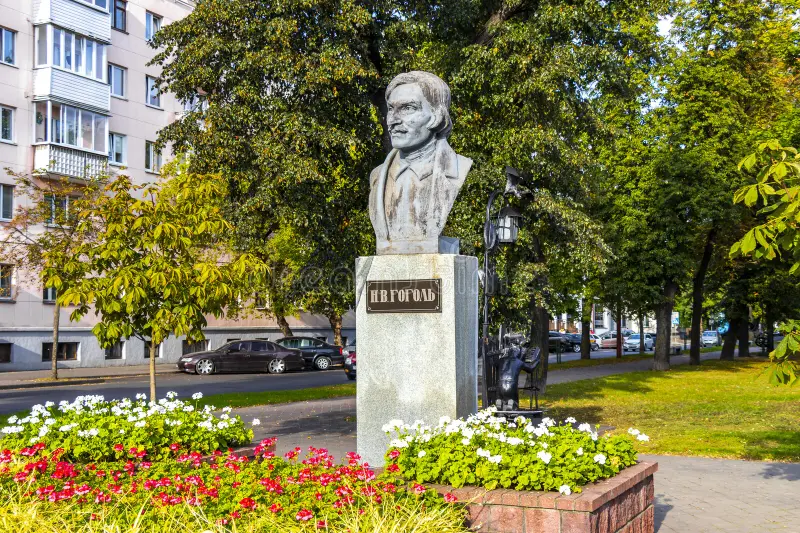
Nikolai Gogol (1809-1852) is a unique figure in Russian literature; he was a writer who took what is generally considered to be trivial social conditions and turned them into compelling literary examinations of absurdity, bureaucracy, vanity, and human frailty. His compositions are a blend of humor and tragedy, realism and fantasy and social satire and deep psychological understanding. Gogol’s seemingly eccentric characters and bizarre situations revealed the paradoxes of the nineteenth century Russian society and addressed universal issues of identity, dignity and the individual’s fight against an impersonal social order.
A Literature of Social Observation
Gogol’s most notable trait in his writing was his keen eye for the details in daily life. Instead of restricting his stories to super-heroes or extraordinary events, he was more apt to have minor officials and impoverished clerks, landowners, and socially ambitious people at the centre of his stories.
This is clearly the case in the short story that was one of his most significant works, “The Overcoat”. The main character is an insignificant government clerk named Akaky Akakievich Bashmachkin whose life consists of copying documents. With the new overcoat he gains for a short while a measure of dignity and social recognition, but in the end, it is taken from him and reveals the lack of concern and brutality of the society around him.
The overcoat thus acquires a more than just fashion or dress-like significance. It represents dignity, identity and the human desire to be recognized. The tragedy of Gogol is his inability to achieve such a simple thing as respect from others, who are at the bottom of the social pyramid.
The Absurdity of Bureaucracy
One of Gogol’s most striking aspects of his work is his critique of the bureaucracy. In “The Government Inspector,” he depicts a provincial town whose officials are terrified when they think an anonymous government inspector has come to examine the corruption in their area.
The ensuing confusion is a laugher that’s masked by a serious critique. The officials are not afraid because they are now aware of their moral duties – they are afraid because they are afraid of being exposed. Gogol shows how corruption, dishonesty and incompetence of institutions can become common within the bureaucratic system.
His satire is timeless not only because it is not about a single administration of history, it is about a general human attitude: “I don’t care about right and wrong, I just want to survive and look good doing it.
“Dead Souls” and the Crisis of Human Identity
In the unfinished Gogol masterpiece “Dead Souls”, these themes are developed further into a general survey of Russian society. The main character, Pavel Chichikov, goes through the countryside, buying the names of serfs who are dead but still on the registers. It’s both foolish and clever—his scheme is foolish because it is so absurd, but it’s clever because it illustrates a bureaucratic system in which human beings are able to be treated as entries in administrative records.
The title itself has a number of definitions. In a literal sense, “Dead Souls” are the literal dead serfs. But, symbolically, many of the living characters are empty of spiritual substance, Gogol implies. Their greed, vanity, hypocrisy and obsession with property make them “dead” in a moral sense.
Chichikov, then, is not just a man who defrauds people. He represents a society in which value of human beings is being calculated in terms of property, status and economy.
The Power of the Absurd
Gogol’s literary universe often transcends the line between reality and imagination. In “The Nose”, for instance, a man loses his nose, and then gets one back as an autonomous and self-reliant being, with a social status superior to that of its owner.
It’s ridiculous and on purpose. Gogol employs an event which is at the very least impossible to show the irrationality that is already there in the normal social life. The person that comes after rank, status and appearance is given less importance than those things.
Thus, Gogol employs this to accomplish something extraordinary: the fantastic is a tool to unveil reality. Sometimes what seems impossible can convey the truth about society better than the simple realism.
Comedy and Tragedy
Gogol’s greatest art is the way he can make the reader laugh, while at the same time making him uncomfortable and sad. His characters are frequently comical, but they have human failings.
This mix keeps his satire from being merely a moral indictment. Gogol isn’t just saying that the characters in his stories are foolish or corrupt; he reveals the fears, inadequacies, vanities and aspirations for recognition that are behind their behavior.
His humor often is tragedy in this way. Akaky Akakievich is comic because of his rather self-absorbed and restricted way of life and his passion for copying documents, but he is also vulnerable and moving because of this. Likewise, the actual people who are in charge in “The Government Inspector” are absurd, but their terror shows the corrupt and negative effects of a corrupt society.
Language and Literary Style
Gogol’s style is exaggerated, abrupt in mood, peculiar in description and has a unique blend of formal and colloquial. His voice of narration can switch from serious observation to the grotesque.
It is a stylistic instability; as is also the instability of the world he portrays. His stories are frequently very believable until something ludicrous occurs, after which the reader is compelled to dub everything he reads but the humorous part, normal; and the humorous part, irrational.
The detail he uses is also noteworthy. Even small items, gestures, titles, clothing and bureaucratic procedures can become very significant. Apparent trivia can tell a whole social story, as in Gogol.
Gogol’s Humanitarian Dimension
But Gogol’s reputation as a satirist would be wrong, as to view his work solely as a social critique would miss an important aspect of his humanism. He is constantly coming back to the issue of human dignity in his writing.
His minor characters tend to be on the periphery of society. They are left out, mocked or downgraded to their official roles. Gogol elevates to literary stature lives which society dismisses as insignificant by putting these people at the heart of his stories.
The significance of this aspect of his work can be understood when it comes to the strong impact which “The Overcoat” had on later Russian literature. Gogol showed that the life of a common clerk can be the stuff of great literature.
Influence on Russian and World Literature
The impact of Gogol’s writing on later authors has been enormous. Realism and satire, psychological observation and the fantastic: his approach to literature influenced the evolution of Russian literature in the nineteenth century.
His literary legacy can be seen in later Russian writers who explored the lives of ordinary people, the psychology of alienated individuals and the contradictions of society. His style also foreshadowed aspects of modernist and absurdist works, most notably the irrational event, which he used to reveal “Empty Truths” in society and psychology.
Conclusion
In the end, I would like to say that Nikolai Gogol’s literary genius is his ability to turn the mundane into the extraordinary. A government building, an overcoat, a missing nose or a paper from the government can be the point of departure for an exploration of the human condition.
His art portrays a rank-obsessed, property-driven, bureaucracy-loving and appearance-conscious society, but it also portrays a more universal phenomenon: the human need for dignity, for recognition, for meaning.
Satirizing institutions and social behaviors may change over the last 150 years, but what has not changed is vanity, bureaucracy, inequality, insecurity and the need for recognition, which are the hallmarks of a human society that resonate with Gogol’s work more than a century and a half after his death. This literature is therefore of great importance as a record of 19th century Russia, and a profound study of humanity.
Owner of “The Europe Today” and Patron-In-Chief/Owner of “The Gulf Observer”, Chairman “The Gulf Observer Research Forum”, Foreign Affairs Expert, Analyst, International Award Winning Author and Poet.