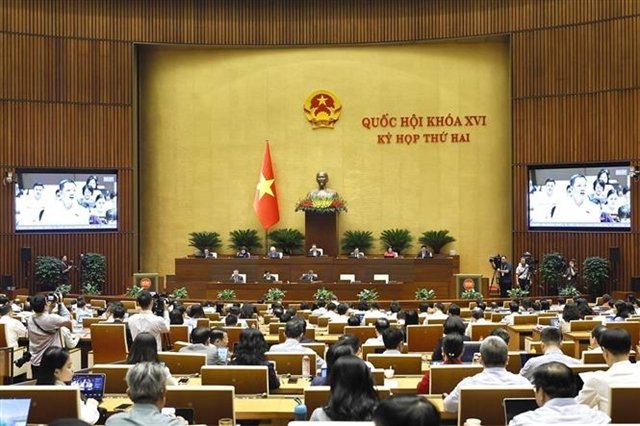
Hanoi, November 1, 2026 – The Europe Today: Members of Vietnam’s National Assembly have called for lower borrowing costs, reduced prices of construction materials and energy, and streamlined investment procedures to accelerate production and business activities and support the country’s ambition of achieving double-digit economic growth.
The proposals were raised during a National Assembly debate on the country’s 2026 socio-economic performance and development plans for 2027 on Saturday. Lawmakers emphasized that improving access to finance, removing investment barriers and ensuring more efficient allocation of capital would be essential to sustaining rapid economic expansion.
They also stressed that higher growth must go hand in hand with macroeconomic stability, increased productivity and tangible improvements in household incomes to ensure that development remains sustainable and inclusive across localities.
Deputy Lê Văn Thế of Ninh Bình Province said the priority should not simply be to mobilize additional financial resources but to ensure that investments are translated into productive capacity, higher value-added activities and improved living standards.
Under the Government’s proposed 2027 budget, development investment expenditure is expected to reach approximately VNĐ1.76 quadrillion (US$67 billion), representing an increase of nearly 57 per cent compared with the 2026 estimate.
Combined with bank credit, private investment and foreign direct investment, the planned increase in public investment is expected to provide substantial financial resources for economic expansion.
However, Thế called for a shift away from evaluating investment performance primarily through disbursement rates, urging authorities to place greater emphasis on the actual economic and social returns of projects.
He said public investment projects should be assessed according to their contributions to expanding production capacity, generating employment and improving people’s living standards.
Similarly, foreign-invested projects should be evaluated based on their connections with domestic suppliers, technology transfer and the quality of employment opportunities they create.
The deputy also urged the Government to address administrative delays, describing them as an often-overlooked cost for businesses.
He noted that while borrowing interest rates represent a visible financial burden, delays in obtaining planning, land, investment and construction approvals also increase operational costs and postpone the allocation of capital to productive activities.
Meanwhile, Deputy Lê Hữu Trí of Khánh Hòa Province emphasized that economic growth targets should not be measured solely by the pace of expansion.
He said greater attention should also be given to the sources of growth, its quality and sustainability, and the extent to which economic progress translates into higher incomes, employment opportunities, improved competitiveness and better quality of life for the population.
The lawmakers underscored that achieving double-digit growth would require not only increased investment but also structural improvements, efficient resource allocation and a more favourable business environment to ensure long-term and inclusive economic development.