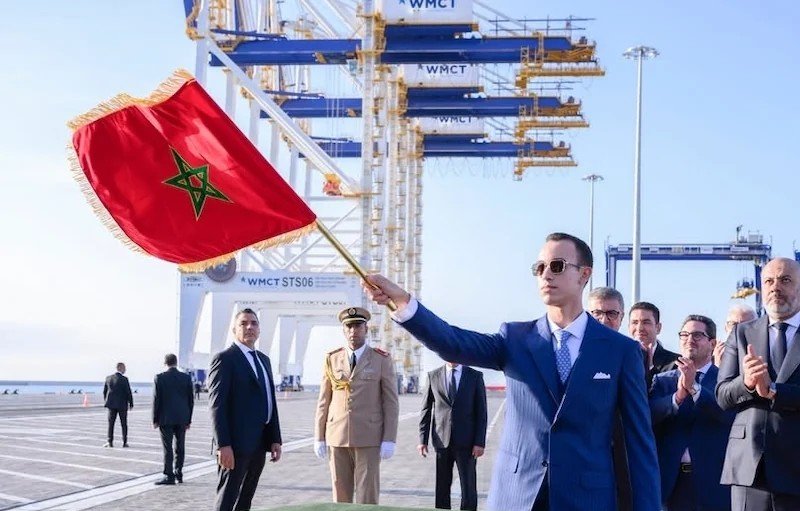
Rabat, November 2, 2026 – The Europe Today: Morocco’s Crown Prince Moulay El Hassan has officially launched operations at the first container terminal of the Nador West Med port, marking a major milestone in the development of the Kingdom’s industrial, logistics and maritime infrastructure.
The inauguration took place on October 31 in the commune of Iaâzzanène in Nador Province, following the instructions of King Mohammed VI. The ceremony marked the beginning of the operational phase of the ambitious Nador West Med industrial-port complex, which has attracted a total of MAD 54 billion in public and private investments.
The Crown Prince inaugurated the East Container Terminal and also launched its first commercial container-unloading operation from a cargo vessel.
The terminal, developed with an investment of approximately MAD 5 billion, features 1,520 metres of quay, a water depth of 18 metres and 70 hectares of storage yards. It is designed to handle up to 3.5 million containers annually by 2030.
The facility will be operated and maintained for 25 years by a consortium comprising Morocco’s Marsa Maroc and Terminal Investment Limited (TIL), a subsidiary of the Switzerland-based MSC Group.
The wider Nador West Med complex will also include a second container terminal, known as the West Terminal, with a planned annual capacity of 1.8 million twenty-foot equivalent units (TEUs). The terminal, which involves an investment of approximately MAD 3 billion, will be operated by a consortium comprising Marsa Maroc and French shipping group CMA CGM. Its operations are scheduled to begin in April 2027, increasing the port’s combined container-handling capacity to 5.3 million TEUs annually.
In addition to container facilities, the port complex will feature a general cargo terminal with an annual handling capacity of three million tonnes, a bulk cargo terminal capable of handling seven million tonnes, and a roll-on/roll-off terminal designed to accommodate up to 400,000 vehicles.
A major component of the project is the establishment of an integrated energy hub, including a liquefied natural gas (LNG) terminal with an annual capacity of five billion cubic metres and a hydrocarbon terminal capable of handling up to 25 million tonnes.
The project also incorporates a 700-hectare industrial and logistics platform, expected to attract approximately MAD 12 billion in private investment. According to official projections, the wider complex is expected to generate 14,000 direct and 20,000 indirect jobs in the short term, creating significant employment opportunities, particularly for young people.
To improve regional connectivity, the project includes a 49-kilometre railway linking Selouane with Nador West Med and a 105-kilometre highway connecting the port with Guercif.
The Moroccan authorities also plan to introduce specialised training programmes aligned with the requirements of emerging industrial and logistics activities to enhance young people’s employment prospects.
Nador West Med forms part of Morocco’s broader strategy to strengthen its position in international maritime trade and establish the Kingdom as a major logistics and commercial hub connecting the Mediterranean, Europe, the Middle East and Asia.
The project is also expected to complement the successful Tanger Med port complex while supporting Morocco’s wider ambition to expand its maritime infrastructure along both the Mediterranean and Atlantic coasts. In this regard, the planned Dakhla Atlantique port is another major initiative aimed at strengthening Morocco’s economic links with African countries and providing landlocked Sahel nations with improved access to international markets.
The inauguration represents an important step in Morocco’s efforts to promote regional development, attract international investment, expand industrial capacity and reinforce its role in global maritime trade.