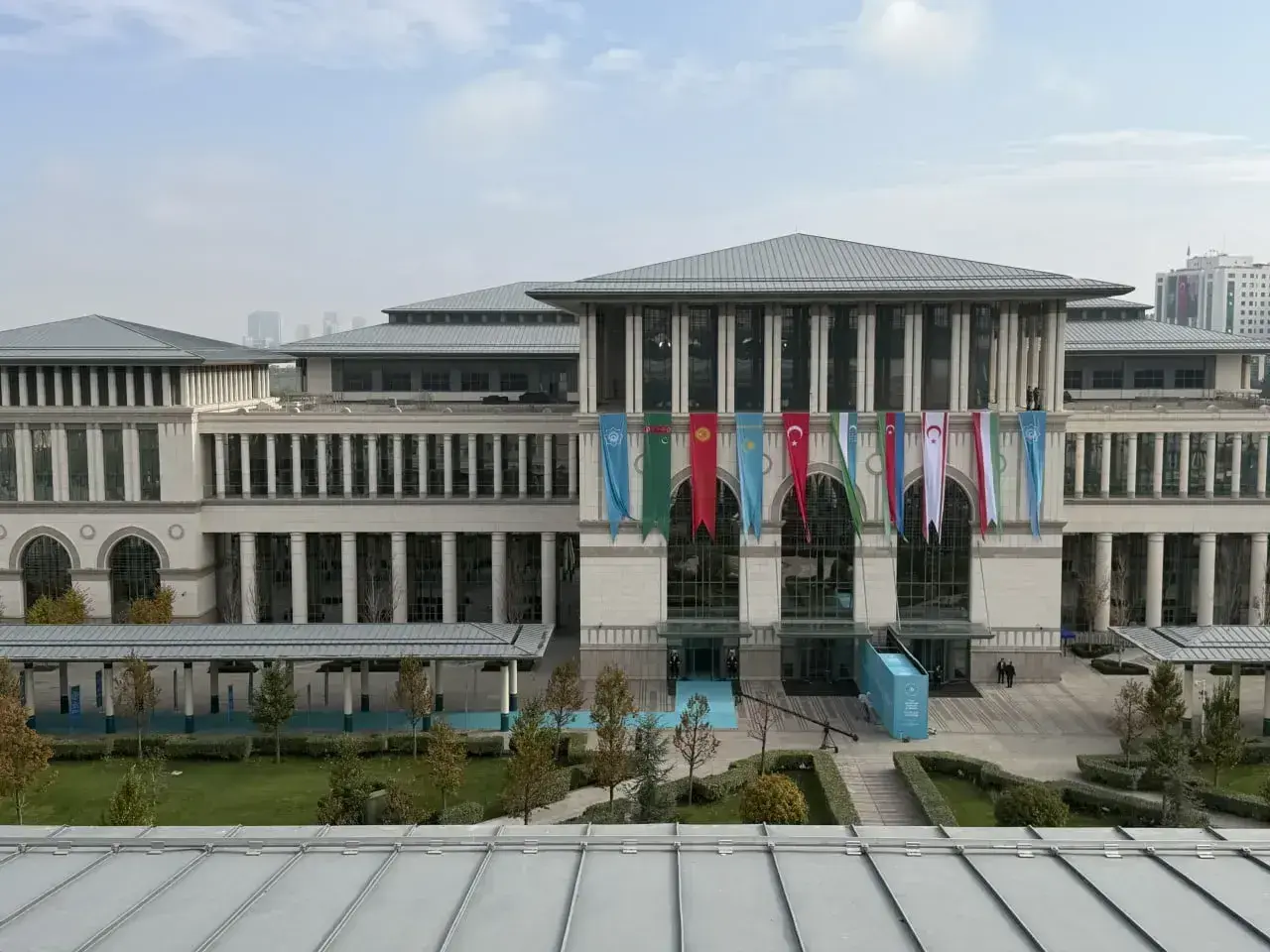
President Kassym-Jomart Tokayev has proposed granting Russia a role within the OTS+ framework of the Organization of Turkic States (OTS), or observer status. To understand his proposal, we must first understand Kazakhstan’s unique geopolitical position.
Kazakhstan’s geopolitical position
Kazakhstan shares a 7,644-kilometre border with Russia, the longest continuous land border between two countries in the world.
Russia remains an essential economic and logistical partner for Kazakhstan. Significant trade flows, transport infrastructure and energy export routes remain connected to Russian territory. The Caspian Pipeline Consortium, for example, plays a crucial role in transporting Kazakh oil to international markets.
By proposing a Russian role, Kazakhstan is arguably trying to prevent future geopolitical tensions rather than create new ones.
Organization of Turkic States and Tokayev’s Russia Proposal – A multi-vector foreign policy: strategic autonomy, not geopolitical alignment
Since independence, Kazakhstan has pursued a multi-vector foreign policy, maintaining relationships with several competing centres of power.
Russia remains an important neighbour and partner. For a country situated between Russia and China, while seeking stronger connections with Europe and the wider Turkic world, this flexibility is a strategic asset.
Tokayev’s proposal can therefore be understood within this broader approach: maintaining dialogue with Russia while continuing to develop other partnerships.
Russia is not an outsider to the Turkic world
Russia is home to millions of people belonging to Turkic communities, including Tatars, Bashkirs, Chuvash, Sakha (Yakuts) and others.
From Kazakhstan’s perspective, there is therefore an argument for involving Russia in certain forms of institutional dialogue and cultural cooperation. However, observer status or OTS+ participation is fundamentally different from full membership.
Kazakhstan wants a stronger OTS
The organisation provides a platform for developing trade, transport connectivity, energy partnerships, digital cooperation, cultural diplomacy and regional coordination.
Tokayev’s proposal could therefore be interpreted as an attempt to protect the long-term development of the OTS, ensuring that stronger cooperation among Turkic states does not generate additional tensions with Russia.
What about EU–OTS relations?
Potential Challenges
The possible expansion of Russia’s involvement in the OTS could introduce an additional layer of complexity into EU–OTS relations. Although the OTS is primarily a platform for cooperation among Turkic-speaking states rather than a military or security alliance, its growing political profile has attracted greater attention from external actors, including the EU, Russia and China. Consequently, any change in the organisation’s membership or observer structure could have implications for how European policymakers perceive its strategic orientation.
1. The Cyprus Question: A Persistent Source of Tension
One of the most politically sensitive issues affecting the relationship between the EU and the OTS concerns the participation of the self-proclaimed Turkish Republic of Northern Cyprus (TRNC) as an observer in the organisation.
The EU does not recognise the TRNC as an independent state. It recognises the Republic of Cyprus as the sole internationally recognised state on the island and considers the entire territory of Cyprus to be part of the EU.
The OTS’s decision to grant observer status to the Turkish Cypriot administration has therefore created a diplomatic discrepancy between the organisation’s approach and the EU’s position.
Nevertheless, the Cyprus question does not necessarily prevent cooperation between the EU and individual OTS member states. The EU maintains extensive relations with countries such as Kazakhstan, Uzbekistan, Azerbaijan and Kyrgyzstan, and these bilateral relationships can continue to develop independently of disagreements surrounding the organisation’s observer arrangements.
2. Potential Russian Participation: New Geopolitical Complication
The possibility of Russia becoming involved in the OTS, particularly through observer status or an OTS+ cooperation format, could further complicate relations between the organisation and the European Union.
This issue is especially sensitive given the EU’s sanctions policy towards Russia following its full-scale invasion of Ukraine in February 2022. The EU has sought to limit Russia’s ability to circumvent sanctions and has encouraged its Central Asian partners to prevent their territories and financial systems from being used to facilitate sanctions evasion.
Russia’s participation in the OTS could therefore raise several concerns in Brussels.
(1) First, it could change the perceived geopolitical orientation of the organisation. One of the OTS’s increasingly important functions is to strengthen political, economic and transport cooperation among Turkic states, including through routes that connect Central Asia to Europe while reducing dependence on traditional transit networks. If Russia were granted a more formal role, European policymakers might question whether the organisation would remain an independent platform for regional cooperation or become another channel through which Moscow could maintain and expand its influence in Central Asia.
(2) Second, Russian participation could complicate European efforts to diversify economic and transport connections. The EU has increasingly supported the development of the Trans-Caspian International Transport Route, commonly known as the Middle Corridor, which connects Central Asia and China with European markets through the Caspian Sea, the South Caucasus and Türkiye. This route is strategically important because it offers an alternative to transport corridors passing through Russian territory.
Greater Russian involvement in the OTS would not automatically undermine the Middle Corridor. Nevertheless, it could create competing priorities within the organisation, particularly if Moscow sought to preserve the centrality of its own transport, energy and logistics networks.
(3) Third, Russian participation could create tensions over sanctions and economic cooperation. The EU has a strong interest in maintaining trade relations with Central Asian countries while ensuring that increased commercial activity does not facilitate the circumvention of restrictions imposed on Russia. A more prominent Russian role within the OTS could make this balancing exercise politically more sensitive, especially if the organisation expanded cooperation in financial services, industrial production, technology or logistics.
There is, however, an important distinction between observer participation and full membership. Observer status would not automatically give Russia decision-making authority within the organisation. Its actual influence would depend on the institutional arrangements, the frequency of its participation and the willingness of OTS members to accommodate Russian interests.
3. Hungary: The EU’s Internal Political Dimension
Hungary occupies a distinctive position in EU–OTS relations because it is both an EU member state and an observer in the Organisation of Turkic States.
Since joining the organisation as an observer in 2018, Hungary has sought to strengthen its political, economic and cultural connections with Turkic countries. Budapest has presented this engagement as part of its broader strategy of opening towards the East, diversifying international partnerships and strengthening its position as a bridge between Europe and Central Asia.
Hungary’s participation provides the OTS with an important institutional connection to the EU.
However, following the April 2026 parliamentary elections, Péter Magyar and his Tisza party took power, ending Viktor Orbán’s 16-year premiership.
Pro-EU Pivot
Unlike Orbán, who heavily promoted an “Eastern Opening” policy and positioned Hungary as a bridge to the Turkic world, Prime Minister Magyar has explicitly prioritized firmly reintegrating Hungary into the European Union.
Magyar campaigned against what he termed “Turkic councils” and has dropped Orbán’s symbolic foreign-policy approach. Highlighting this shift, Hungary did not send a delegation to the 13th OTS summit in Ankara in October 2026.
Implications for the EU’s Central Asia Strategy
The potential expansion of Russia’s involvement in the OTS should also be considered within the broader context of the EU’s growing engagement with Central Asia.
The EU has increasingly recognised the strategic importance of Kazakhstan, Uzbekistan, Kyrgyzstan, Tajikistan and Turkmenistan, particularly in relation to energy security, critical raw materials, transport connectivity and regional stability.
The first EU–Central Asia Summit, held in Samarkand on 4 April 2025, demonstrated this growing political interest. The two sides agreed to strengthen their strategic partnership, including cooperation in sustainable transport, critical raw materials, energy, digital connectivity and regional security.
This creates an important consideration for the future of EU–OTS relations: the EU does not necessarily need to cooperate with the OTS as a single institutional partner to maintain and expand its influence in Central Asia.
Instead, Brussels can pursue a combination of bilateral relations with individual OTS member states and broader regional cooperation with Central Asian countries.
What does the OTS want to become?
Ultimately, Tokayev’s proposal raises a broader question: what does the OTS want to become?
A cultural and economic cooperation platform, a powerful geopolitical actor, or an independent Eurasian bloc capable of shaping the regional and international order?
The answer will influence not only the organisation’s relationship with Russia, but also its future relations with the European Union.
Historian and environmental management expert on Central Asia and researcher on Central Asia post-Soviet period. Journalist for EuReporter and EuReflect and Special Director of “The Gulf Observer” for Europe and Central Asia.