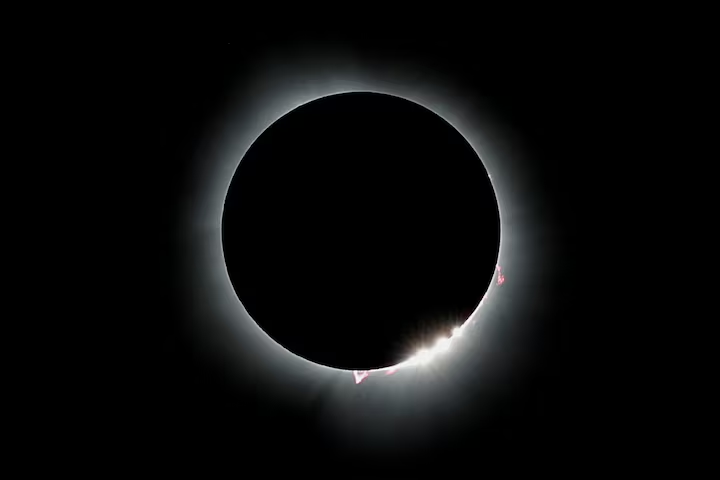
Rome, August 11, 2026 – The Europe Today: Italian scientists are preparing to put a new solar observation instrument through a crucial test during the total solar eclipse on August 12, in an experiment that could significantly advance scientists’ ability to study the Sun’s outer atmosphere.
The team, based in the northern Italian city of Padua, has spent about two and a half years developing the instrument, known as the Circular Slit Spectrometer (CISS). Researchers believe the technology could transform the way scientists observe the solar corona, the Sun’s extremely hot outer atmospheric layer.
Unlike conventional spectrometers, which generally scan the Sun line by line and can take considerable time to produce a complete image, CISS is designed to capture the Sun’s spectrum across a single circular-slit image. This approach could allow scientists to observe rapid changes in the corona much more efficiently.
The instrument will undergo its critical field test at Spain’s Javalambre Astrophysical Observatory, where researchers will take advantage of the brief period during which the Moon blocks the Sun’s bright surface and exposes the corona.
Scientists say the experiment is particularly important because the solar corona is highly dynamic. Changes in the corona can generate solar activity capable of affecting communications systems, satellites and power grids on Earth.
The research team has taken extensive precautions to ensure the delicate equipment reaches the observation site safely. Rather than transporting the instrument by air, scientists chose to move it by road to minimize the risk of damage and avoid potential disruptions caused by flight cancellations.
The August 12 eclipse provides a rare natural laboratory for testing the new technology under conditions that cannot easily be reproduced. Researchers face a narrow window for the experiment and will also depend on favorable weather conditions at the observation site.
If the test proves successful, the CISS technology could eventually be adapted for future space missions, potentially providing scientists with faster and more detailed observations of the solar corona.
The experiment represents an important step in solar physics, as scientists worldwide seek improved ways to understand the Sun’s atmosphere and the space-weather phenomena that can influence technological systems on Earth.