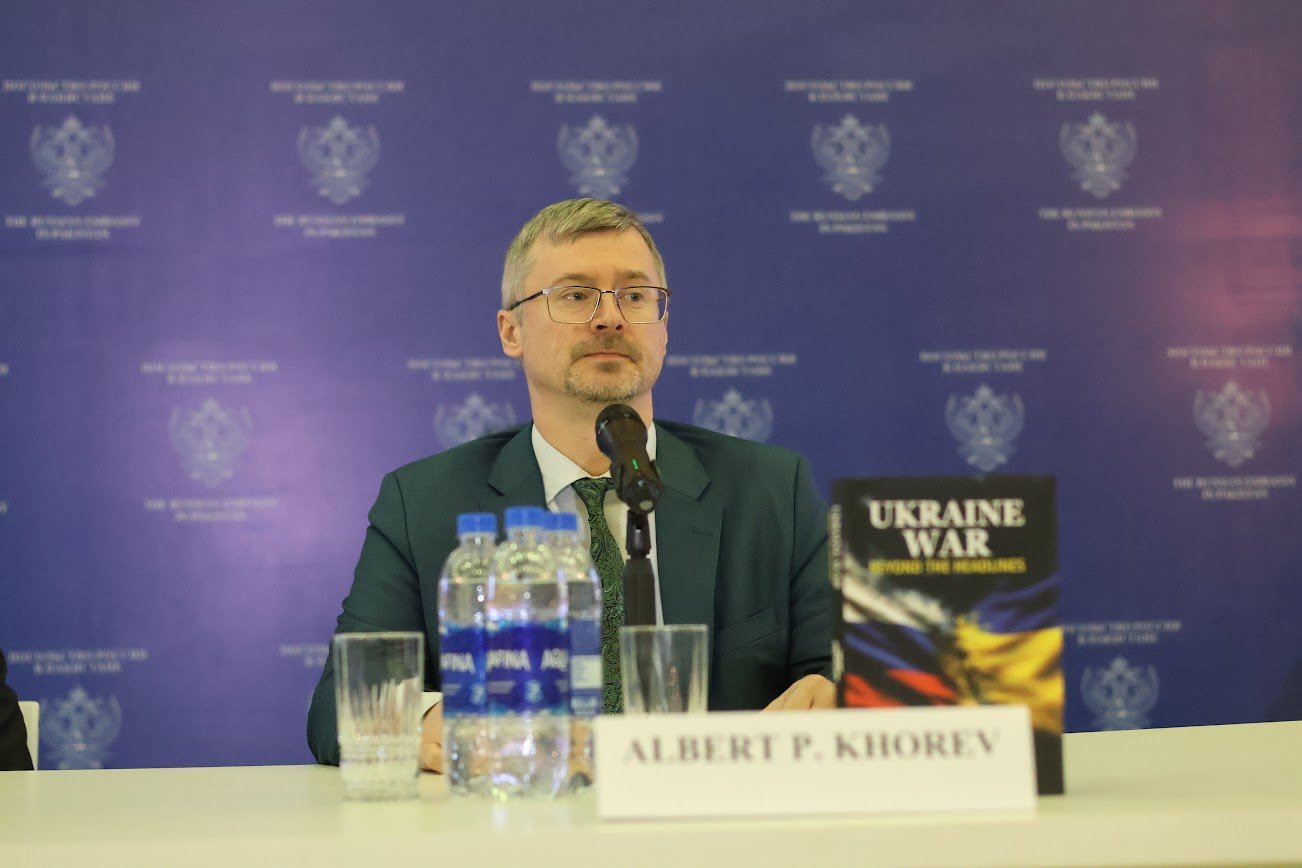
Islamabad, October 30, 2026 – The Europe Today: Russian Ambassador to Pakistan H.E. Albert P. Khorev has highlighted Russia’s perspective on the historical roots, geopolitical dimensions and international implications of the Russia-Ukraine conflict, emphasizing the need for a diplomatic settlement based on mutual respect, justice and the legitimate security interests of all parties.
He expressed these views while delivering opening remarks at the launching ceremony of the book “Ukraine War: Beyond the Headlines – An Alternative Narrative on the Russia–Ukraine Crisis”, authored by Munir Ahmed, in Islamabad on October 29, 2026.
Congratulating the author on his publication, Ambassador Khorev described the book as a significant contribution to the academic examination of the European security crisis. He appreciated its research-based approach, noting that it draws upon official documents, United Nations reports, statements by international organizations and publicly available factual information.
The ambassador said the book examines the historical background of the conflict, its geopolitical and economic dimensions, and its broader consequences for international security. He particularly highlighted its chapters addressing global food security, energy markets, the Black Sea situation, NATO’s role, the future of European security and the emergence of a multipolar international order.
He observed that the publication offered an alternative perspective on the conflict and encouraged readers to examine its historical background beyond prevailing media narratives. He also identified NATO’s eastward expansion, the events of February 2014 in Kyiv and the failure to implement the Minsk agreements as key factors contributing to the escalation of tensions, reflecting Russia’s longstanding position on the origins of the crisis.
Addressing the broader geopolitical situation, Ambassador Khorev maintained that the conflict could not be understood solely in the context of February 2022, arguing that Russia’s security concerns had remained unaddressed for decades. He criticized NATO, the European Union and the Ukrainian leadership over their respective roles in the continuation of hostilities, while referring to the failure of diplomatic initiatives and peace negotiations.
He also expressed concern over the wider economic and political consequences of the conflict, particularly for European countries, citing energy shortages, deindustrialization and rising living costs. He further criticized what he described as restrictions on alternative viewpoints and growing limitations on freedom of expression in Western countries.
Explaining Moscow’s stated objectives, the Russian ambassador said Russia sought to ensure the security of its borders and establish a European security architecture based on equal and indivisible security. He also referred to Russia’s opposition to what it describes as the glorification of Nazism and discrimination against Russian-speaking communities in Donbas and other regions.
At the same time, he reiterated that Russia remained open to a political and diplomatic settlement addressing the underlying causes of the crisis and providing sustainable security guarantees. However, he expressed concern over continued Western military assistance to Ukraine, arguing that the supply of increasingly sophisticated weapons was prolonging the conflict.
A substantial part of his address focused on global food security and the role of Russia and Ukraine in international agricultural markets. Referring to figures for the 2025–2026 period, Ambassador Khorev stated that Ukraine accounted for approximately seven per cent of global wheat trade, compared with Russia’s 23 per cent. In barley trade, he cited Ukraine’s share at five per cent and Russia’s at 20 per cent.
He further argued that a significant proportion of Ukraine’s agricultural exports was directed towards European Union and other Western markets rather than developing countries in Africa and Asia. He emphasized that Russia remained an important global supplier of agricultural commodities and fertilizers and that its contribution was essential to international food security.
The ambassador also criticized Western sanctions against Russia and restrictions targeting Russian maritime activities, arguing that such measures could disrupt international agricultural supply chains and threaten global food security.
Referring to the Black Sea Grain Initiative, he said Russia had participated in the arrangement in good faith but maintained that the promised provisions had not been implemented by the Western parties, ultimately contributing to the collapse of the agreement.
He also expressed concern over attacks on commercial vessels in the Black Sea, emphasizing that civilian ships transporting grain and other essential commodities should not be targeted. He described such incidents as threats to freedom of navigation, international maritime security and the uninterrupted movement of food supplies.
Ambassador Khorev appreciated Pakistan’s balanced approach to the Ukraine conflict, describing it as “positive neutrality.” He said Russia valued Pakistan’s independent assessment of international developments, its commitment to dialogue and its recognition that complex international disputes could not be resolved through confrontation and polarization.
He reaffirmed Russia’s readiness to work with Pakistan to address food security challenges, strengthen economic cooperation, promote regional stability and contribute to a more equitable international order. He also highlighted Russia’s role as a reliable supplier of energy, agricultural products and fertilizers.
Concluding his remarks, the ambassador reiterated that Russia remained committed to dialogue and peace, emphasizing that any sustainable settlement should be founded on justice, mutual respect and recognition of the legitimate security interests of all parties.
He expressed hope that Munir Ahmed’s book would encourage readers, researchers and students to explore the historical record, critically examine international developments and develop a deeper understanding of the broader implications of the Ukraine conflict.
The ambassador once again congratulated the author, expressing confidence that the publication would contribute to further academic research, informed debate and a better understanding of the international developments shaping the contemporary world.