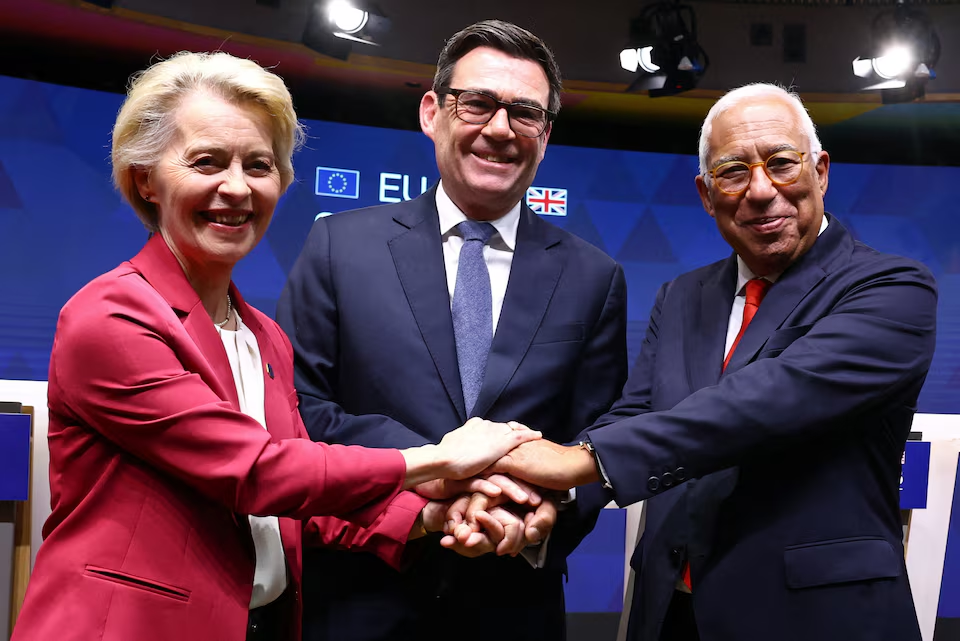
Brussels, November 21, 2026 – The Europe Today: At a UK-EU summit on Friday, Britain and the European Union agreed to ease food trade, link their carbon markets and open the door to youth travel. It is the boldest attempt yet to reset relations since Brexit, but the two sides postponed a deal on university tuition fees and left the question of their long-term relationship open.
A decade after Britain voted to leave what is now a 27-nation bloc, much of the bitterness has faded. Both sides now see the need for a closer alliance as the world order is reshaped by Russia’s full-scale invasion of Ukraine, US tariffs, China’s grip on critical mineral supply chains and the war in Iran.
British Prime Minister Andy Burnham told a press conference after the UK-EU summit that the agreement was “a win-win” for both sides.
What Was Agreed
The most significant deal allows animals, plants and related products, from sausages to seeds, to cross the border without the certificates and checks now required. Britain estimates this could add up to £5.1 billion ($6.7 billion) a year to its economy.
A second deal will link the British and EU emissions trading systems. Goods such as steel would then be exempt from each other’s border carbon levies.
Under a new youth mobility scheme, each side will let up to 100,000 young people a year come to work or study for up to three years.
According to a joint statement, the deals will apply from 2028, and the first young people should be able to use the mobility scheme by 2030.
Tuition Fees Stall the Talks
University fees remain the main sticking point. EU countries want their students to pay “home fees” at British universities rather than the international rate, which is often three times higher. Britain is offering only “significantly reduced” fees. Negotiators now have six months to settle the issue.
Made in Europe and Supply Chains
The two sides also agreed on an approach to the EU’s “Made in Europe” rules, which Britain wants to access for industries such as car manufacturing. Brussels has signalled it is willing, but only if Britain aligns with EU policies, including restrictions on imports of Chinese electric vehicles. London has so far been reluctant to do that.
They also committed to building “diversified and resilient” supply chains in key sectors such as electric vehicles and steel, with progress reviewed every four months. Where cooperation has been agreed, Britain will ensure outcomes consistent with relevant EU measures, to protect those industries and prevent circumvention.
Rejoining the EU Back in the Conversation
Burnham, who was greeted on arrival by a string quintet, has said Britain should consider all options for its future relationship with the bloc, including rejoining. Earlier this week he called it an “obvious truth” that Britain had lost more than it gained from Brexit.
He said Friday’s package was probably the limit of what could be done before the next general election, due by mid-2029. He suggested an informal conversation with Brussels in about a year on what could come next.
European Commission President Ursula von der Leyen welcomed Burnham’s openness to a broad debate on future ties. “We are open for brainstorming,” she said, adding that London could count on the EU.
Farage Vows to Fight
Nigel Farage, the veteran anti-EU campaigner and leader of Reform UK, condemned the deal as the first incremental steps towards taking Britain back into the European Union. He again predicted an early election next year and vowed to campaign to defend Brexit, saying he was ready for the fight.
The UK-EU summit was originally planned for July but was postponed after the resignation of Burnham’s predecessor, Keir Starmer.