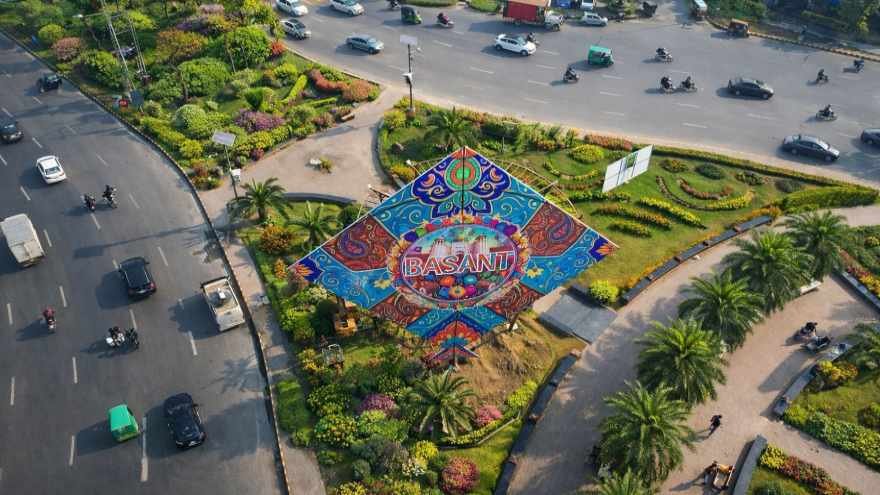
Lahore, February 9, 2026 – The Europe Today: Lahore on Sunday marked the conclusion of the Basant festival with widespread celebrations across the city, as colourful kites filled the skies and residents gathered on rooftops, streets, and public spaces to welcome spring in a display of tradition, resilience, and cautious festivity under heightened security.
Widely regarded as Pakistan’s cultural capital, Lahore—particularly the historic Walled City—came alive as kite flyers of all ages took to rooftops. Children raced through narrow streets chasing fallen kites, while families engaged in friendly aerial contests that continued for hours. Many residents wore traditional yellow attire, prepared seasonal delicacies, and exchanged sweets, adding warmth and colour to neighbourhood celebrations.
The festivities unfolded over several days, shaped by changing weather and a restrained public mood. On the opening day, calm winds delayed kite flying until evening, when a late breeze drew residents outdoors and white kites—often associated with peace—dotted the night sky. However, the atmosphere remained subdued following news of a deadly blast in Islamabad, which cast a sombre shadow over the occasion.
By the second day, drumbeats and loud festivities were kept muted, though kite flying continued late into the night as conditions improved. Enthusiasm peaked on the third day, with steady winds enabling uninterrupted kite battles across the city.
Visitors from other cities and abroad joined residents in large numbers, including overseas Pakistanis and foreign guests, underscoring the festival’s broad appeal. Several political figures participated in the celebrations. Pakistan Muslim League-N supremo Nawaz Sharif marked Basant in the inner city, while Hamza Shehbaz celebrated near Lohari Gate. Senior Minister Marriyum Aurangzeb and politician Fawad Chaudhry were also seen flying kites, with Chaudhry describing the festival as a positive government initiative.
Women played a visible role throughout the celebrations, with many flying kites themselves, while others applied henna, wore colourful clothing, and prepared traditional foods. Special meals and sweets were widely shared among neighbours and guests.
Cultural programmes complemented the festivities. At Delhi Gate, the Ministry of Information and Culture hosted the “Basant Bahar” programme, where a music concert on the third day drew local and foreign audiences. Live performances by singers Nadeem Abbas Lonewala and Megha prompted crowds to dance as nearby rooftops filled with spectators.
Aurangzeb hosted members of the US diplomatic mission, including the ambassador, consul general, and an undersecretary, who joined in kite flying. The delegation praised Lahore’s cuisine, cultural heritage, and hospitality. Aurangzeb said such cultural activities help bring nations closer and project Pakistan’s peaceful and positive image globally.
Provincial Information Minister Azma Bokhari welcomed guests from the United States and the United Kingdom, noting that families had travelled specifically to experience Basant in Lahore. She confirmed that Chief Minister Maryam Nawaz extended the festival until 5am the following morning in view of the scale of public participation, adding that the celebrations resonated across the country.
Authorities maintained heightened security throughout the festival. Dolphin Force teams patrolled sensitive areas, while strict enforcement targeted aerial firing, fireworks, narcotics, and banned kite strings. Police units remained linked to a central control room to ensure swift responses.
Despite extensive safety measures, tragic incidents were reported. In Bilal Ganj, a 16-year-old boy from Sialkot, identified as Abdullah, died after falling from a rooftop while celebrating. Officials from the Edhi Foundation said he was taken to hospital in critical condition but did not survive. Police completed legal formalities and shifted the body to a morgue.
A local journalist, Zain Malik, also lost his life after falling from a rooftop in Lahore. Malik, a resident of Sanda, reportedly slipped while trying to disentangle a kite and later succumbed to his injuries at Mian Munshi Hospital. He had worked as a reporter with several television channels in the city.
In another incident, a child identified as Zain was seriously injured in Defence C when a kite string struck his neck, requiring 15 stitches. Police said the child received immediate medical treatment, prompting renewed safety concerns among residents.
Officials recorded the entry of nearly 900,000 vehicles into Lahore over three days. Under government arrangements, about 1.4 million passengers used free public transport, including metro services, feeder buses, and electric buses. On the final day, 419 buses and 6,000 subsidised online rickshaw rides remained operational.
Chief Minister Maryam Nawaz praised residents for largely adhering to safety standard operating procedures, noting there were no confirmed reports of banned kite strings or metal wire and that power infrastructure remained protected. Emergency services, including mobile clinics and field hospitals, were deployed across major areas.
Officials acknowledged that recent security incidents elsewhere had tempered the mood but said the peaceful conduct of Basant sent a clear message that cultural life in Lahore would continue despite challenges.