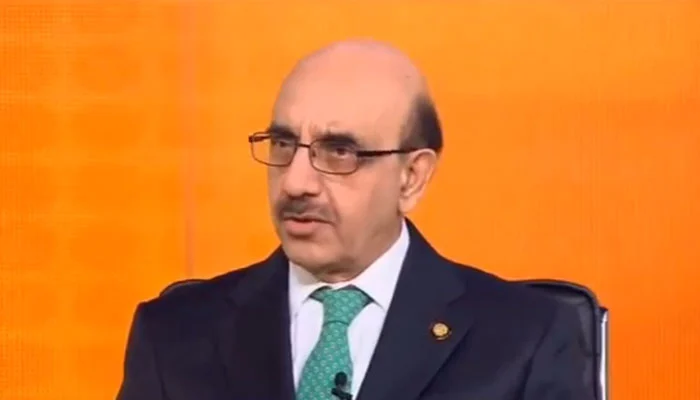
Islamabad, March 26, 2026 – The Europe Today/GNP: Masood Khan, former President of Azad Jammu and Kashmir and ex-envoy of Pakistan to the United States, China, and the United Nations, has emphasized that despite ongoing military escalation in the Gulf, all parties increasingly recognize the urgent need for a diplomatic pathway to prevent wider strategic and economic fallout.
Speaking during a television interview, Ambassador Khan noted that while public posturing continues and negotiations are often denied, there is credible evidence of ongoing behind-the-scenes diplomatic engagement. He observed that military deployments, including the movement of United States Marine Expeditionary Units to the region, reflect a broader strategy of deterrence and coercive signaling rather than a contradiction of diplomacy.
“Escalation and diplomacy are proceeding simultaneously,” he stated, adding that such parallel tracks are often intended to strengthen negotiating leverage, though they also narrow the political space for compromise.
Ambassador Khan cautioned that a significant trust deficit—particularly from Iran’s perspective—remains a major obstacle. He pointed out that past disruptions to nuclear negotiations, including military actions during active talks, have eroded confidence, making future dialogue fragile and complex.
Highlighting Pakistan’s evolving diplomatic posture, he said Islamabad has moved beyond a traditional back-channel facilitator to emerge as a credible lead mediator. He underscored that Pakistan’s balanced and equidistant relations with the United States, Iran, and Gulf countries place it in a unique position amid the current crisis.
He recalled that Pakistan had previously facilitated sensitive diplomatic exchanges between Washington and Tehran, a role publicly acknowledged by senior US leadership.
Ambassador Khan further noted that Pakistan is coordinating closely with key regional actors, including Egypt, Turkey, and Oman, stressing that resolving the crisis would require a collective diplomatic effort rather than a unilateral initiative.
He added that Gulf states increasingly view Pakistan as a reliable intermediary capable of pursuing de-escalation without disturbing the regional balance, while acknowledging that Israel would monitor Islamabad’s role cautiously. However, he maintained that Pakistan’s non-partisan stance enhances its credibility as an honest broker.
Addressing the broader dimensions of the conflict, Ambassador Khan emphasized that reopening vital maritime routes such as the Strait of Hormuz would require more than a ceasefire. He outlined key issues likely to dominate negotiations, including Iran’s nuclear programme, regional security concerns, and demands for guarantees against future hostilities.
Concluding his remarks, he said the path to peace would be long and complex. “The immediate priority is to secure a ceasefire and transition towards structured diplomacy,” he stressed, noting that sustainable peace would depend on credible security assurances for all parties involved.