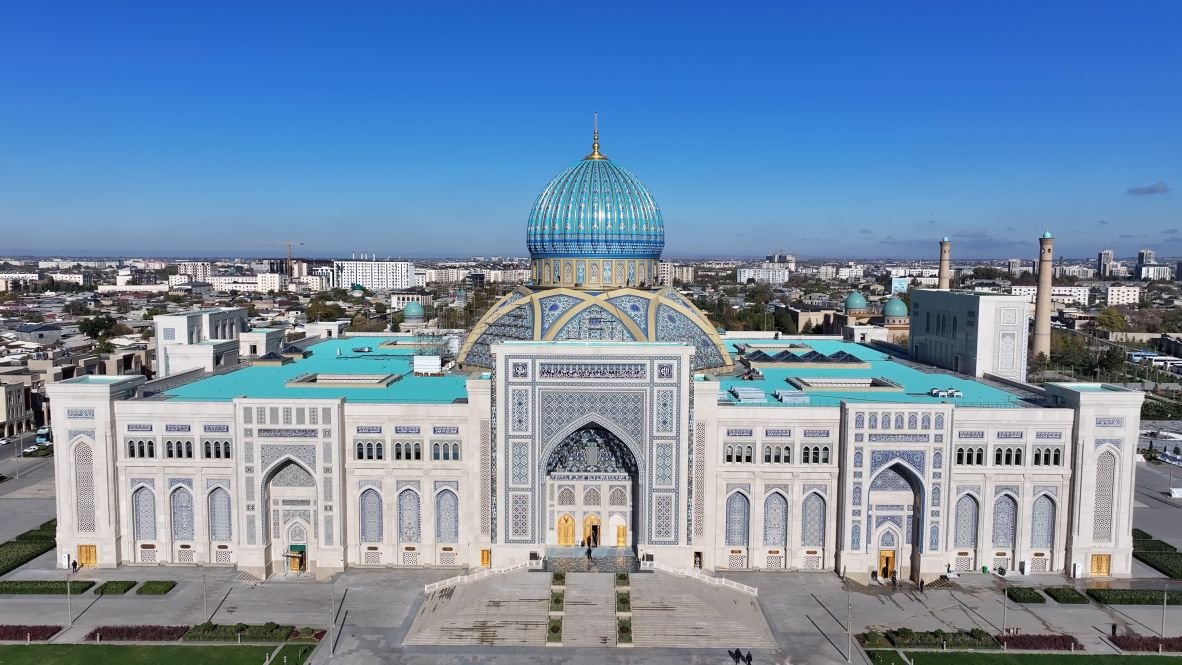
Human history has shown that all the great advances of which we are worthy are built upon deep foundations of intellectual and spiritual work. This is true, and now the landmark project of Central Asia exemplifies this with great clarity and ambition. The Center of Islamic Civilization in Tashkent is more than just an architectural feat or a national museum. It is a living intellectual bridge, linking the bright history of the region with the dynamic present and promising future. The opening of this cultural project in March 2026 will be a defining landmark of the New Uzbekistan, already acclaimed by the world’s leading international publications and institutions as one of the most important civilizational projects of our time.
Vision
The project began in 2017 when President Shavkat Mirziyoyev presented the project during the 72nd session of the United Nations General Assembly. It was there that he spoke out with a powerful force: to make the world know the true humanistic nature of Islam which is based on enlightenment, peace and creation. This was not a diplomatic maneuver, but a program of civilizational reclamation. Uzbekistan, which is the cradle of science, philosophy and culture, is consciously turning its back to the role of a knowledge beacon.
This is an important time in the world’s history, Uzbekistan provides a positive alternative to the negative narrative emerging in today’s era of growing Islamophobia and misrepresentation by extremist groups—one based on education, scholarship, and inter-cultural respect. The Center makes this vision last in the form of stone, glass, and light.
Architectural Harmony
Covering an area of ten hectares in the historic centre of Tashkent, the complex is breathtaking with its majestic 65-metre azure dome and the four golden gates, representing the unity of the region of Uzbekistan. The building incorporates a range of elements from the Timurid tradition, such as the use of brick and stone, the incorporation of intricate details, and the creation of a central courtyard surrounded by smaller structures. The design is a beautiful blend of the Timurid architectural style and the modern era, and the building is sure to be a long-lasting landmark that will inspire future generations. The landscaped grounds make it a welcoming cultural oasis for locals and tourists worldwide.
The centerpiece of the design is a pillar that symbolizes the Ulugh Beg Madrasah, topped with the first revealed verse of the Qur’an: Iqra — “Read in the name of your Lord.” This is the Center’s spirit in one word, the quest for knowledge as the highest calling of humankind. The site’s deep religious and scholarly meaning is highlighted by the centerpiece exhibition of the sacred 7th-century Uthman Qur’an, a treasure of the UNESCO Memory of the World.
New Museum Paradigm
The Center departs decisively from the traditional museum model. Under the guidance of President Mirziyoyev “Civilization – Personalities – Discoveries” is the basis of the exhibitions of this museum, which does not only show artifacts, but also reflects a living intellectual chain. The text is arranged in a chronological framework, beginning with the pre-Islamic period and the First Renaissance, evolving into the New Uzbekistan as a foundation for the Third Renaissance, thus focusing on continuity rather than rupture.
The “Wall of Civilizations” is a remarkable illustration of the intellectual heritage that connects the achievements of great scientists like Al-Khwarizmi, Al-Farghani, Ibn Sina (Avicenna), Al-Biruni, Mirzo Ulughbek, and contemporary digital technologies and scientific frontiers. Interactive VR/AR holograms, artificial intelligence (AI) and advanced VR/AR technology resurrect ancient manuscripts, recreation ancient observatories, and enable VR interaction with ancient scholars and their experiments. The Center becomes an active incubator of tomorrow’s innovators with the “1001 Inventions” Laboratory dedicated to stimulating the minds of young people.
Cultural Restoration
The project has been the catalyst for a concerted initiative to return to the nation’s home the cultural treasures that were scattered across the globe. In the period of Firdavs Abdukhalikov’s leadership and work of expert commissions, more than a thousand unique manuscripts and artifacts have come back to their homeland, with the help of auction houses, collectors and institutions around the world. The World Society for the Study, Preservation and Promotion of the Cultural Heritage of Uzbekistan (WOSCU) has played a vital supporting role. The Center’s archives are also enriched by facsimiles of invaluable collections of other nations of the world, which further demonstrates that Central Asian heritage is part of the Islamic world and the heritage of all mankind.
Research Hub
It has been officially recognized by offices of prominent bodies such as ICESCO, IRCICA and Oxford Centre for Islamic Studies (OCIS) as a global platform for dialogue.
It was realized by more than 1,500 experts from more than 40 countries. It has been praised by noted commentators as a “unique civilizational complex” that combines “next-generation” museum, research and digital humanities in a single architectural structure. Finnish President Alexander Stubb likened it to the historic Bayt al-Hikma, Academy of Ma’mun and Ulugh Beg Madrasah institutions that once have lit up the world. The Prix Versailles committee named it as one of the “World’s most beautiful museums of 2026”, and it has also been featured in many magazines, such as the BBC Travel, the BBC History, National Geographic, and Smithsonian Magazine.
Symbol of Future
Center’s opening during the holy month of Ramadan and today, the doors of the completed vision open to the world, a testament to patience, vision and cultural revival, after eight years of construction, with the first stone laid during the month of Ramadan 2018. It has already become a symbol of the region’s pride and shared future when five Central Asian presidents attended the Congress “Central Asia: Shared Spiritual and Educational Heritage – Shared Future.”
New Uzbekistan is not only passing on the legacy of the past but also contributing to the intellectual development of the next generation, ensuring a more enlightened and wiser future for humanity as a whole.
Many of them, passing under that lofty blue dome, are confronted by one of the most time-honored and yet contemporary of all the convictions: “Seek the knowledge of God with sincerity and awe, for it is the mightiest force in the civilizations of mankind. The Center is committed to fostering that belief in the future.
President “The Gulf Observer Research Forum” and the Editor-In-Chief, https://thegulfobserver.com