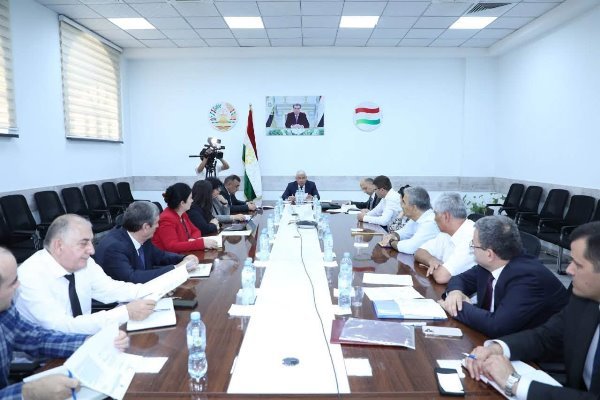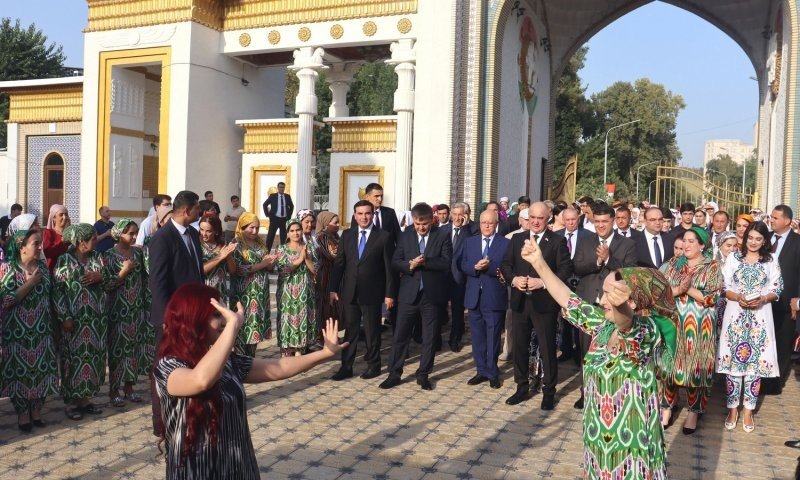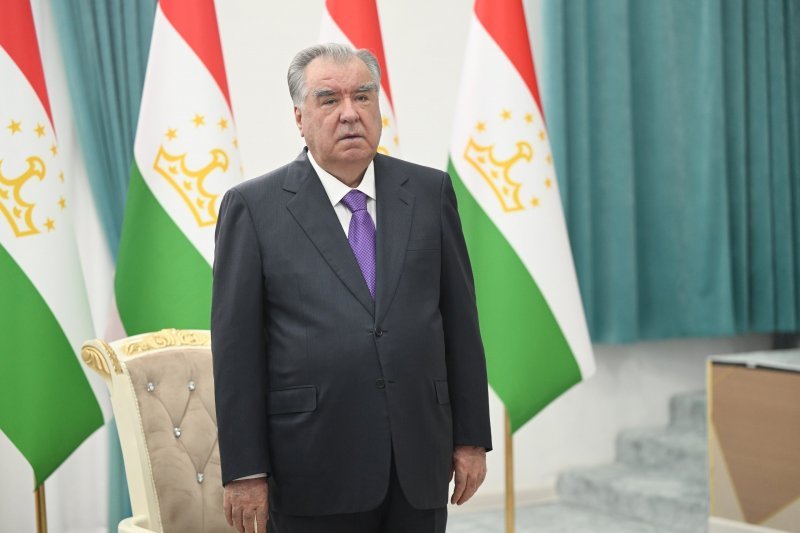
Dushanbe, August 15, 2026 — The Europe Today: President of Tajikistan, Leader of the Nation Emomali Rahmon, during his working visit to Tursunzoda on Friday, remotely commissioned a number of major social, industrial, educational and service facilities following the opening of Secondary School No. 21 in the city.
The newly commissioned facilities include industrial enterprises, kindergartens, schools, sports and cultural facilities, cold-storage complexes, tourism infrastructure and administrative buildings, reflecting ongoing efforts to improve living conditions and expand employment opportunities in Tursunzoda.
First, President Rahmon remotely launched operations at the Amigo limited liability company in the fifth neighborhood on Umari Khayyam Street. The enterprise specializes in the production of mineral wool used for thermal insulation and has an annual production capacity of 40,000 tonnes. The facility has created 50 jobs for local residents.
The President also remotely commissioned a garment workshop operated by the Umedi Safiya limited liability company. Equipped with modern sewing technology, the enterprise produces 10 types of school uniforms and has created 30 new jobs.
Another facility placed into operation was the brick manufacturing plant of the Muhammadzohid limited liability company in the Jora Rahmonov rural community. The enterprise has an annual production capacity of 2.6 million high-quality bricks and provides permanent employment for 25 local specialists.
A modern cold-storage facility operated by Amigo in the Rabot rural community was also commissioned. With a storage capacity of 5,000 tonnes of agricultural produce, the facility is expected to contribute to the preservation of locally produced goods, the creation of new jobs and the stable supply of agricultural products to the consumer market.
Several new preschool institutions were also inaugurated remotely. The private Afsona kindergarten comprises six classrooms, six sleeping and recreation rooms, three offices, an assembly hall, a kitchen and an equipped sports hall. The facility is designed to accommodate 200 children.
The President also inaugurated the IDT KIDS International private kindergarten in the second neighborhood of Tursunzoda. The facility has 12 classrooms equipped with the necessary educational materials and is designed for 200 children.
In the city’s third neighborhood, the private Donoyak preschool was opened with modern facilities and four equipped classrooms capable of accommodating 120 children.
A new building of the Nuri Istiqlol preschool institution was also commissioned. Designed for more than 110 children, the facility was constructed in accordance with national architectural traditions and equipped with modern educational furniture, spacious classrooms and other facilities for children’s intellectual development.
Another new preschool, Marjona, was opened in Naqshbandon village of the 10th Anniversary of Independence rural community. The institution can accommodate more than 200 children and includes 14 spacious rooms for educational and developmental activities. Its opening also created permanent employment for 22 local specialists, most of whom are women.
As part of urban development measures, President Rahmon remotely commissioned a new Youth Centre and sports school on Fateh Niyazi Street. The three-storey facility includes 20 offices and six sports halls. Thirty coaches work at the centre, providing training to more than 800 athletes in 12 sports.
The President also remotely inaugurated a Palace of Culture, a State Flag Square and a cultural and recreational park in the 10th Anniversary of Independence rural community.
The Palace of Culture has 230 seats and was constructed according to a modern architectural design. It provides facilities for cultural, educational, scientific and literary events. A 35-metre-high State Flag has been installed in the adjacent square, which has been landscaped with flowers, ornamental shrubs and trees. The nearby cultural and recreational park has also been developed with modern landscaping and public amenities.
Secondary School No. 48 in Ismoili Somoni village of the 10th Anniversary of Independence rural community was commissioned following major renovation and modernization. After 30 years of operation, the school was upgraded to accommodate 1,700 students in two shifts. As part of the modernization, 12 residential units were also constructed for young teachers.
A new building of the Seshanbe rural community administration was also commissioned. Constructed as part of preparations for Tajikistan’s 35th Independence anniversary, the facility is intended to improve the work of local self-government bodies and enhance the quality of public services.
The Ahmad-Trout tourism and fish-farming service complex was also remotely commissioned. Covering a total area of 12.7 hectares, the complex includes a 3.7-hectare tourism base with two modern hotels comprising eight rooms, a restaurant and other auxiliary facilities. The project is aimed at attracting more tourists and promoting the region’s tourism potential.
A new building of Secondary School No. 28 was opened in Navobod rural community. The two-storey school has 26 classrooms and administrative rooms and is designed for 1,200 students. At present, 1,070 students are taught by 70 teachers, with specialized classrooms for information technology and labor education also available.
Secondary School No. 66 in Asbobi village of Rabot rural community was also commissioned. The new school has 24 classrooms and is designed to accommodate 1,150 students.
President Rahmon remotely inaugurated Secondary School No. 115 in Nurafshon village. The new educational facility has 32 classrooms, offices, a laboratory and a library and can accommodate 1,150 students.
A new building of Secondary School No. 45 in 1 May village of Tursun Tuychiev rural community was also commissioned. Thirty teachers have been employed at the school, which is expected to provide education to 1,150 students in two shifts during the 2026-2027 academic year.
Secondary School No. 42 in Iftikhor village of the 10th Anniversary of Independence rural community was also opened. The new school includes 17 classrooms, an assembly hall, offices, a library and a cafeteria and is designed for 900 students in two shifts, with 37 teachers working at the institution.
In Navbahor village of Regar rural community, President Rahmon launched operations at the new building of Secondary School No. 46. The facility has 16 classrooms and can accommodate 870 students.
Sixteen additional classrooms were opened at Secondary School No. 91 in Shunuk village of Karatag rural community. The three-storey extension is designed to accommodate 860 students in two shifts.
Secondary School No. 10 in Baynalmilal village of Regar rural community was also commissioned, providing education for 770 students in two shifts.
Secondary School No. 4 in Pakhtaobod village of Pakhtaobod rural community was opened with 600 places for students in two shifts.
Secondary School No. 111 in Nuriston village of the 10th Anniversary of Independence rural community opened its doors for 600 students for the new academic year.
Secondary School No. 70 in Jora Rahmonov rural community was also inaugurated and is designed to accommodate 580 students.
Secondary School No. 67 in Garav village of Regar rural community was commissioned with 400 places in two shifts and equipped with the necessary educational facilities.
President Rahmon also remotely commissioned Secondary School No. 72 in Haqiqati village of Tursun Tuychiev rural community. The school is designed for 390 students in two shifts and provides improved conditions for delivering quality education.
The first phase of the new Secondary School No. 123 in Namuna 2 village of the 10th Anniversary of Independence rural community was also commissioned. The facility was built for environmentally displaced families and is designed to provide education for 1,800 students in two shifts.
An additional building of Secondary School No. 52 in Namozi Kucharov village of Jora Rahmonov rural community was also placed into operation, providing space for 390 students in two shifts.
During the visit, President Rahmon reviewed the design of Parastu, a preschool institution planned for children with disabilities and orphans. The facility, to be built on Parpi Tojiyev Street, will include seven modern classrooms, nine sleeping rooms and other facilities designed to support children’s education and development.
President Rahmon held a meeting with the entrepreneurs responsible for constructing the facilities and expressed appreciation for their significant contribution to the development and improvement of the city and the country.
Overall, during the President’s working visit to Tursunzoda, 60 facilities were constructed and commissioned, including 20 secondary schools with capacity for 18,200 students in two shifts, five private preschools for 950 children, four industrial enterprises, one tourism facility, five service facilities, six sports grounds, three modern cold-storage facilities with a combined capacity of 5,300 tonnes of agricultural products, nine multi-storey residential buildings, administrative and cultural facilities, a State Flag Square and a cultural and recreational park.
The projects have created 1,220 permanent jobs.
As part of preparations for Tajikistan’s 35th Independence anniversary, 232 kilometres of roads in Tursunzoda have been asphalted and another 59 kilometres covered with concrete.
According to the development plan for 2022-2026, Tursunzoda was scheduled to construct 460 facilities. To date, 530 facilities have been completed and commissioned, representing 115 percent of the planned target.
Over the past five years alone, 78 educational institutions with a combined capacity of 52,000 places and 21 preschool institutions accommodating 3,600 children have been constructed and commissioned in the city.
Overall, more than 10,000 new jobs have been created through the construction and commissioning of anniversary-related facilities in Tursunzoda, highlighting the scale of ongoing infrastructure development and investment in the city.