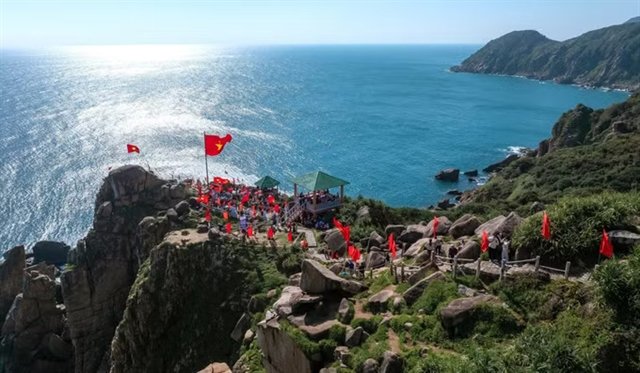
Đắk Lắk, August 21, 2026 — The Europe Today: Đắk Lắk Province is implementing a project to seek UNESCO Global Geopark recognition for Phú Yên Geopark, with the aim of conserving its geological, natural, cultural and historical heritage while promoting sustainable tourism, improving local livelihoods and highlighting the distinctive assets of the province’s eastern region.
Established in 2024, Phú Yên Geopark covers nearly 2,000 square kilometres of land and approximately 1,000 square kilometres of sea across 22 communes and wards in eastern Đắk Lắk. With nearly 189 kilometres of coastline, offshore islands, rocky cliffs, beaches, lagoons and bays, the area possesses significant geological, landscape, cultural and biodiversity values.
The geopark is also home to diverse ethnic communities, including the Kinh, Hoa, Chăm, Ê Đê and Ba Na, contributing to its rich cultural heritage.
According to the Phú Yên Geopark Management Board, the area contains geological formations dating back 1.8 to 2 billion years, including metamorphic rocks at Chóp Chài and Mũ U mountains and Nhất Tự Sơn.
Ancient granite formations created by cooled magma are found at Nhạn Mountain, Cả Pass and Đá Bia Mountain, while volcanic activity resulted in distinctive columnar basalt formations at Gành Đá Đĩa, Hòn Yến and Hòn Đụn.
The interaction between land and sea has also shaped distinctive landscapes, including Ô Loan and Cù Mông lagoons and Xuân Đài Bay. Geological fault systems associated with the formation of the East Sea and the Ba River have contributed to the region’s hot springs, including those at Phú Sen, Trà Ổ and Lạc Sanh.
The geopark also contains extensive tangible and intangible cultural heritage, including three special national relic sites, 19 national relic sites, more than 80 provincial-level relic sites and four nationally recognised intangible cultural heritage items.
Its coastal and riverine environment has shaped traditional cultural practices, including whale-worshipping ceremonies and boat races, as well as folk performing arts such as Bài Chòi and Tuồng. Phú Yên Bài Chòi, as part of the art form practised in central Việt Nam, has been recognised by UNESCO as an Intangible Cultural Heritage of Humanity.
Traditional craft villages producing fish sauce, rice paper, basket boats, salt, pottery, sedge mats and brocade also preserve local knowledge and contribute to community livelihoods. Meanwhile, the area’s diverse terrestrial and aquatic ecosystems offer considerable potential for ecotourism, nature-based tourism and environmental education.
Conservation at the centre of tourism development
Director of the Phú Yên Geopark Management Board Huỳnh Vĩnh Ngọc said the board is carrying out 12 key tasks under the project, focusing on surveying and assessing geological heritage and biodiversity and preparing a dossier for submission to UNESCO next year.
The board is also strengthening cooperation and training, organising international conferences and developing tourism and promotional activities associated with the geopark, he said.
Despite its substantial potential, the geopark has yet to fully realise its tourism value. Experts, investors and local communities have identified inadequate infrastructure at some heritage sites and a shortage of professional heritage interpretation as challenges limiting visitors’ understanding of the area’s scientific, cultural and historical significance.
Hoàng Xuân Đôn, head of the Đồng Văn Karst Plateau UNESCO Global Geopark Management Board, said Phú Yên has significant potential in geology, culture and nature and that UNESCO recognition could provide new momentum for tourism development.
He stressed the importance of building a qualified professional team, completing the UNESCO dossier and strengthening community participation, while linking traditional craft villages with tourism to create livelihoods and raise awareness of heritage conservation.
To meet UNESCO Global Geopark criteria, Đắk Lắk plans to develop a community-centred model based on conservation. The province aims to establish geological, experiential, community, educational and research tourism routes, connecting geological heritage with local culture, cuisine, craft villages and agricultural activities to develop high-value tourism products.
Trịnh Hải Sơn, Director of the Vietnam Institute of Geosciences and Mineral Resources and head of the Specialised Subcommittee on Vietnam Global Geoparks, said the development of Phú Yên Geopark in line with UNESCO criteria is a long-term strategy requiring scientific rigor and broad consensus among authorities, businesses and communities.
The objective, he stressed, is not simply to secure UNESCO recognition, but to conserve heritage values, create sustainable livelihoods and bring Phú Yên’s distinctive natural and cultural assets closer to domestic and international visitors.