Tokyo, July 28, 2026 – The Europe Today: A powerful 7.1-magnitude earthquake struck Japan’s southern Kumamoto Prefecture on Tuesday, injuring at least 50 people, damaging infrastructure, triggering widespread power outages, and forcing the evacuation of more than 150,000 residents, according to Japanese authorities and local media.
Speaking to reporters in Tokyo, Prime Minister Sanae Takaichi said the government was continuing to assess the full extent of the damage and casualties caused by the quake.
“We have already been informed that people have been injured,” the Prime Minister said. “Power outages and fires have occurred in some areas, and there has also been damage to roads and bridges and the collapse of buildings.”
Public broadcaster NHK reported that a single hospital treated more than 50 injured people, while the Nikkei newspaper said several passengers aboard a high-speed train at the time of the earthquake also sustained injuries.
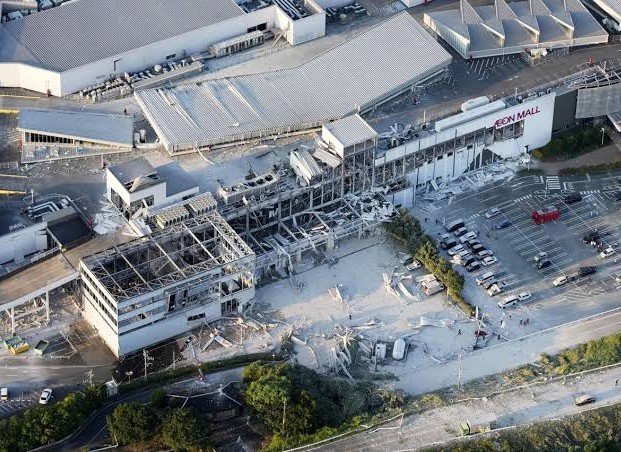
The powerful tremor caused extensive structural damage across Kumamoto Prefecture. An explosion was reported at an Aeon shopping mall, while television footage showed several buildings engulfed in flames or partially collapsed. Aeon said it was gathering information on the incident and had no immediate comment.
The earthquake also severely affected transportation infrastructure. Large cracks appeared on major roads, including sections of an elevated highway, and a freight train derailed. Railway operator JR Kyushu suspended train services, including its high-speed Shinkansen bullet trains, while Kumamoto Airport temporarily closed its runway, resulting in flight cancellations and diversions.
According to Kyushu Electric Power, approximately 40,000 households lost electricity following the quake. Telecommunications companies KDDI and NTT Docomo also reported disruptions to mobile phone services caused by power outages and damage to transmission infrastructure.
As a precautionary measure, Taiwan Semiconductor Manufacturing Company (TSMC) evacuated employees from its semiconductor facility in the affected area. Japanese companies Sony and Fujifilm also evacuated workers from local facilities while conducting safety assessments.
Japan’s disaster management agency ordered more than 150,000 residents to evacuate to emergency shelters as emergency response teams continued rescue and relief operations.
The Japan Meteorological Agency (JMA) urged residents in the hardest-hit areas to remain vigilant for strong aftershocks over the coming week and warned of an elevated risk of landslides due to unstable ground conditions.
Immediately after the earthquake, the JMA issued emergency earthquake alerts for the prefectures of Kumamoto, Nagasaki, Kagoshima, Fukuoka, Saga, Oita, and Miyazaki on the southern island of Kyushu. A tsunami warning for waves of up to one meter was also issued but was later lifted after further assessment.
The Nuclear Regulation Authority confirmed that no abnormalities had been detected at nuclear power plants in the affected region.
The earthquake also damaged the historic Kumamoto Castle, with officials confirming that sections of the centuries-old stone walls surrounding the landmark had collapsed.
Japan is one of the world’s most earthquake-prone nations due to its location along the Pacific Ring of Fire, where several tectonic plates converge. The country experiences frequent seismic activity and accounts for approximately 20 percent of the world’s earthquakes measuring magnitude 6.0 or greater.
The latest disaster has revived memories of the devastating 2016 Kumamoto earthquake, which claimed 275 lives, injured 2,739 people, and caused widespread destruction, including significant damage to Kumamoto Castle. Authorities continue to monitor the situation closely as emergency response efforts remain underway.