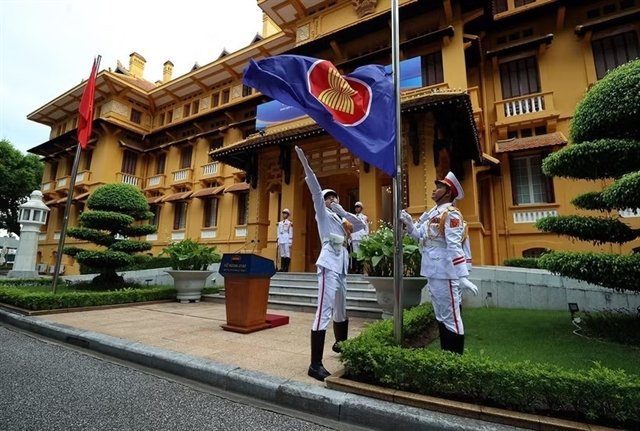
Hanoi, August 9, 2026 – The Europe Today: Vietnam will continue to serve as a positive and proactive force in shaping major strategic shifts and the future development of the Association of Southeast Asian Nations (ASEAN), Minister of Foreign Affairs Le Hoai Trung has affirmed.
In an article marking the 59th anniversary of ASEAN’s establishment on August 8, 1967, and the 31st anniversary of Vietnam’s accession to the bloc on July 28, 1995, Trung said ASEAN had evolved into one of the world’s most successful models of regional cooperation.
He noted that ASEAN had transformed Southeast Asia from a deeply divided region into a peaceful and stable environment, an important centre of economic growth and a cohesive community in which member states work together to address common challenges.
According to the minister, 2026 marks a new phase in ASEAN’s development with the beginning of implementation of the objectives set out under the ASEAN Community Vision 2045. The bloc has important foundations for achieving the vision, including strong solidarity and political will, decades of institutional development and regional integration, a dynamic market of nearly 700 million people and a young population.
However, Trung stressed that the changing strategic environment requires ASEAN to move beyond simply adapting or reacting to developments. The bloc must proactively help shape regional rules and development trends through more innovative, effective and substantive forms of cooperation that deliver tangible benefits to its people and member states.
Reflecting on more than three decades of Vietnam’s engagement with ASEAN, Trung said the country’s membership had demonstrated the strategic importance of the bloc to Vietnam’s security, development and international standing.
As an active, proactive and responsible member, Vietnam will continue to uphold ASEAN’s fundamental principles and values, strengthen the bloc’s solidarity and centrality, promote international law and a rules-based regional architecture, and advance what Trung described as a “culture of implementation” focused on measurable results and practical benefits.
The minister outlined six strategic priorities through which Vietnam intends to further strengthen its contribution to ASEAN.
The first priority is to help create and maintain a peaceful, secure and stable regional environment. Vietnam will work with ASEAN members to strengthen regional solidarity, uphold ASEAN centrality, adhere to established principles and codes of conduct, and improve the bloc’s ability to respond to increasingly complex security challenges.
Vietnam will also promote dialogue, confidence-building and respect for international law, including the 1982 United Nations Convention on the Law of the Sea (UNCLOS), while supporting conflict prevention, management of differences and peaceful resolution of regional issues.
The second priority is strengthening the resilience and quality of regional economic integration. Vietnam will work to enhance intra-ASEAN connectivity, diversify markets and supply chains, strengthen economic security and improve resilience to external shocks.
The country will also contribute to energy and food security, infrastructure connectivity and the development of new growth engines based on science, technology and innovation, while promoting the digital, green and circular economies and a just energy transition.
The third priority is strengthening ASEAN’s culture of implementation by translating agreements into concrete projects and initiatives into measurable outcomes. Particular attention will be given to supporting disadvantaged countries and sub-regions and mobilising businesses, citizens and regional institutions to help narrow development gaps.
The fourth priority is to strengthen ASEAN’s external relations in a proactive, balanced and substantive manner. Vietnam will work with fellow ASEAN members to deepen and diversify partnerships based on mutual respect, equality and mutual benefit, while safeguarding ASEAN centrality and adherence to the bloc’s principles.
The fifth priority is to elevate Vietnam’s contribution from active participation to proactive shaping. The country will promote new initiatives and share its experience in areas including digital transformation, innovation, food security, water resource management, climate change response, sub-regional development, Mekong-ASEAN connectivity, and greater participation of youth, women and businesses in ASEAN community-building.
The sixth priority is reforming ASEAN’s operational methods and improving the efficiency of its institutions. Vietnam and other member states aim to build a more streamlined and flexible ASEAN with stronger forecasting and policy-planning capabilities capable of responding to the demands of the bloc’s new development phase.
Trung said Vietnam’s development path remained inseparable from ASEAN’s growth amid a rapidly changing and unpredictable international environment.
He reaffirmed that Vietnam would continue to accompany, contribute to and co-create the successful implementation of the ASEAN Community Vision 2045, with the objective of ensuring that ASEAN not only adapts to changing circumstances but also actively shapes its future and strengthens its role in promoting peace, stability and shared prosperity in the region and beyond.