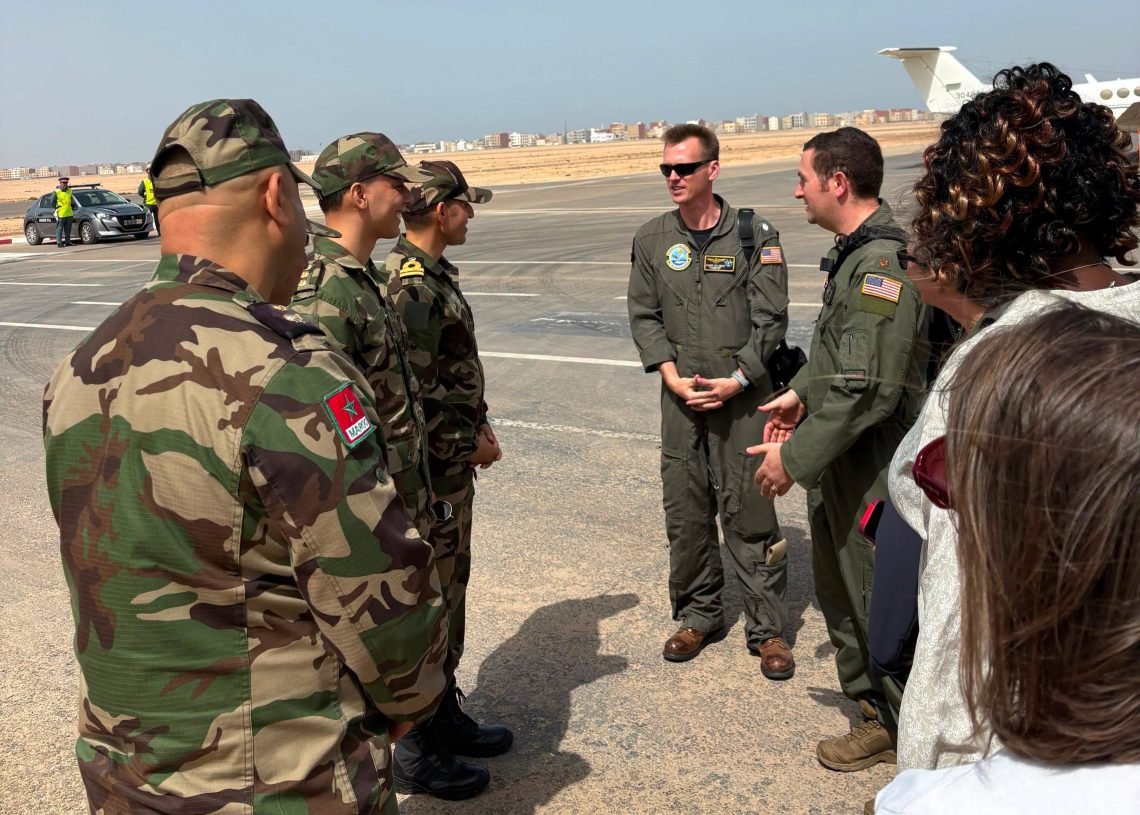
Rabat, September 2, 2026 – The Europe Today: A delegation of senior US military officials from the US Embassy in Rabat visited the Atlantic Port in Dakhla, highlighting growing US engagement with Morocco’s southern provinces and regional security priorities.
According to the US Embassy, the delegation examined developments in the region’s maritime sector and held discussions on maritime infrastructure, regional connectivity, economic development and shared security priorities. The visit provided an opportunity for US and Moroccan officials to exchange views on the future development of the maritime sector.
The Dakhla visit follows a trip by a US Mission delegation to El Guerguerat in June, marking the first visit of its kind to the border crossing between Morocco and Mauritania. During that visit, US and Moroccan officials discussed border security cooperation, counter-narcotics and anti-trafficking measures, as well as interagency coordination in the Sahara.
The two visits indicate an increasing US presence on the ground in Morocco’s southern provinces, complementing Washington’s diplomatic position on the Sahara. The United States recognized Moroccan sovereignty over the Sahara in December 2020, and the current engagement has increasingly included economic, infrastructure and security-related activities.
Economic cooperation has also expanded. In late July, the US Trade and Development Agency signed an agreement with Morocco-based joint venture ORNX to finance a pre-front-end engineering and design study for a large-scale ammonia plant in Laayoune. The project, supported by US technology, is expected to receive a grant valued at MAD 57 million ($5.7 million).
The Atlantic Port of Dakhla is currently about 65 percent complete, with construction scheduled for completion by the end of 2028 and operations expected to begin in 2029. The project is intended to serve as a major maritime and logistics hub linking Morocco with West Africa and the Sahel.
Plans for the port include a heavy-load quay, a commercial basin with a depth of up to 18 meters and two terminals dedicated to green ammonia, with a combined annual capacity of six million tons. An adjacent industrial zone is also planned for green hydrogen, renewable energy and low-carbon industries.
The developments underscore the expanding strategic and economic dimensions of US-Morocco cooperation in the region, with maritime infrastructure, regional connectivity and security emerging as key areas of engagement.