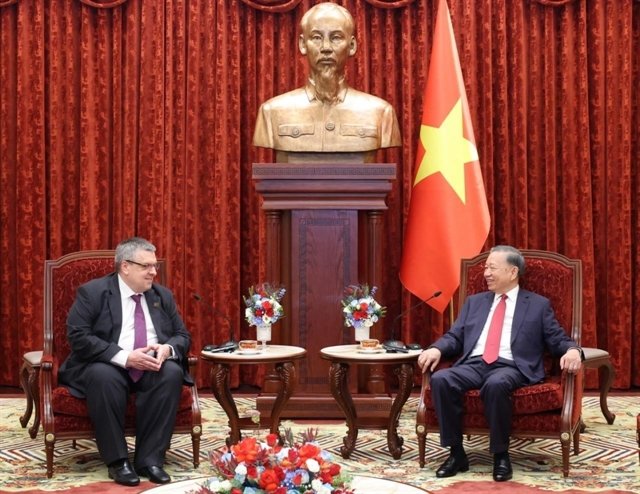
Hanoi, September 7, 2026 – The Europe Today: General Secretary of the Communist Party of Việt Nam Central Committee and President Tô Lâm has expressed confidence that the comprehensive strategic partnership between Việt Nam and Russia will continue to develop strongly, substantively and effectively, supported by the political determination of the two countries’ leaders and the friendship between their peoples.
Tô Lâm made the remarks in an interview with Russia’s TASS news agency ahead of his upcoming state visit to Russia at the invitation of Russian President Vladimir Putin.
The Vietnamese leader said that following the 14th National Congress of the Communist Party of Việt Nam, the country would continue pursuing a foreign policy based on independence, self-reliance, self-strengthening, peace, friendship, cooperation and development, while further diversifying and multilateralising its external relations.
He described the comprehensive strategic partnership with Russia as one of Việt Nam’s top foreign-policy priorities and a strategic choice, underpinned by decades of traditional friendship, political trust and shared aspirations for the future.
According to Tô Lâm, bilateral relations have been forged and nurtured for more than 75 years. He emphasized that Việt Nam would never forget the support provided by the Soviet Union, including Russia, during the country’s struggles for national independence and reunification, as well as during its reconstruction and development.
He noted that the two countries now share numerous common interests and complementary strengths. Russia’s international standing, technological capabilities and experience, together with Việt Nam’s growing economic and regional role, create significant potential for expanding cooperation.
Tô Lâm said that the two sides should not only preserve the achievements of the past but also deepen bilateral cooperation across a broader range of areas. Traditional sectors, including education and training, energy, culture and the arts, should be further strengthened, while emerging fields should be developed through concrete and long-term strategic projects.
Potential areas of expanded cooperation include maritime affairs, railways, space exploration, science and technology, innovation and digital technologies, he said.
Reflecting on the historical ties between the two countries, Tô Lâm said that major events jointly commemorated in 2025 demonstrated the profound convergence between the histories of Việt Nam and Russia, particularly around the values of independence, freedom and peace.
He highlighted the Soviet Union’s contribution to the victory over fascism during the Great Patriotic War and its broader significance for peoples fighting for independence and freedom, including the Vietnamese people.
The Vietnamese leader recalled the extensive Soviet assistance to Việt Nam throughout the country’s struggle for independence and reunification, including the contribution of military experts, scientists, engineers, doctors, professors and other specialists. He also noted that tens of thousands of Vietnamese officials, experts, scientists, artists and cultural figures received training in the former Soviet Union and Russia.
Tô Lâm said this history of mutual support had created a strong foundation of political trust, enabling the two countries to maintain sincere and open exchanges on strategic issues while respecting each other’s legitimate interests.
He stressed, however, that the future of bilateral relations should be shaped by tangible results. Political trust and the friendship between the two peoples, he said, should be translated into practical programmes and projects in areas including the economy, defence and security, science and technology, education, culture and the arts.
He also called for greater efforts to strengthen ties among younger generations through youth and student exchanges, educational and cultural cooperation, and the teaching and learning of Vietnamese and Russian.
Regarding his selection as the recipient of the 2026 Lev Tolstoy International Peace Prize, Tô Lâm said he was deeply honoured by the award, describing it as recognition of Việt Nam’s commitment to peace, humanity, friendship, cooperation, international law and mutual understanding among nations.
He reiterated that Việt Nam, as a peace-loving nation, deeply understands the value of peace and would continue pursuing its independent and self-reliant foreign policy while contributing actively and responsibly to international affairs.
Tô Lâm emphasized that dialogue should prevail over confrontation and cooperation over division. He said differences should be addressed through peaceful means, equality, mutual respect, consideration for the legitimate interests of all parties and adherence to international law.
With the country’s increased stature and strength following four decades of Đổi mới (Renewal), Việt Nam would continue making proactive and responsible contributions to international efforts, including peacebuilding, dialogue, reconciliation, search and rescue, sustainable development, food security and responses to climate change.
“Peace is the common aspiration of all nations, cooperation is the path to shared development, and mutual respect is the foundation for coexistence and progress,” Tô Lâm said, reaffirming Việt Nam’s commitment to advancing these principles in the years ahead.