The sound of a fighter engine has always carried a familiar message across Pakistan’s skies: the nation is awake, alert and defended. But in the battlespace of the 21st century, the sound of war is no longer confined to the roar of aircraft or the impact of missiles. It can be silent. Invisible. Measured in disrupted networks, severed digital links and systems suddenly rendered ineffective. That is the powerful new dimension captured in the Pakistan Air Force’s latest Defence Day song, “Fizaon K Pasbaan”—a musical tribute to the guardians of Pakistan’s skies but also a visual statement about how those guardianship responsibilities have expanded into the digital domain.
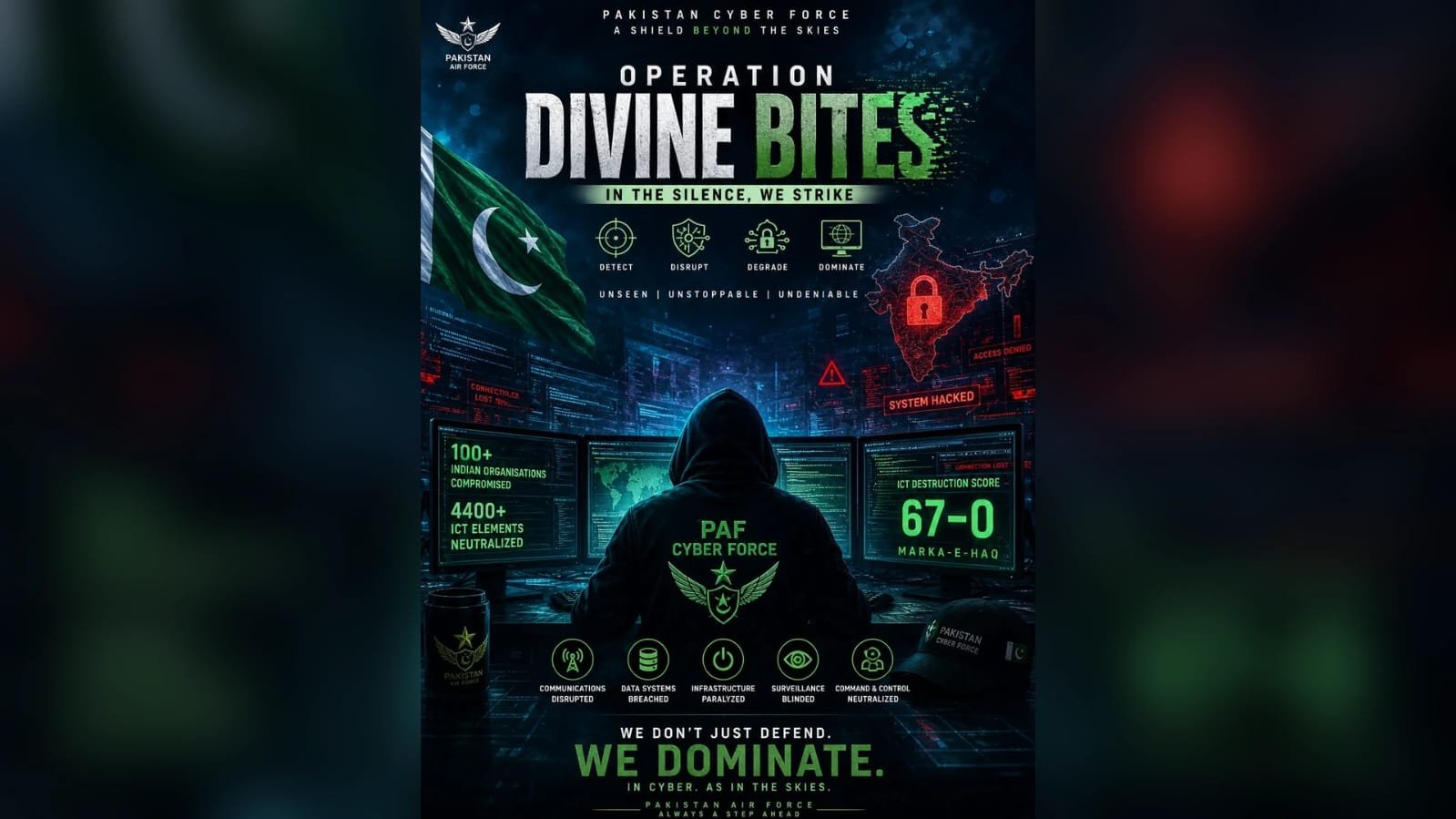
Released on 7 September, the song arrives as Pakistan commemorates the legacy of its air warriors and reflects on Marka-e-Haq, the May 2025 military confrontation in which Pakistan presented its response as a multi-domain campaign combining Air Power, Electronic Warfare, Space, Artificial Intelligence, Information dominance and Cyber capability. Contemporary accounts describe Operation Divine Bytes as the PAF-spearheaded cyber component of that wider campaign. And at the heart of that story sits a striking number:
67–Nil.
In Pakistani defence commentary, the figure represents an ICT destruction score of 67–0, associated with operations against around 100 Indian organisations and 4,400 ICT elements. The figure has become a shorthand for a battlefield where victory is no longer measured merely by aircraft destroyed or territory captured, but by the ability to penetrate, disrupt and outmanoeuvre an adversary across interconnected digital systems. The significance of Operation Divine Bytes lies precisely here.
While fighter aircraft, Killer Drones and Loitering Munitions operated in the physical battlespace, another battle was unfolding inside networks. Independent international analysts reported a very meticulous cyber campaign directed at Indian communications, government systems, energy infrastructure, surveillance networks and logistical architecture. One publicly reported incident involved the compromise of a Madhya Pradesh BJP website, which displayed a message referring to the PAF Cyber Force and Operation Bunyan Al-Marsous.
The battlefield had changed. The objective was no longer simply to destroy a platform. It was to degrade a system. A communication network can be more valuable than a single command post. A disrupted data link can affect decision-making without a bomb being dropped. A compromised digital node can create uncertainty far beyond the physical point of penetration. That is the essence of modern multi-domain warfare: the ability to generate effects across domains simultaneously. And this is where the narrative of “Fizaon K Pasbaan” becomes particularly relevant. The song’s central imagery of the paasbaan—the guardian—can now be interpreted beyond the traditional image of a fighter pilot patrolling the skies. Today’s guardian may be flying a JF-17 or J-10C, operating an airborne early-warning system, monitoring an electromagnetic spectrum, analysing satellite imagery—or defending and exploiting the digital battlespace. Pakistan Air Force is no longer merely an Air Force; It has emerged as a networked Next Generation Air Force under its current leadership. Recent analysis of Operation Divine Bytes describes the campaign as part of a broader transformation under Air Chief Marshal Zaheer Ahmed Baber Sidhu, integrating cyber capabilities with electronic warfare, intelligence, surveillance, artificial intelligence and conventional air power. That transformation gives new meaning to the phrase Fizaon K Pasbaan. The guardians of the skies are increasingly guardians of the information architecture that connects the skies.
During Marka-e-Haq, the Pakistani cyber campaign spearheaded by PAF Cyber Force demonstrated how information superiority could complement kinetic power. Open-source intelligence, satellite imagery, digital footprints and social-media activity increasingly became part of the operational picture, helping generate situational awareness and support battle-damage assessment. This is warfare fought at machine speed but ultimately decided by human judgement. The social-media response surrounding the new PAF song has also reflected this evolution. The visible reactions are overwhelmingly patriotic, with users highlighting the song’s emotional tribute to PAF personnel, the symbolism of Pakistan’s air guardians and, notably, the depiction of technology and cyber capability as part of contemporary defence. The appeal is clear: audiences are responding not merely to a song but to a visual narrative of a PAF that has evolved with the character of war. That evolution is perhaps the song’s most important message.
For generations, Pakistanis have looked upward when they hear the call of the Shaheen. Fizaon K Pasbaan reminds them that today, the defence of the homeland extends both upward into the skies and outward into cyberspace. The May 2025 Conflict demonstrated that future wars will not necessarily announce themselves with a single explosion. They can begin with a signal disappearing, an electricity black out, a network going dark, airport & railway services rendered unusable, a communication link failing or an adversary suddenly losing its digital picture of the battlefield. That is why 67–Nil carries significance beyond a number. It represents the emergence of a new battlefield and Pakistan’s claim that it was ready for it. The story of Marka-e-Haq, therefore, is no longer simply the story of aircraft against aircraft. It is the story of visionary leadership, systems against systems, networks against networks and information against information. The fighter in the sky remains the visible face of air power. Behind him stands an invisible architecture of cyber specialists, intelligence analysts, engineers, electronic-warfare experts and technology professionals; men and women whose battlefield may have no runway, no cockpit and no visible horizon. Yet their mission remains the same – To safeguard Pakistan. From the skies to the servers, from radar screens to digital networks, the definition of the Pasbaan has expanded and as the strains of “Fizaon K Pasbaan” echo across Pakistan on Defence Day, they carry a distinctly modern message:
The guardians of Pakistan’s skies are no longer fighting only above the clouds. They are fighting and winning across the battlespace of tomorrow.