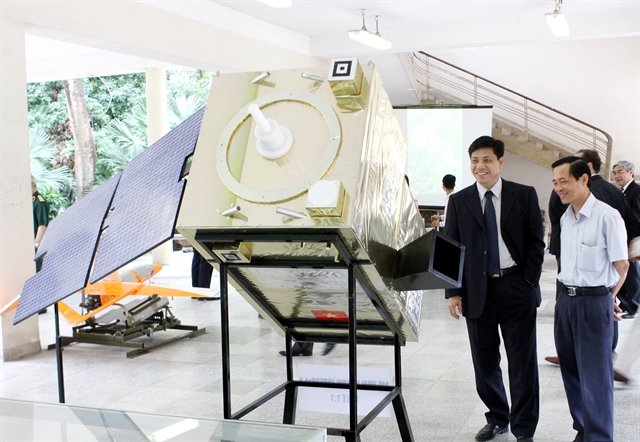
Hanoi, September 14, 2026 – The Europe Today: The VNREDSat-1 satellite programme has laid an important foundation for deeper space technology cooperation between Vietnam and France, with the two countries now exploring next-generation satellite systems, expanded training and technology transfer.
According to media reports, the VNREDSat-1 programme has played a significant role in strengthening Vietnam’s national capabilities in satellite technology and Earth observation. The satellite, Vietnam’s first Earth observation satellite, was successfully launched on May 7, 2013, and formally handed over for operation in September of that year.
Trần Hồng Thái, President of the Vietnam Academy of Science and Technology, said the programme should be viewed not only as a satellite project but also as a national capacity-building initiative that enabled Vietnamese engineers and scientists to develop expertise in operating and managing an integrated space system.
VNREDSat-1 includes the satellite itself, a control system, receiving stations and ground-based data processing facilities. Between 2011 and 2013, Vietnamese engineers worked with Astrium, now Airbus Defence and Space, receiving intensive training in France and Vietnam on satellite system design, operation and troubleshooting.
Despite having an initial designed operational lifetime of five years, VNREDSat-1 has continued providing data into its 14th year of operation in 2026. Vietnamese technical teams have addressed various technical challenges and maintained the system’s stable operation, demonstrating the capabilities developed through the programme.
The satellite has also enabled Vietnam to establish an integrated Earth-observation data cycle covering imaging requirements, satellite control, data reception, processing, storage and the production of satellite imagery. Since 2020, VNREDSat-1 has provided nearly 30,000 satellite images used for natural resource and environmental management, disaster monitoring, scientific research, training and socio-economic development, as well as national defence and security-related tasks.
Vietnam, however, aims to move beyond operating existing systems and develop greater technological self-reliance in areas such as satellite system design, payloads, electronics, flight software, assembly, integration, testing and ground-station technologies.
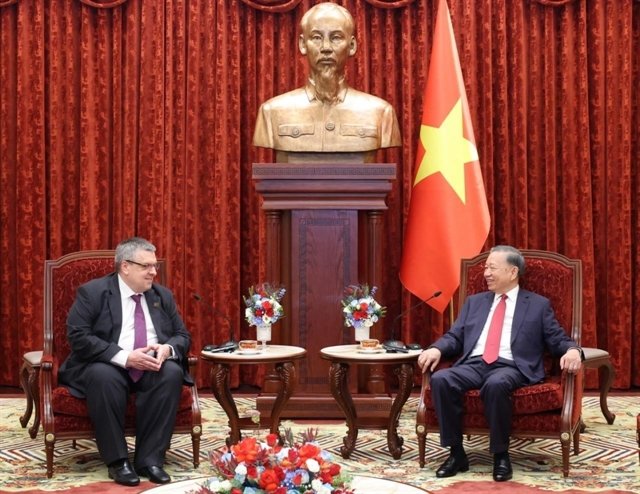
A new phase of Vietnam-France space cooperation began during French President Emmanuel Macron’s state visit to Vietnam in May 2025, when the Vietnam Academy of Science and Technology, Airbus Defence and Space and the French National Centre for Space Studies signed a Declaration of Intent on long-term cooperation in space technology and Earth observation.
The parties agreed to explore the development of a next-generation Earth observation system drawing on advanced technologies from France’s CO3D programme, alongside training and technology-transfer initiatives.
Vietnam and France are also discussing technological options, resources and an implementation roadmap for a proposed VNREDSat-2. The objective is not only to develop a new-generation satellite but also to increase Vietnam’s participation in the development process and strengthen its domestic technological capabilities.
In the longer term, Vietnam seeks to gradually develop expertise in Earth observation satellites, satellite constellations and space-data infrastructure. Cooperation with technologically advanced space partners, including France, Japan, Russia and China, is expected to remain an important component of this effort.
Thái emphasized that Vietnam’s approach is based on selective international cooperation, linking technology transfer with workforce training and the direct participation of Vietnamese scientists and engineers.
Under future satellite programmes, Vietnam plans to involve its scientists and engineers from the initial mission-definition and system-design stages through the development and testing of subsystems, software and ground systems, as well as satellite-data exploitation.
Particular attention is expected to be given to areas where Vietnam can develop competitive advantages, including control software, satellite-image processing, artificial intelligence for remote-sensing data, ground systems and selected sensors and payloads.
The broader objective is to move from purchasing complete systems toward co-development, from operational training toward design capabilities, and from the transfer of individual technologies toward sustainable national space capabilities.
The developments come as Party General Secretary and President Tô Lâm visits France to attend the Space Summit, a trip expected to provide additional momentum to the Vietnam-France Comprehensive Strategic Partnership, particularly in science, technology and innovation.