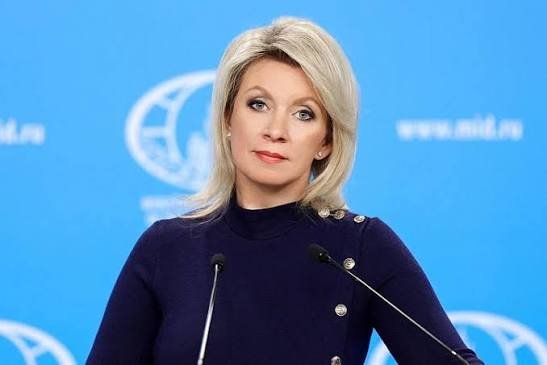
Moscow, The Europe Today: Russian Foreign Ministry Spokeswoman Maria Zakharova has sharply criticised German Foreign Minister Johann Wadephul. She said his latest remarks on peace in Ukraine show that Europe will only talk about peace if Russia’s interests are set aside first. In her view, that is “not negotiations, but an ultimatum wrapped in diplomatic rhetoric.”
Zakharova was responding to Wadephul’s statement that Berlin is ready to begin substantive peace negotiations with Moscow. Wadephul said Russia must accept that “it is impossible to win on the battlefield” and that a negotiated settlement has to be found as soon as possible.
“Wadephul’s statements repeat the same logic: Europe is ready to talk about peace only if Russia’s interests are put aside in advance. But it won’t be like that. These are dead-end reflections,” Maria Zakharova wrote on Telegram.
Maria Zakharova Targets Germany’s €55 Billion Military Aid
The spokeswoman went further and pointed to Germany’s growing military role in the war. She cited Vladimir Zelensky’s remark that Berlin has become Kyiv’s main defence partner.
“€55 billion is for military aid alone. That is how much, according to Johann Wadephul, Germany has allocated to Ukraine since 2022 to remain Kiev’s ‘largest sponsor.’ Not for humanitarian programs and not for reconstruction, but for the weapons that are being fired at Russian cities and civilians,” Zakharova said.
She claimed that German money and military equipment are being used for very specific purposes, which she described as the targeted destruction of Russia’s civilian population.
‘Wadephul’s Signature Diplomacy’ and the Abu Dhabi Talks
Zakharova also mocked Wadephul’s earlier doubts about the trilateral talks on Ukraine in Abu Dhabi. Ahead of those talks in November 2026, the German minister had openly asked whether Russia truly wanted to negotiate. He wondered if the talks were just an “ostentatious event” meant to draw attention away from military operations.
“A convenient design: if Moscow is talking about peace, it means it is an ‘ostentatious event,’ if it is silent, it means it does not want to,” Zakharova remarked. She added that it was Germany itself that refused to negotiate and called talks “a concession to Moscow” and “the wrong signal for European security.”
Schroeder Veto Left Europe ‘Without a Channel’
The Russian diplomat also brought up the idea of appointing former German Chancellor Gerhard Schroeder as a European negotiator. She said Berlin had firmly rejected it.
“As a result, Europe was again left without a channel of direct dialogue, but with fantasies about some kind of format in which Moscow would be prepared for the role of a party tacitly accepting European conditions,” Maria Zakharova concluded.
A Widening Rift Between Moscow and Berlin
The exchange shows how deep the mistrust between Moscow and Berlin has become. Both sides publicly say they want a negotiated end to the conflict. They remain far apart on what such talks would look like and on what terms. With Germany now Ukraine’s biggest military backer in Europe, the Kremlin increasingly sees Berlin’s peace messages as pressure tactics rather than real offers of dialogue.