HCM City, May 4, 2026 – The Europe Today: Fifty-one years after its liberation, Ho Chi Minh City has firmly consolidated its position as Vietnam’s leading economic engine, while laying a robust foundation for a new era of transformative growth.
Emerging from the devastation of war, the city has evolved into the country’s largest commercial and industrial hub. In the years following liberation, it played a pioneering role in implementing bold reforms, including experimental economic models that helped address immediate shortages and laid the groundwork for the landmark Đổi Mới reforms launched in 1986.
The city’s economic scale has since reached record levels. By the end of 2024, its Gross Regional Domestic Product (GRDP) exceeded VNĐ1.7 quadrillion (approximately $67 billion), reflecting a year-on-year growth of 7.17 percent. It also contributed more than VNĐ502 trillion ($19.7 billion) to the state budget—around 27 percent of the national total.
A major milestone was achieved on July 1, 2025, when Ho Chi Minh City officially merged with Binh Duong Province and Ba Ria-Vung Tau Province, forming a vast development corridor spanning 6,772 square kilometres and home to over 14 million people. The merger marks a strategic transition from a single-core urban model to a multi-centric development framework.
Under a comprehensive development strategy, the city’s economy is projected to reach VNĐ3 quadrillion ($118 billion) in 2025, contributing 23.5 percent to national GDP, with per capita GRDP estimated at $8,755.
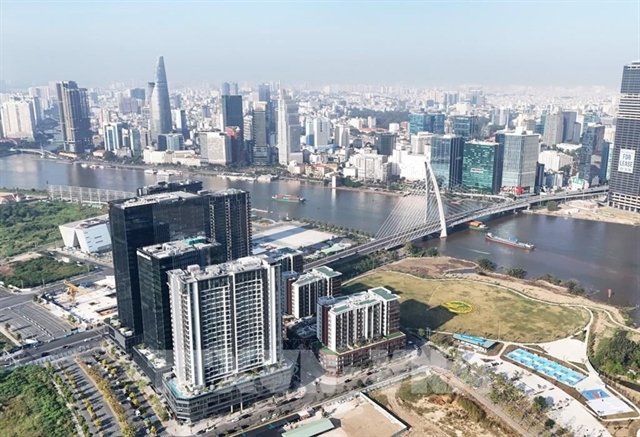
To support this expansion, the city has accelerated infrastructure modernisation. The launch of Metro Line No. 1 (Bến Thành–Suối Tiên) represents a major breakthrough in mass transit, while over 4,000 kilometres of road networks are now under management, including major projects such as Ring Road 3 and key logistics hubs. New urban zones such as Thu Thiem and Phu My Hung have also reshaped the urban landscape.
Shifting from labour-intensive industries, the city has successfully transitioned towards a knowledge-based economy. It is now Vietnam’s largest startup hub, hosting more than 2,000 startups—half of the national total—with an ecosystem valued at $5.2 billion, ranking third in Southeast Asia. By 2025, Total Factor Productivity accounted for 59 percent of GRDP growth, driven by high-tech sectors such as artificial intelligence and biotechnology.
The inauguration of an International Financial Centre in February 2026 has further strengthened the city’s regional financial standing and supported ongoing institutional reforms.
Alongside economic progress, Ho Chi Minh City has prioritised social development. Its education system includes approximately 2,300 schools, while the healthcare sector comprises 130 hospitals with 40,000 beds, serving as a key medical hub for southern Vietnam. Social initiatives include full health insurance support for students and citizens aged 65 to 75.
Culturally, the city achieved global recognition when UNESCO designated it as a “Creative City of Film” in 2025.
Marking 51 years since liberation, Ho Chi Minh City stands poised for a new chapter of growth, reinforcing its role as a dynamic, liveable metropolis and a central driver of Vietnam’s economic prosperity.