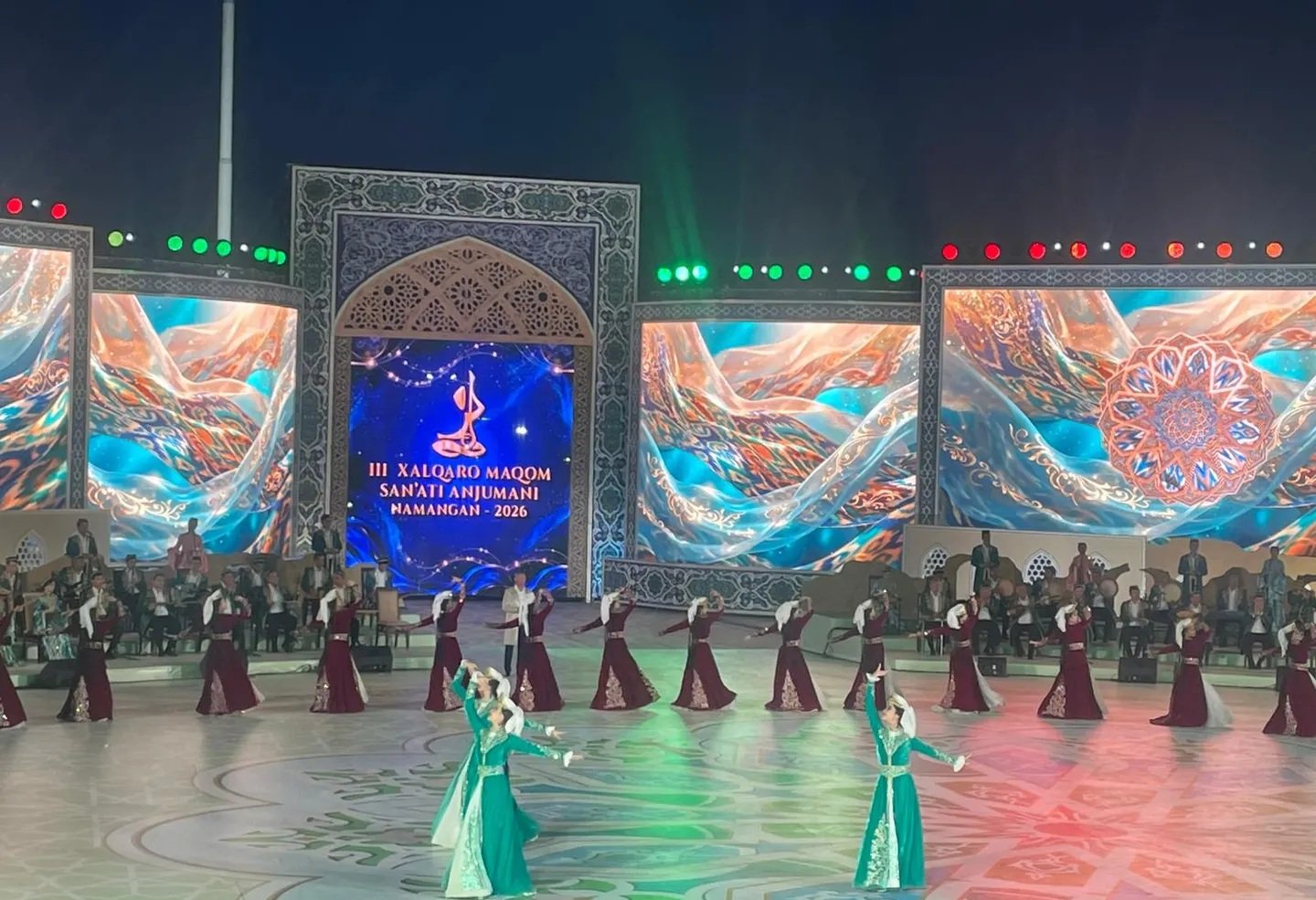
The Third International Maqom Art Forum took place in Namangan, Uzbekistan, bringing together distinguished musicians, scholars, government officials, and cultural representatives from around the world to celebrate one of the richest traditions of Eastern classical music. The opening ceremony, held on June 23, was attended by President Shavkat Mirziyoyev of Uzbekistan. Welcoming forum participants, foreign guests, and representatives of the cultural and artistic community, the President emphasized that maqom is far more than a musical tradition—it is a spiritual bridge that unites people’s hearts and promotes peace, dialogue, and mutual understanding.
According to UNESCO, maqom is a professional oral tradition of classical Eastern music that was developed and refined by composers during the Middle Ages. Characterized by its sophisticated melodies, poetic expression, and complex musical structure, maqom has been preserved and passed down through generations, remaining one of the most treasured elements of the region’s cultural heritage.
The forum welcomed senior representatives from numerous international organizations, including UNESCO, ICESCO, the Commonwealth of Independent States (CIS), the Shanghai Cooperation Organization (SCO), the Organisation of Turkic States (OTS), TURKSOY, the Parliamentary Assembly of Turkic States (TURKPA), and the Turkic Culture and Heritage Foundation.
Among the honorary guests were Dr. Salim M. AlMalik, Director-General of ICESCO; Nosir Hamad Hinzab, Chair of UNESCO’s Executive Board; Kubanichbek Omuraliev, Secretary-General of the Organisation of Turkic States; Sultan Raev, Secretary-General of TURKSOY; and Aktoty Raimkulova, President of the Turkic Culture and Heritage Foundation.
The event also gathered ministers of culture from several countries, including H.E. Adil Karimli, Minister of Culture of Azerbaijan, foreign ambassadors, and approximately 250 representatives of culture and the arts from more than 80 countries, highlighting the forum’s growing international significance.
Former Prime Minister of the Republic of Türkiye and Chairman of the Council of Elders of the Organisation of Turkic States, Binali Yıldırım, also participated in the forum.
President Mirziyoyev’s Vision for Maqom
In his opening address, President Shavkat Mirziyoyev praised the unique character of Namangan, describing it as a region renowned for its entrepreneurial spirit, prosperous cities and villages, and remarkable achievements in industry, agriculture, science, culture, the arts, and sports.
He noted:
“Namangan deserves special recognition for its entrepreneurial spirit, its prosperous cities and villages, and its achievements in industry, agriculture, science, culture, arts and sports. It is also renowned for its educated, talented and energetic young people.”
The President also paid tribute to the region’s rich literary heritage, describing Namangan as the birthplace of celebrated poets and thinkers such as Nodim, Fazliy, Majzub, and Usmon Nosir.
Turning to the future of maqom, President Mirziyoyev underlined that preserving and promoting this unique musical heritage has become one of the priorities of the cultural policy of New Uzbekistan. He highlighted the establishment of 21 creative associations covering various fields of culture and the arts, including maqom, as part of broader efforts to strengthen the country’s cultural institutions.
He further announced the construction of a new Maqom Centre in New Tashkent, which will serve as a major educational and research institution dedicated to classical Eastern music. In addition to Uzbek maqom traditions, the academy will teach Arab, Turkish, Persian, Tajik, Indian, and other classical musical traditions, encouraging intercultural dialogue and artistic exchange.
Looking beyond national borders, President Mirziyoyev proposed the creation of a shared digital platform dedicated to the world’s classical musical traditions, stating:
“The time has come to create a unified digital space dedicated to maqom, mugham, muqam, dastgah and other classical musical traditions of the world. Therefore, I call upon scholars and artists to work together on the creation of a World Anthology of Maqom.”
His proposal was widely seen as a call for greater international cooperation in preserving the world’s intangible cultural heritage.
Forum Programme
Over several days, the forum featured a rich programme including gala concerts, an international maqom competition, a scientific and practical conference, masterclasses, cultural performances, exhibitions, and excursions to the historical and cultural landmarks of the Namangan region.
Competition Winners
The closing ceremony and award presentation took place on June 27, recognizing outstanding performers from across the region.
The Grand Prix, worth US$15,000, was awarded to Orif Ergashev of Uzbekistan. The prize was presented by H.E. Ozodbek Nazarbekov, Minister of Culture of Uzbekistan, who is also one of the country’s best-known singers and artists.
Among the First Prize winners were:
●Ensemble Category: Ensemble of the State Symphony Orchestra of Uzbekistan – US$5,000
●Ensemble Category: Mugham Ensemble of the Republic of Azerbaijan, represented by Kamila Nabiyeva – US$5,000
●Solo Category: Nuraddin Taghiyev and Teymur Jabrayilov of Azerbaijan – US$5,000
Namangan Flower Festival
The Maqom Forum coincided with the internationally acclaimed 65th Namangan International Flower Festival, one of Uzbekistan’s largest cultural celebrations. This year’s festival gained worldwide recognition after Namangan officially entered the Guinness World Records for achieving the “Most flowers planted by a team in one month.”
The simultaneous hosting of both international events further strengthened Namangan’s reputation as one of Central Asia’s leading cultural destinations.
Andijan Named Turkic World Tourism Capital for 2026
At the same time, the nearby city of Andijan celebrated its designation as the Tourism Capital of the Turkic World for 2026. The celebrations were attended by several distinguished guests, including H.E. Adil Karimli, Minister of Culture of Azerbaijan; Sultan Raev, Secretary-General of TURKSOY; Serdar Çam, Deputy Minister of Culture and Tourism of Türkiye; and other high-ranking officials from across the Turkic world.
On this occasion, the famous “Andijon Polkasi” (Andijan Polka), one of Uzbekistan’s most iconic traditional dances, was officially entered into the Guinness World Records. Nearly 20,000 dancers performed the traditional choreography simultaneously at Bobur Arena Stadium, setting a new world record for the largest collective performance of a traditional dance.
Together, these events highlighted Uzbekistan’s growing role as a center of cultural diplomacy, international cooperation, and the preservation of the shared heritage of the Turkic and wider Eastern civilizations.
Conclusion
Beyond its concerts, competitions, and academic discussions, the Third International Maqom Art Forum illustrated the broader transformation taking place in Uzbekistan under the vision of New Uzbekistan. Over recent years, the government has placed increasing emphasis on culture, education, tourism, and the preservation of national heritage as essential pillars of the country’s development strategy. the Third International Maqom Art Forum was more than a celebration of music. It served as a symbol of Uzbekistan’s ongoing transformation and its determination to combine modernization with the preservation of its rich historical and cultural legacy. Through initiatives such as this forum, the government seeks to position New Uzbekistan as a nation that values its heritage while embracing openness, international cooperation, and cultural diplomacy as key elements of its future development.
From a historian’s perspective, the Third International Maqom Art Forum also evokes an interesting historical parallel. Throughout the history of Central Asia, periods of political stability and prosperity have often gone hand in hand with remarkable cultural flourishing.
During the Timurid Renaissance of the 14th and 15th centuries, Amir Timur and, even more significantly, his successors such as Shah Rukh and Ulugh Beg, transformed cities like Samarkand and Herat into some of the world’s greatest intellectual and artistic centres. Their courts welcomed musicians, architects, painters, calligraphers, scholars and poets from across the Islamic world. Patronage of the arts was not viewed as a luxury but as an essential component of state-building and international prestige.
There, the great poet Alisher Navoiy, regarded as the father of Chagatai Turkic literature, elevated the Turkic language to the status of a major literary language while promoting humanist ideals through his poetry. Music also flourished during this period, with classical traditions that would later contribute to the development of maqom receiving strong royal patronage.
Seen through this historical lens, the policies pursued today by the Government of Uzbekistan reveal certain parallels: recognizing culture, education and artistic excellence as strategic assets for national development and international influence.
The creation of the new Maqom Centre in New Tashkent and the government’s continued investment in festivals such as the International Maqom Art Forum illustrate this long-term commitment.
In many respects, these initiatives echo the historical role once played by the great cultural courts of the Timurid era: creating spaces where artists, musicians, poets and scholars from different civilizations can meet, exchange ideas and enrich one another. Just as the Timurid Renaissance contributed to making Central Asia one of the intellectual centres of the medieval world, contemporary Uzbekistan is seeking to strengthen its role as a regional centre of culture, dialogue and artistic cooperation in the twenty-first century.
The Third International Maqom Art Forum therefore represents more than an international cultural event. It reflects a broader vision in which heritage is not simply preserved as a memory of the past but is actively promoted as a source of national identity, international engagement and future development – an approach that resonates with one of the most distinguished periods in the history of the region.
Historian and environmental management expert on Central Asia and researcher on Central Asia post-Soviet period. Journalist for EuReporter and EuReflect and Special Director of “The Gulf Observer” for Europe and Central Asia.