Helsinki, March 8, 2026 – The Europe Today: Finland’s housing market recorded a decline in property transactions in February 2026, though price indicators in major cities showed early signs of recovery following a prolonged downturn.
According to data released by the Finnish Association of Real Estate Agencies (KVKL), a total of 4,039 housing transactions were completed across the country during the month, marking a 9.4 percent decrease compared with February 2025. The figures include both new and existing homes reported through the KVKL price monitoring service.
Sales of existing homes reached 3,961 units, representing an 8.2 percent drop year-on-year, while the market for newly built homes experienced a sharper slowdown. Only 78 new homes were sold, a 46.9 percent decline compared with the same period last year.
Tuomas Viljamaa, Chief Executive of the Finnish Association of Real Estate Agencies, said demand for new housing developments remained subdued.
“Consumer purchases of new developments were quiet and sales volumes almost halved compared with a year earlier,” Viljamaa said.
Despite the decline, he noted that the market’s performance remained stronger than during the downturn earlier in the decade. Transaction volumes in February 2026 were still higher than those recorded in February 2023 and February 2024.
Economic pressures such as rising electricity costs and higher unemployment have continued to influence household spending decisions. Many households are increasing savings as a precaution, a trend also reflected in data from the Bank of Finland showing a rise in consumer deposits.
However, several indicators suggest the market could gradually stabilize during 2026. Wage growth combined with lower housing prices has improved purchasing power for buyers.
“Wages are rising and housing prices have fallen. From a buyer’s perspective the situation is the most attractive seen in decades,” Viljamaa said.
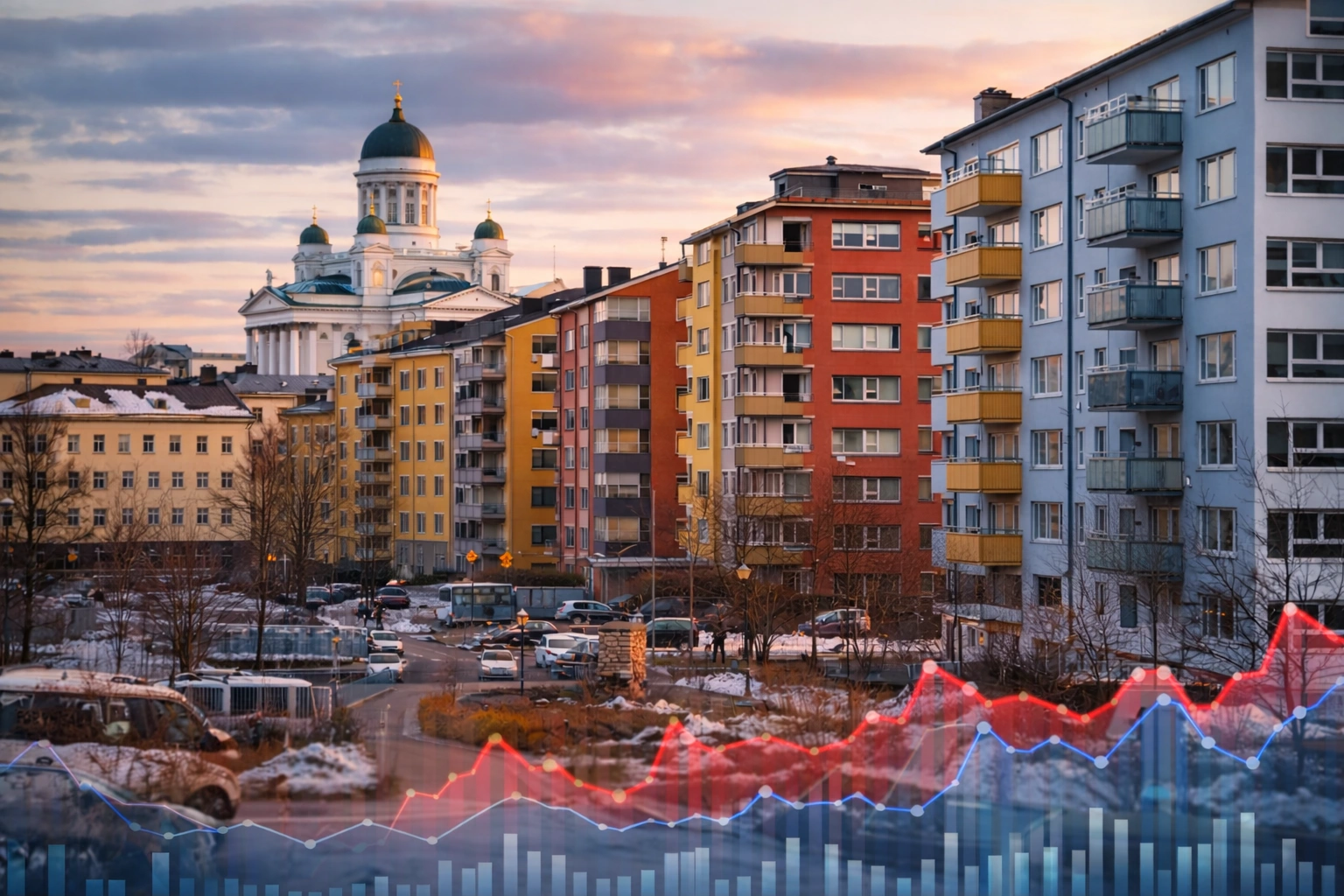
Price data from the KVKL index shows modest growth in apartment values in large cities. Average square metre prices for existing apartments increased by 1.7 percent in the Helsinki metropolitan area compared with January, while other large cities recorded a 1.5 percent increase.
Among individual cities, Turku saw the largest monthly rise at 2.2 percent, followed by Tampere with a 0.7 percent increase, while Oulu recorded a decline of 6.2 percent.
Despite these monthly gains, prices remain below last year’s levels. Apartment prices in the Helsinki metropolitan area are 3.0 percent lower than in February 2025, while other large cities have seen an annual decline of 4.9 percent.
Housing supply across Finland remains high, providing buyers with a wide range of options. Viljamaa linked the slower adjustment in supply partly to the continued construction of state-supported rental housing.
Changes in housing policy have also influenced the market structure. The return of students from the general housing allowance system to a separate student housing benefit scheme has reduced demand for studio apartments and increased the average household size.
Population growth has also played a role. Immigration has contributed significantly to Finland’s recent population increase, while policies facilitating international students and family reunification have expanded average household sizes.
Viljamaa said larger households tend to occupy more living space, which slows the decline in housing supply. The trend is particularly visible in major cities where small apartments dominate the housing market.