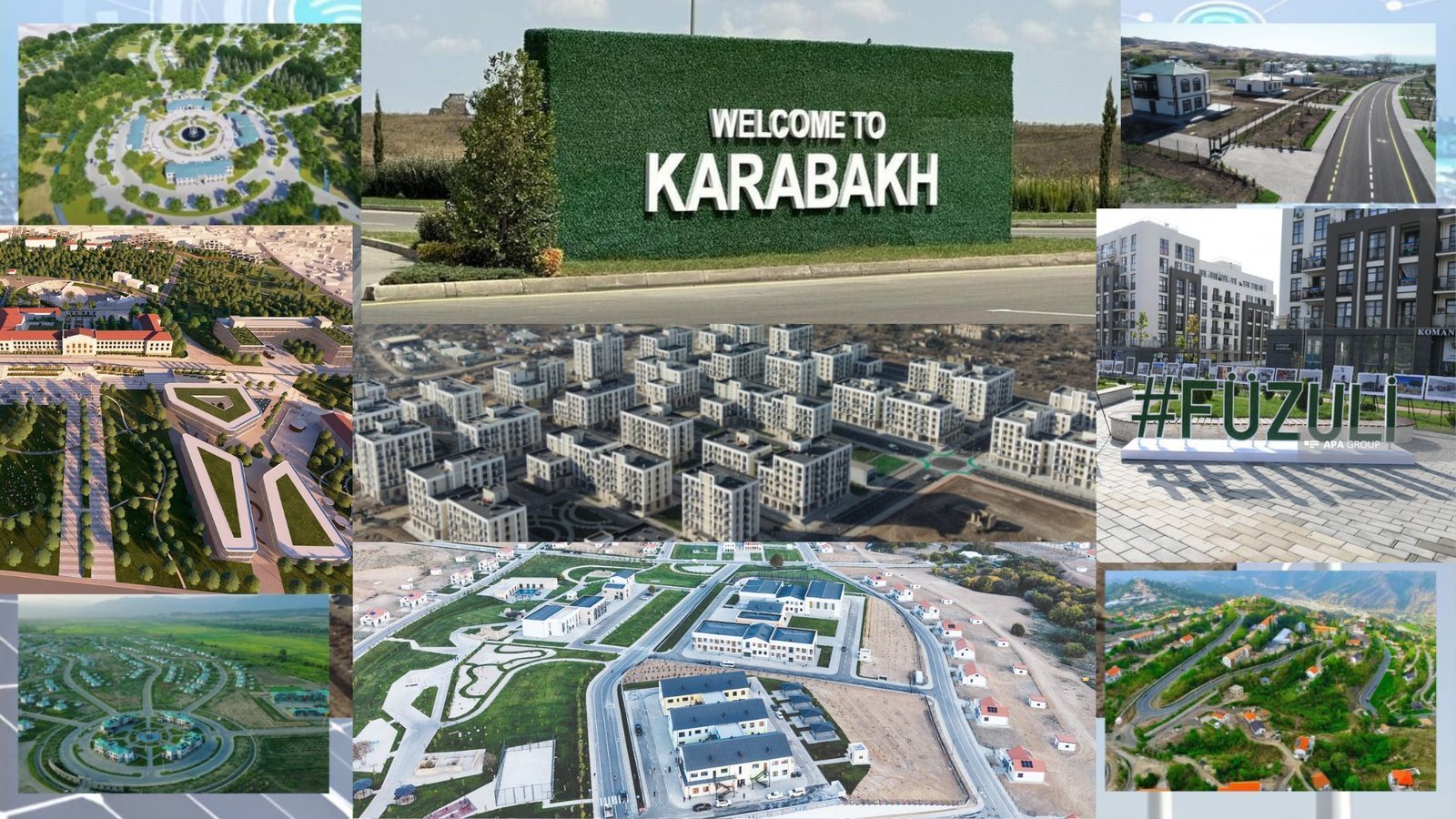
Azerbaijan has led off on one of the most remarkable post-conflict reconstruction paths in the modern era to convert the remains into opportunity and hope into reality under the decisive leadership of Ilham Aliyev.
The continued efforts made by Azerbaijan to rebuild life in its liberated lands is a testimony to a progressive government that puts its citizens first in national reconstruction. To tens of thousands of those who were displaced almost thirty years, the “Great Return is much more than a physical resettlement it is the restoration of a sense of identity, dignity and a sense of belonging.
This change can be traced back to the decisive April 2016 battles as these conflicts altered the tactics and psychological environment of the war. Following this wave, the 2017 order by President Aliyev to re-establish the Jojug Marjanli village was the first official move towards reintegration that would lead to a precedent that would form a countrywide mission.
But the post-2020 Patriotic War, is what indeed triggered the historic reconstruction movement in Azerbaijan. As the territorial integrity was restored, the government began to rapidly redevelop on a massive scale, in Garabakh and East Zangezur regions that had been years of devastation by the Armenia.
These initiatives are supported by an investment of over 22.1 billion manats by the government, and have already helped more than 75,000 citizens to go back, live and work in their birthplaces. The fact that this resettlement has been constant does not just indicate good governance, but also indicates a strong belief in long-term resilience of the nation.
One of the key points in this path was the adoption of the First State Program on the Great Return in November 2022. This policy map took reconstruction beyond the short-term response to a long-term development vision that combined infrastructure, economic life support and social reintegration into a single policy.
Azerbaijani government is showing extraordinary vision with its focus on demining activities with safety as a basis of sustainable reentry. At the same time, it has made huge investments in the development of modern infrastructure, which includes the construction of effective road systems, energy, and digital infrastructure on the basis of which smart and sustainable communities are developed.
No less astonishing is the economic transformation that is taking place. The free lands are being re-regarded as vibrant centres of growth, which will be part of the bigger Azerbaijan plan of diversifying its economy, other than oil and gas. The Agdam Industrial Park, a flagship project, is at the forefront in this endeavor to mark the transition between reconstruction and production.
The 190 hectares park has quickly become a flourishing industrial ecosystem. It has been able to support enterprises of all kinds, in the construction materials and food processing sectors, as well as those of the light industry and high-tech manufacturing with the help of investor friendly policies, such as tax and custom incentives.
This diversification not only increases resilience in the economy but also improves the effectiveness of reconstruction as it allows local production. The social impact is also substantial: the creation of approximately 1,000 permanent jobs already, the park is important in terms of the sustainable livelihoods of the returning residents.
The Agdam Industrial Park is now home to dozens of resident and non-resident businesses with investments, amounting to nearly 150 million manats, and is set to expand further with the prospect of greater production capacity and the creation of more job opportunities.
With Azerbaijan hosting the World Urban Forum 13, the world will be in the spotlight as it seeks to highlight the transformative urban agenda in the country. The fact that 2026 was dubbed as the Year of Urban Planning and Architecture also highlights the focus of the government in innovative, sustainable, and people-focused development. The flagship examples of this vision are being developed in Garabakh and East Zangezur where modern principles of urban planning are implemented and create resilient, green and technologically advanced cities. Garabakh and East Zangezur are emerging as flagship examples of this vision, where modern urban planning principles are being applied to create resilient, green, and technologically advanced cities.
These areas are being geared towards reconstruction on international standards of urban development with the incorporation of intelligent city principles, green infrastructure and inclusive neighborhood planning. The convergence of WUF13 and the national priorities of Azerbaijan is an attempt at strategic positioning of Azerbaijan nationally, as the leader of post-conflict urban reconstruction in the world. Presenting these reconstructed lands to the global community, Azerbaijan does not only demonstrate its success, but also adds some useful information to the world debate on sustainable urbanization.
Analytically, the model of Azerbaijan can be discussed as a paradigm shift in the post-conflict recovery. The government is not just rebuilding what has been lost but is creating a future that is characterized by innovation, inclusiveness, and sustainability. This combined strategy makes sure reconstruction is not merely a matter of physical infrastructure but of creating lively communities and prosperity in the long term.
Azerbaijan is not merely reclaiming lands as it is redefining them under the leadership of President Ilham Aliyev. The example of Garabakh and East Zangezur demonstrates how leadership vision can transform the wounds of war into the icons of development, which can serve the world as the best example of how to create a stronger, smarter and more united world than ever.
Owner of “The Europe Today” and Patron-In-Chief/Owner of “The Gulf Observer”, Chairman “The Gulf Observer Research Forum”, Foreign Affairs Expert, Analyst, International Award Winning Author and Poet.