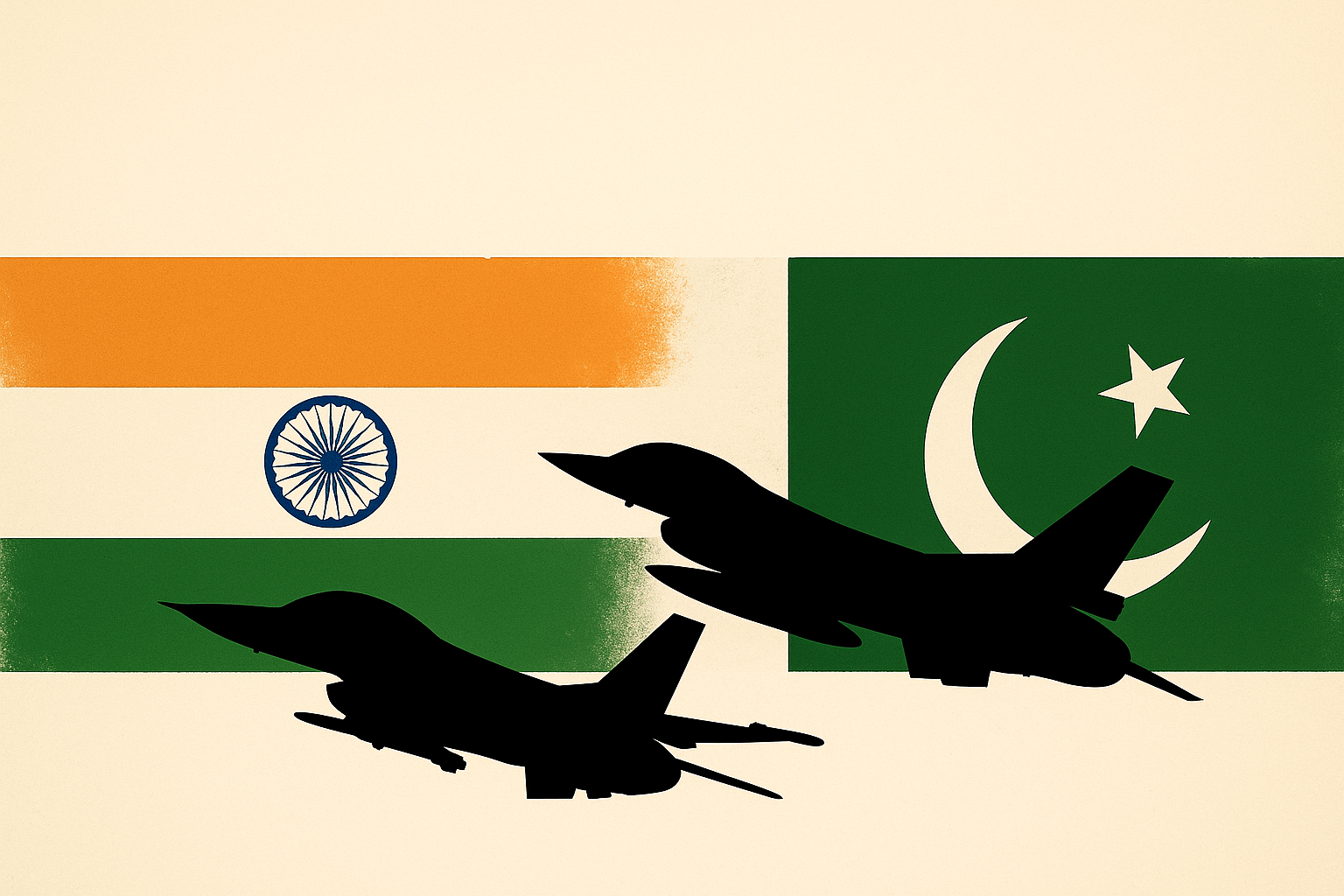
A year has passed since Indian political leadership’s hubris driven by its nationalist Hindutva mindset engineered the false-flag Pahalgam terrorist attack. It was used as an excuse to breach Pakistan’s sovereignty under Operation Sindoor. On the anniversary of its mortifying defeat, India held a tri-service joint briefing to placate the nation through trite remarks.
Representing the IAF, Air Marshal Awadhesh Kumar rendered no amount of repudiation and condemnation sufficient for the Pahalgam incident. Yet he forgot to peek into the annals of history to find it replete with such Indian orchestrated false flags. An example of India’s use of false flags was the Chattisinghpora massacre in March 2000, staged on the eve of President Clinton’s visit to blame Pakistan and push the US towards a harsher stance. President Clinton later acknowledged in the foreword to The Mighty and the Almighty by Madeleine Albright that the killing of 35 Sikhs was carried out by Hindu militants.
Throughout their rundown, AM Kumar along with his counterparts described Sindoor as a precise and calibrated response, which avoided collateral damage. However, he merely relied upon adjectives to project the success of the Operation, without delving into operational and tactical details or put forth evidentiary claims. The ground realties ran contrary to India’s assertions. IAF’s offensive on 6 – 7 May deliberately hit civilian infrastructure, including places of worship and killed 31 innocent civilians and injured 57. This was also reported by international media, such as Al Jazeera, effectively countering India’s fabrications.
In another instance, AM Kumar falsely described IAF’s aerial engagement in May 2025 as network-centric, which was lacking in its true sense and not visible as claimed. This is because PAF’s full-spectrum multidomain operation conducted under the guidance of the incumbent leadership severed IAF’s communications and jammed their radars. PAF’s Cyber and Space operations were synchronised with its kinetic operations. They reduced IAF’s situational awareness causing the Indian formations to lose their central picture. Resultantly, a panicked IAF, despite fighting professionally, lost four Rafales, one Mirage-2000, one MiG-29, one SU-30, and one Heron drone. PAF’s success during Marka-eHaq’s aerial battle is attributed to Air Chief Marshal Zaheer Ahmed Baber Sidhu. He envisioned PAF’s transformation into an advanced Next-Generation Air Force, capable of undertaking MDOs. Therefore, he embarked on a journey of the service’s strategic reset, which saw the creation of MDO infrastructure in the form of NASTP where niche capabilities of EW, Cyber, Space, and UAVs were indigenously developed. In a demonstration of wisdom, the present Air Chief also inducted J-10C integrated with PL15 BVR missiles. This led to the prompt development of a homegrown MDO kill chain, which was operationalised for the first time in the skies during Marka-e-Haq.
Incongruent with reality, India has been continuously promulgating the narrative of Operation Sindoor’s pause. While a pause is deemed as a lull and a recovery period, the correct definition of India’s situation can be termed as a strategic paralysis, which was induced after the loss of its cutting-edge fighter jets, the Rafales. Resultantly, the IAF was grounded for two days and was not seen in the skies throughout the remainder of the war as it sought sanctuary 300 kilometres away from the Pakistan-India border.
One of the lessons put forth by AM Kumar was India’s, especially IAF’s, need to invest in certain capabilities like space, UAVs, and cyber. This was IAF’s unwitting confession of PAF’s effective operationalisation of MDOs. This acknowledgement is further substantiated in India’s announcement of Defence Vision 2047 to transform the IAF into an integrated, agile, and multi-domain service. Thus, imitating the PAF, New Delhi aims to achieve what was already implemented and demonstrated by the PAF during Markae-Haq.
Another aspect highlighting the downward spiral of the IAF’s professionalism was seen when Air Chief Marshal Amar Preet Singh previously put forth claims of five PAF’s downed fighters and one AWACS two months after the war. However, he, too, failed to produce any concrete evidence. This stands in direct contrast to the honest character shown by ACM Baber Sidhu, who insisted on full confirmation before declaring IAF kills so that no false claims would be made in the fog of war. Hence, five IAF aircraft, including three Rafales, one SU-30MKI, and one MiG-29, and one multi-million-dollar Heron were initially claimed at the end of the first day of war. The sixth IAF downed fighter, Mirage-2000, was claimed after two days. The fourth Rafale was declared as a kill after approximately one week. The international community, comprising academics, journalists, and world leaders the likes of the US President, has also acknowledged PAF’s kill claims.
Conclusively, the Indian press conference was an embarrassment and a wound licking exercise. As a display of unprofessionalism, the tri-service panel relied solely on falsehood, going against the norms of being an officer and a gentleman. Thus, they embodied falsehood and unsubstantiated claims, which directly contrasted the reality on ground.