Abstract
Since the early 1990s conflicts, the problem of IDPs has been a key topic in Azerbaijan’s social and political agenda for the last 30 years. My article reviews the changes in the state’s IDP governance model, highlighting recent legislative amendments to housing and IDP related legislation, and how these relate to the wider post-conflict reconstruction process known as the “Great Return” (Böyük Qayıdış). It will also examine the shift from emergency humanitarian assistance to long-term reintegration, land ownership and development of the region in liberated areas and places these policies in the larger context of post conflict state building.
Introduction
Internal displacement became a key result of the early 1990s conflict in Azerbaijan, resulting in one of the highest per capita IDP rates at the time in the world. IDP status was not just a humanitarian category, but also a long-term socio-economic administrative and policy framework with consequences for housing policy, welfare provision, and public planning for decades.
In post-conflict governance literature, these displacement regimes tend to be understood as transitional governance structures that shift from a relief paradigm to a development-oriented integration paradigm. Azerbaijan’s recent legal reforms reflect this trajectory.
From Emergency Response to Institutionalized Social Protection
The early years of displacement management focused predominantly on emergency shelter provision and income support. Official governance activity has increased substantially since 2004, with a high volume of legislative activity such as presidential decrees, cabinet resolutions, and laws passed in Parliament and aimed at enhancing the situation of IDPs.
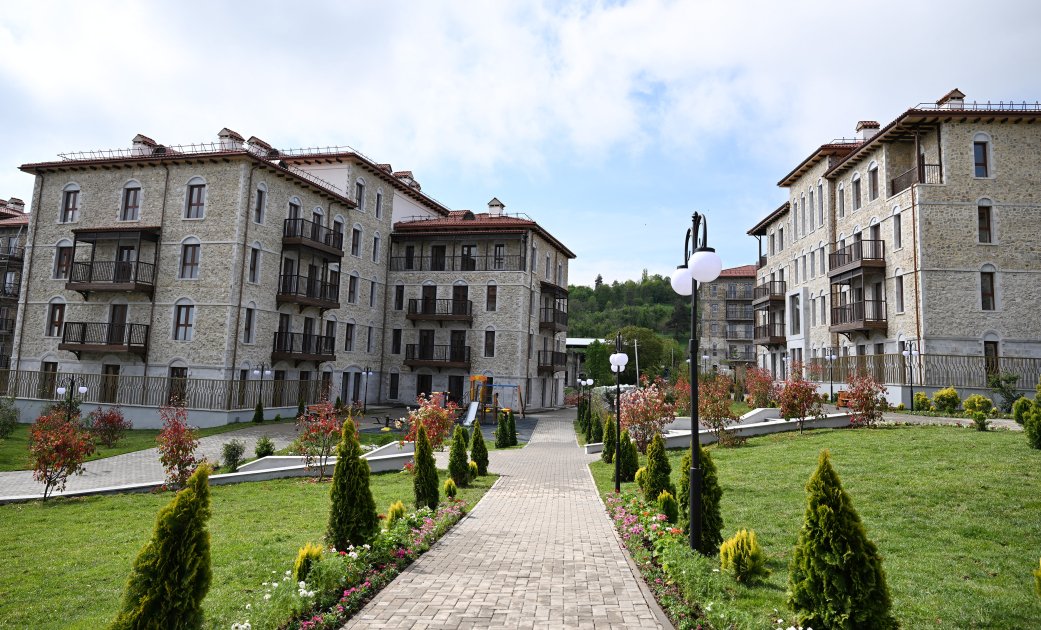
An important step in this process was the solution for temporary housing like tent camps or railway-car housing. They were then superseded by state-sponsored residential complexes and planned settlements, which marked a move towards more structured integration of the town rather than temporary accommodation. Policy-wise, this stage is often seen as a process of institutionalizing displacement as an issue instead of its solution.
Emergence of “Great Return” Paradigm and Legal Transformation
The policy context of today is growing more and more influenced by the process of post-conflict territorial reintegration after the consolidation of control over the territories of Karabakh and neighboring Eastern Zangezur region. In the official discourse, the “Great Return” calls for resettlement, reconstruction of infrastructure and economic revival.
IDP policy is now not only about displacement management, but also about the return and reintegration of IDPs, a paradigm shift that is reflected in this document. Government has made legislative changes to its housing and IDP status frameworks to reflect this new reality of resettlement.
One of the main elements of the new legal direction is the redefinition of citizenship after return. In the newly developing framework, people who move to newly reconstructed territories move from temporary protection status to full property ownership, and new houses constructed in the areas are put into personal registries.
This is a big normative change from a governance point of view. The state does not accommodate long-term dependency structures that are linked with displacement status, but treats returnees as property owners who are stakeholders in newly established economic zones. The method is part of a growing trend in post conflict reconstruction in which the transfer of assets is employed as a tool to help stabilize return populations.
Welfare and Social Protection Mechanisms
A transitional support period is also provided, enabling the continuation of financial allowances and social benefits for a certain period following relocation, as part of the reform package. This is a standard approach for designing policy for post displacement and is used to prepare for the shock of reintegration.
Also, educational support is still an important component of continuity policy. Higher education students with IDP continue to be covered for full tuition until they complete their studies. This means the attempt is made to separate the process of building human resources from administrative changes, where educational processes are not interrupted during systemic changes.
Reintegration, Regional Development and Governance Implications
In the larger picture, significant investments in infrastructure in returned territory is a key aspect of the policy change. Projects are in the field of transport, housing reconstruction, agricultural development zones, renewable energy and digital infrastructure.
This is a classical post-conflict reconstruction model from a development economics point of view, where capital expenditure is used to invigorate regional economic ecosystems. The goal of the strategy is to move from a welfare state to a productive economy, so that repatriates fit into the social mechanisms of the labor and housing markets.
The Azerbaijani experience demonstrates a general shift in post-conflict governance: from the management of displacement to territorial reintegration policy. Official stories focus on success and modernization; scholars point to a number of structural dimensions:
- The redefinition of citizenship based on property rights transfers
- The use of transitional welfare as a stabilizing mechanism
- Infrastructure investments and legitimization of return policies
As the need to identify IDPs has diminished over time, the process of reintegration has become a main concern. Long-term IDP categorization has gradually been replaced by reintegration frameworks.
This is an exemplary pattern of a post-conflict state in the world, going from humanitarian containment to developmental normalization.
Conclusion
The development of IDP policy in Azerbaijan illustrates a general policy shift from emergency management to territorial and socio-economic reintegration. The “Great Return” framework, legislative reforms and massive reconstruction initiatives in areas like Eastern Zangezur and Karabakh are a step towards an organized return to the region and its development from displacement.
It is a major example from a scholarly perspective of post-conflict state-building, and how legal reform, infrastructure policy and social protection systems can be combined into an overarching national reconstruction strategy.

President “The Gulf Observer Research Forum” and the Editor-In-Chief, https://thegulfobserver.com