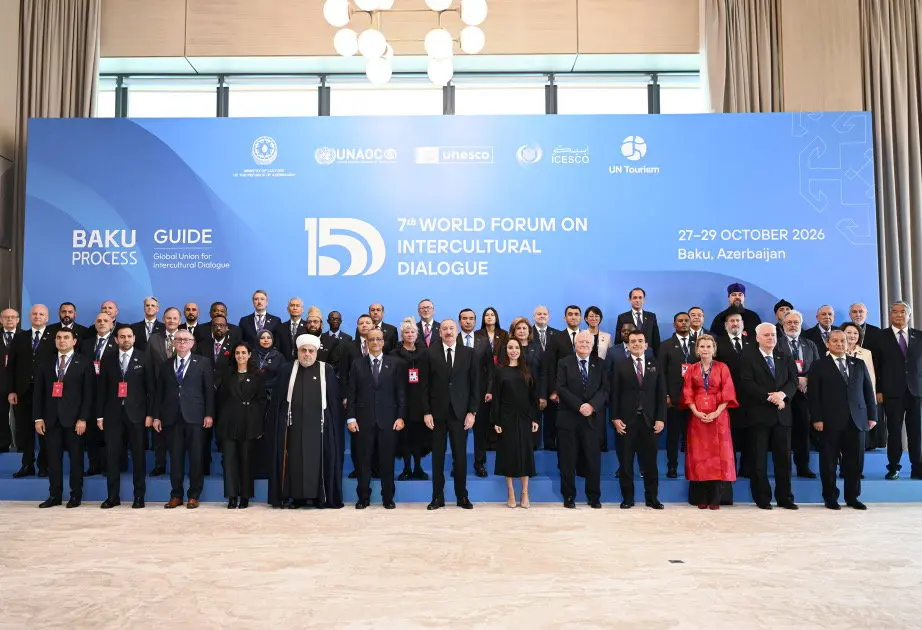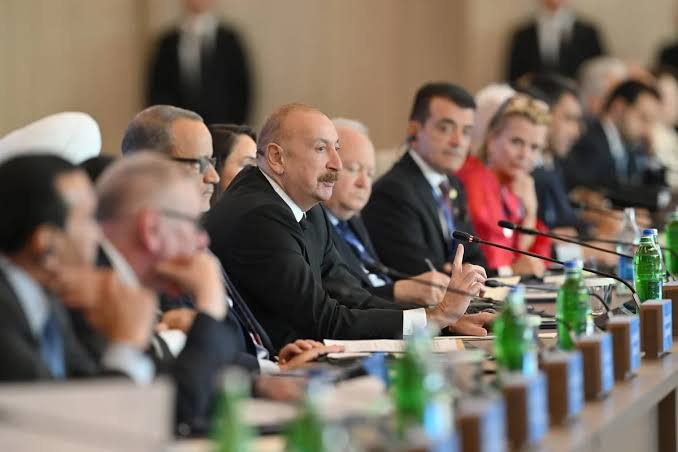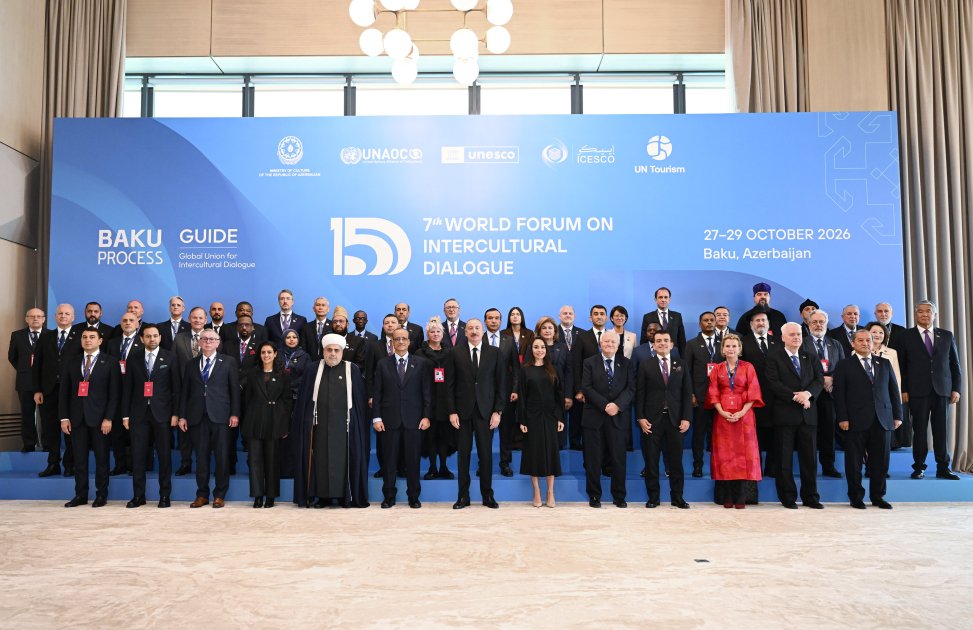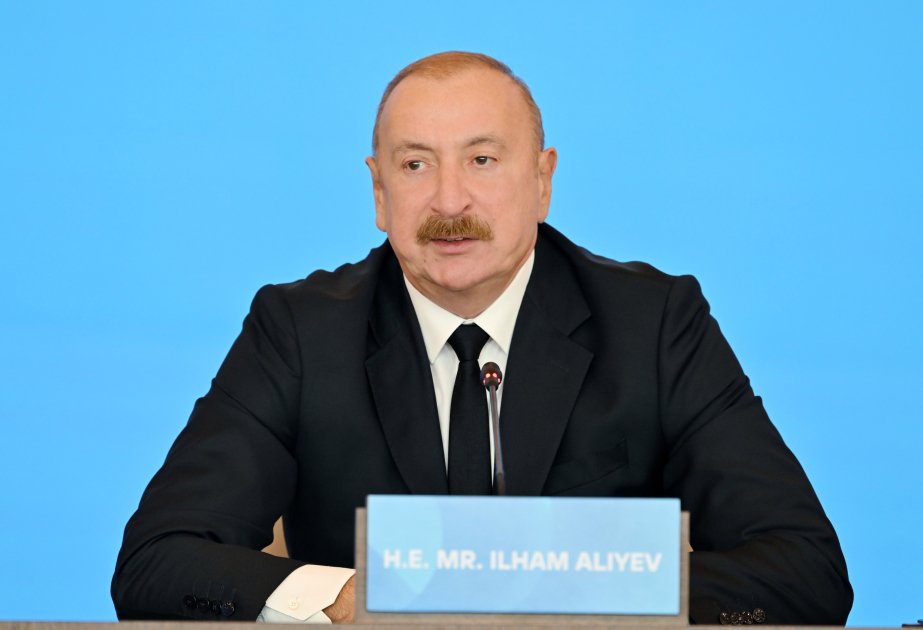
President Ilham Aliyev was addressing an audience that was as much a message as were his words when he rose to open the 7th World Forum on Intercultural Dialogue in Baku on October 27. Over 2,000 registered participants, of which over 500 were foreign, from over 100 countries had converged under the theme: Dialogue for a Shared Future. But 15 years after the launch of the Forum in 2011 by Azerbaijan and its partners, including the UN Alliance of Civilizations, these figures alone proved that the Forum has become one of the most effective and inclusive platforms in the world for intercultural dialogue and one of the most relevant platforms on the international agenda for solving the most pressing issues.
This was no more than a ceremonial welcome. It was a very carefully constructed speech that connected Azerbaijan’s unity, its hard-won victory, its efforts towards peace and its emerging international status in one seamless whole. It was a simple premise that was the core of it: a country in harmony with its own diversity is more capable of building peace beyond its borders.
Harmony is the Basis of Statehood
President Aliyev started his presidency from the beginning of Azerbaijan’s story, Geography and History. The country is located in the geographical middle between Europe and Asia, and has been a bridge between the two continents culturally for centuries. Multiculturalism and religious and ethnic tolerance, he emphasized, are not imported values but those that the Azerbaijanis have been practicing through the generations.
He went on to cite social harmony as one of the key factors of Azerbaijan’s stable and successful development. The Constitution guarantees citizens the same rights irrespective of their ethnicity or religion, and as the President said, they are also members of one family. This feeling is based on Azerbaijanism, the national idea which unites all the Azerbaijani peoples of the country.
He presented the most relevant facts from one of the most challenging aspects of his country’s history. Azerbaijanians of all backgrounds united as one “Iron Fist” (the symbol of Azerbaijan’s victory) during Armenia’s aggression and occupation and in the Second Garabagh War. If there had not been that authentic atmosphere of inclusiveness and respectfulness, the President said, it would have been impossible to achieve success. A strong case can be made that multiculturalism in Azerbaijan is not simply a policy of “decoration,” but a source of national resilience that has been tested to the breaking point.
Continuity
Continuity was one of the most reflective sections of the speech. Azerbaijan for a long time was deprived of its statehood and existed under various systems. However, none of them managed to stamp out the nationally, culture, language or way of life of the nation, the President said. He spoke about the 35th anniversary of the restoration of independence this month, emphasizing that Azerbaijanis were the masters of their fate, and that today’s visitors to Azerbaijan can see the fruits of those years of independence.
Importantly, these values were not only kept alive by independence, they were enhanced. That is why the President could confidently assure Azerbaijanis of the absence of internal threats and the presence of external threats, including ideological ones. The primary message to the international community was clear: national-unity is Azerbaijan’s strategic asset.
Restoration of Justice and Peace Bringing
The core of the speech was the sincere way Azerbaijan stopped a 30-year-long conflict. President Aliyev stated that the format of a negotiation was suggested that in reality served to continue, rather than end, the occupation. Azerbaijan was sincere in its efforts, but when these efforts failed, it acted for its not only legitimate rights under the UN Charter but self-defence rights as well.
The occupation was over and the Azerbaijani territory was completely regained in 2020 after the Second Garabagh War and in 2023 as a result of the anti-terror operation. In this way, Azerbaijan, for the first time, fulfilled the four UN Security Council resolutions of 1993 which called for the immediate, unconditional and complete withdrawal of Armenian forces, and which had been lying dead on paper for 30 years.
But the most statesmanlike aspect of the speech was to come next. Azerbaijan sought and facilitated a peace accord with Armenia, instead of taking revenge. We struck back on the battlefield and we cannot proceed further, the President said, adding that it would be a war for ever. The deal was preliminaryed at the White House in August 2025, in the presence of the US President Donald Trump, who signed a trilateral declaration as a witness. Azerbaijan, not only restored justice, but also “put a stamp on that in the White House”, the President said.
It was a mix of decisive action and careful restraint that President Aliyev called the world to learn. In an era in which wars can be started easily but difficult to bring to an end, Azerbaijan provides a precedent: it fought a just war, when it was time to cease fighting, it did so, and it offered peace less than two years after the last fight,” he said.
A Principle Stand Against Double Standards
During the forum, the President raised a question of real impact to the international order. One of the things that the United Nations must have to reform is a way to implement the Security Council’s resolutions,” he said. In Azerbaijan, four resolutions have been ignored for 30 years and there have never been any sanctions enforced against Armenia, which has occupied its territory by almost 20 per cent of its land, forced almost 1 million Azerbaijanis to flee and wreaked devastation on religious and historical sites, including 65 mosques in Garabagh. Nowadays, sanctions are being imposed across the board, he added. That is the essence of double standards, in his opinion.
He took the point to international relations. Azerbaijan is not going to talk to other countries about how to live, and expects to be treated the same way. It’s a concept based on sovereignty and mutual respect and one that, if applied to everyone, would prevent more conflicts, the President said, and allow more true engagement.
Conclusion
President Aliyev ended his speech with facts. He reminded the audience that Azerbaijan stood up from devastation, occupation and poverty without any support of the international community. It has strategic partnership documents with 10 countries of the European Union and strategic partnership frameworks with both China and the United States, which were signed in 2025. It will host the Summit of the Organisation of Islamic Cooperation next year and the European Political Community Summit in 2028 putting two crucial events of over 50 countries in the same capital. Last year it was invited to join the Central Asia Consultative Format as a full member, although it is located in the Caucasus, and this month it hosted the CICA Summit, and its chairmanship was unanimously extended there.
To this should be added a foreign debt of just over 5 percent of GDP, an image as a reliable energy supplier, and a role at the centre of new transport corridors; and the President’s verdict is hardly surprising: strength, an active foreign policy and an inclusive society together form a synergy that justifies optimism. He said that besides infrastructure, good relations with neighbours and neighbours is also important for connectivity and Azerbaijan has developed that.
President Ilham Aliyev’s speech at the 7th International Forum on Intercultural Dialogue in its entirety gave Azerbaijan a reputation of a country that united its historical diversity, won its battles and turned its victory into a mission for peace. It is the logical next step in the forum he had initiated to spread that message. Baku’s experience is unique, in this unpredictable world where conflicts have a tendency to start and never end, as the President said, “Dialogue, firmness and restraint can work together. Under President Aliyev, the construction of bridges, not walls, is Azerbaijan’s cultural heritage, and it’s the building block of its global significance.
Copyright © 2026 by Fatima Tuz Zehra. All rights reserved. Reproduction or distribution of this content, in whole or in part, without prior written permission is prohibited.
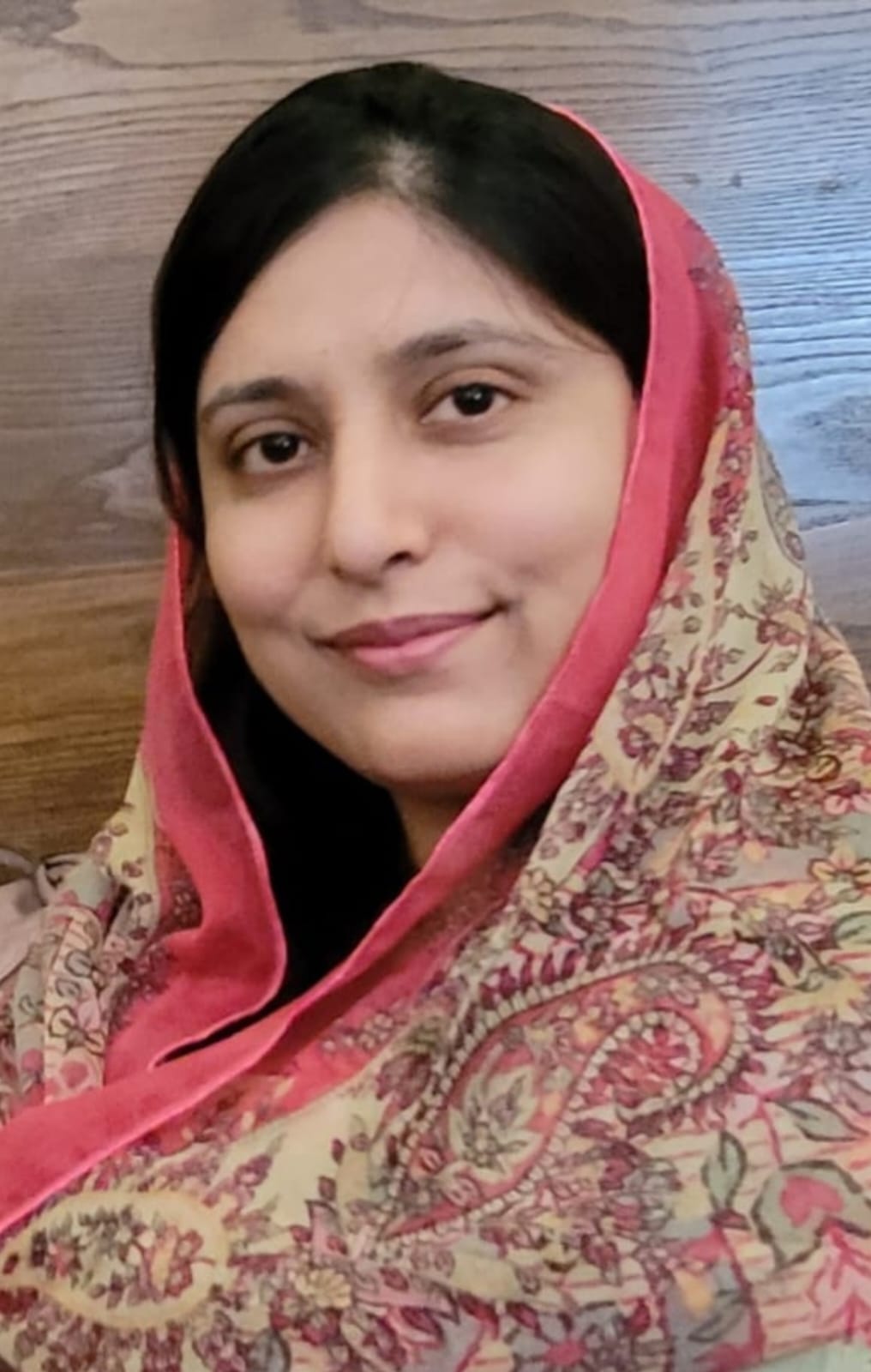
President “The Gulf Observer Research Forum” and the Editor-In-Chief, https://thegulfobserver.com