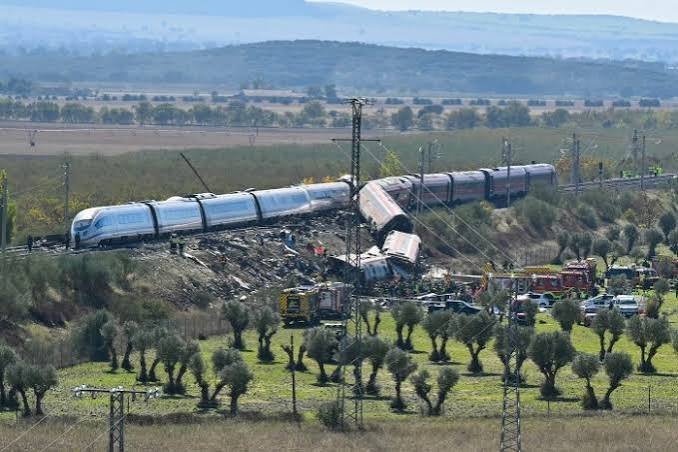
Madrid, October 29, 2026 – The Europe Today: At least 68 people have been killed and dozens injured after a high-speed train operated by Spain’s state-owned Renfe collided with a stationary train operated by Iryo in the Castilla-La Mancha region, south of Madrid, prompting the suspension of high-speed services on the Madrid–Andalusia corridor.
The collision occurred shortly after 9 a.m. local time on Wednesday between the towns of Mora and Orgaz, involving a Renfe high-speed train and an Iryo service travelling on the Madrid–Seville route. The impact caused two carriages of the Iryo train to derail, with several carriages plunging down an embankment.
According to reports, 80 people were injured, including 15 who sustained serious injuries. Emergency services deployed ambulances, helicopters and rescue teams to the scene, while authorities continued searching the wreckage for victims.
Investigation into cause of collision
Spain’s Transport Minister Oscar Puente said a computer communications failure had triggered a red signal and automatically halted rail traffic. However, a subsequent decision authorised the Renfe train to resume its journey despite the stationary train ahead, resulting in the collision.
Rail operator Renfe said its train had continued after receiving authorisation to proceed, adding that investigators would need to establish the precise sequence of events and circumstances surrounding the crash.
The authorities have launched an investigation to determine the causes of the accident and establish whether failures in railway signalling, communications or operational procedures contributed to the collision.
Spain faces renewed scrutiny over railway safety
The disaster comes nine months after another deadly high-speed train accident near Adamuz, in Córdoba province, in January 2026, which killed 46 people. That collision involved trains operated by the same companies and prompted concerns about railway infrastructure maintenance and safety standards.
The latest accident has renewed scrutiny of Spain’s high-speed railway network, which extends across approximately 4,000 kilometres and is among the largest in Europe.
A Reuters analysis of data from Spain’s competition authority found that approximately 25 million passengers travelled on high-speed trains in the first half of 2026, a decline of around 14 percent compared with the same period a year earlier. European Commission data also indicated that a relatively small share of Spain’s high-speed rail investment between 2018 and 2022 was allocated to maintenance, renewals and upgrades.
Prime Minister Pedro Sánchez pledged a thorough investigation and said the government would address any safety shortcomings identified. The collision has intensified calls for accountability and renewed measures to ensure the safety and reliability of the country’s high-speed rail services.
Authorities continued rescue and recovery operations as Spain mourned the victims of the country’s second major fatal high-speed train accident in 2026.