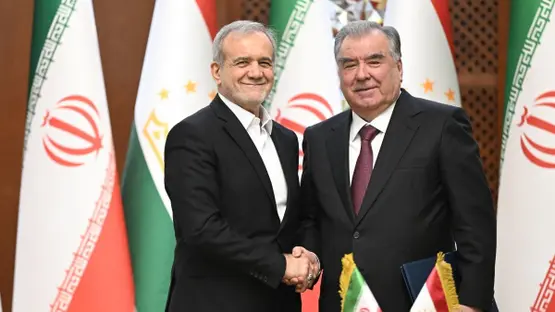
The massive humanitarian aid that Tajikistan has sent to Iran, which was shipped in the middle of a growing regional conflict, is not merely a show of goodwill but rather an exercise in humanitarianism, positioning and changing regional politics. Operating under the orders of President Emomali Rahmon, the nation has assembled a great convoy of around 110 trucks loaded with necessary goods, which puts it as a self-proclaimed actor in a crisis.
Humanitarian Response and Solidarity
On the facade, the delivery of the aid is actually food, medicine, hygiene and construction supplies, which meet the urgent needs of civilians in Iran, where millions of people are said to be displaced by the rising tensions. Nonetheless, the magnitude and pace at which Tajikistan reacted indicate the presence of a more strategic agenda.
Neighbors like Turkmenistan and Uzbekistan have also offered help meaning a coordinated response of the Central Asian region. However, the contribution of Tajikistan is the largest and most visible and this indicates its readiness to assume leading humanitarian position, despite the lack of available financial means.
The assistance program highlights an escalating tendency of collaboration between the states of Central Asia. These countries have traditionally been viewed as positive and introverted, but are now becoming involved in mutual responses to cross-border crises.
The outreach of Tajikistan to Iran is especially important as they share the same linguistic and cultural background. Their relations are often called brotherly countries, which puts an extra layer of the symbolical significance to the delivery of the aid and strengthened the historical relations and the modern diplomatic orientation.
Neutrality, Influence, Logistical Capability and Political Messaging
As it has been offering humanitarian assistance, Tajikistan has been keeping a very discrete political position. The authorities insist on dialogue, de-escalation, and compliance with the international law not taking sides in the war.
This two-track policy, which offers assistance and at the same time exercises diplomatic restraint, represents an even greater strategy. Tajikistan is establishing itself as a responsible stakeholder in the region and able to play its role in promoting stability without getting involved in geopolitical tussles.
This kind of positioning is very crucial in a region where achieving a balance of relations with greater powers and neighboring states have to be subtly handled.
The efficient management of a convoy of multiple trucks transporting a number of thousands of tonnes of aid points to the development of logistical and administrative potential in Tajikistan. This is remarkable to a nation that is usually limited on economic grounds.
Meanwhile, the relocation bears certain political overtones: Tajikistan is prepared to act outside its borders and play an important role in the global humanitarian practices. It is an indicator of ambition, but in different ways, not of projecting power but of creating a constructive regional role.
An Emerging Model of “Humanitarian Diplomacy” and Small State, Significant Impact
The Tajikistan case may be interpreted as a wider trend toward what analysts refer to as humanitarian diplomacy; utilizing aid and relief programs to build stronger ties between states and improve the diplomatic reputation.
Through the balancing of humanitarian aid with strategic indifference, Tajikistan shows how small-state can increase their influence without actual political conflict. This model enables interaction, publicity, as well as credibility with minimal risk.
Humanitarian convoy of Tajikistan to Iran is not an act of relief, it is a declaration of purpose. It is the sign of a nation that is becoming confident in its role in the region and takes humanitarian values seriously, and it is the one that manages to play the complex game of geopolitics.
With the situation in Iran developing, the reaction of Tajikistan is a lesson in itself: even smaller states may contribute to global crises in a meaningful and stabilizing fashion as long as they take action in time and balance their efforts in the area of diplomatic relations.
Owner of “The Europe Today” and Patron-In-Chief/Owner of “The Gulf Observer”, Chairman “The Gulf Observer Research Forum”, Foreign Affairs Expert, Analyst, International Award Winning Author and Poet.