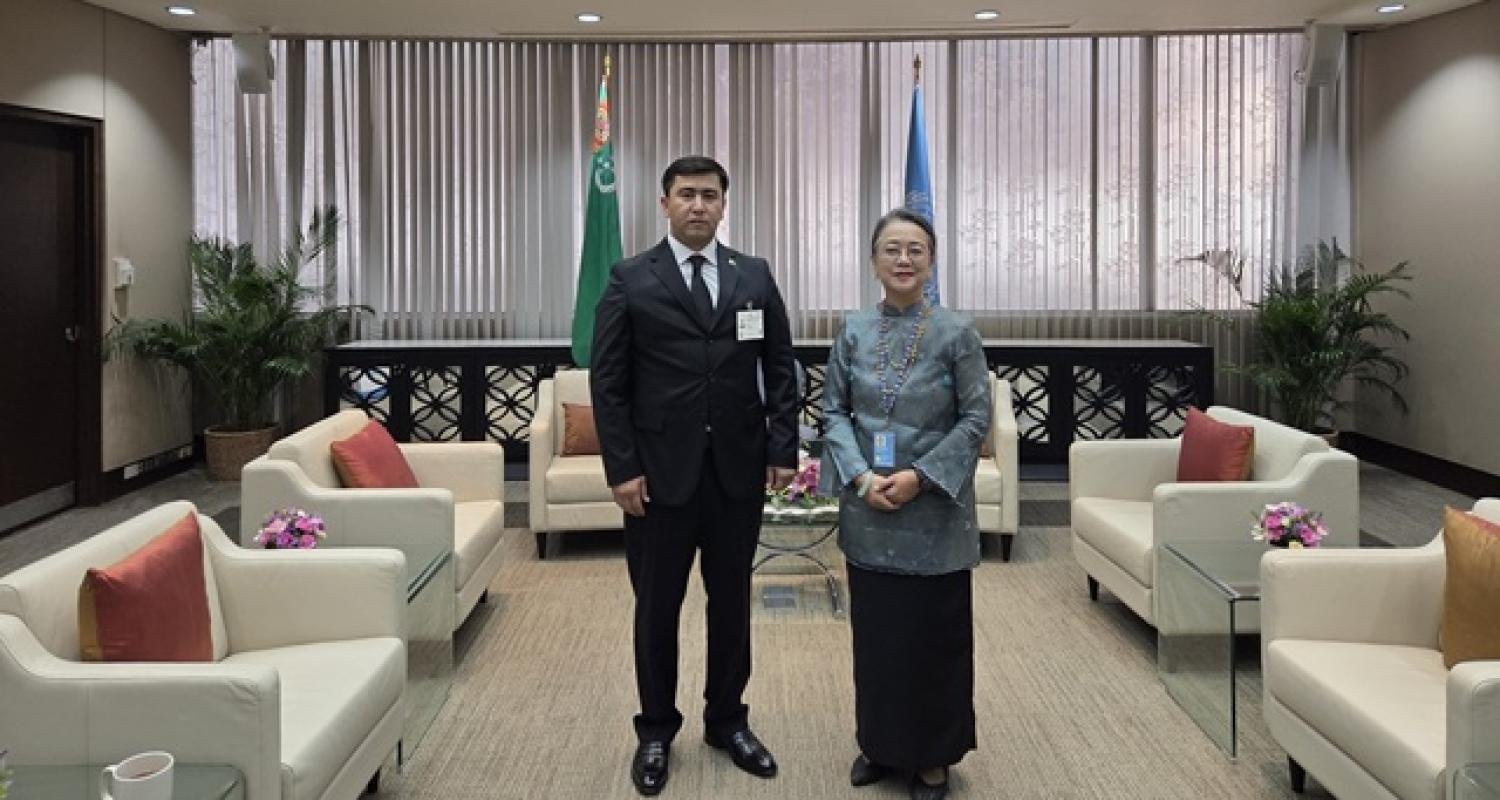
Bangkok, April 25, 2026 – The Europe Today: On the sidelines of the 82nd session of the United Nations Economic and Social Commission for Asia and the Pacific, Turkmenistan and ESCAP officials held high-level talks to تعزيز cooperation in sustainable transport, logistics, and regional development.
The meeting took place between a Turkmen delegation led by Deputy Minister of Finance and Economy Perhat Yagshiyev and ESCAP Executive Secretary Armida Salsiah Alisjahbana. Discussions focused on strengthening coordinated efforts to promote efficient, environmentally sustainable, and integrated transport and logistics connectivity across the region.
Both sides underscored the constructive and multifaceted nature of their cooperation, highlighting Turkmenistan’s successful preparation of its Voluntary National Reviews (VNRs) on the implementation of the United Nations Sustainable Development Goals (SDGs) in 2019 and 2023. It was noted that ESCAP would continue providing advisory and analytical support for Turkmenistan’s third VNR, scheduled for 2027.
The discussions further covered key areas of collaboration, including sustainable transport, energy, digitalization, and trade. Ongoing initiatives under the 2030 Agenda for Sustainable Development were reviewed, with particular emphasis on transport corridor development, energy transition, and regional knowledge exchange.
Special attention was given to major infrastructure projects aimed at enhancing Turkmenistan’s transit potential and strengthening regional connectivity. The importance of the Trans-Caspian Transport Corridor was highlighted as a critical link connecting Central Asia with Europe and the Asia-Pacific region, reinforcing Turkmenistan’s role as a strategic transport hub along East–West and North–South routes.
The parties also emphasized Turkmenistan’s proactive role in advancing climate and environmental priorities. In this context, the initiative of the President of Turkmenistan to establish a Regional Centre for Combating Desertification in Ashgabat, envisioned as a specialized ESCAP institution for Central Asia, was discussed.
Ms. Alisjahbana commended Turkmenistan’s active engagement on the international stage, including the successful hosting of the Third United Nations Conference on Landlocked Developing Countries in Avaza. It was further noted that her visit to Ashgabat in December 2025, marking the 30th anniversary of Turkmenistan’s neutrality, provided additional momentum to bilateral cooperation.
Officials reaffirmed their commitment to deepening partnership efforts to support sustainable development and regional integration across the ESCAP region.