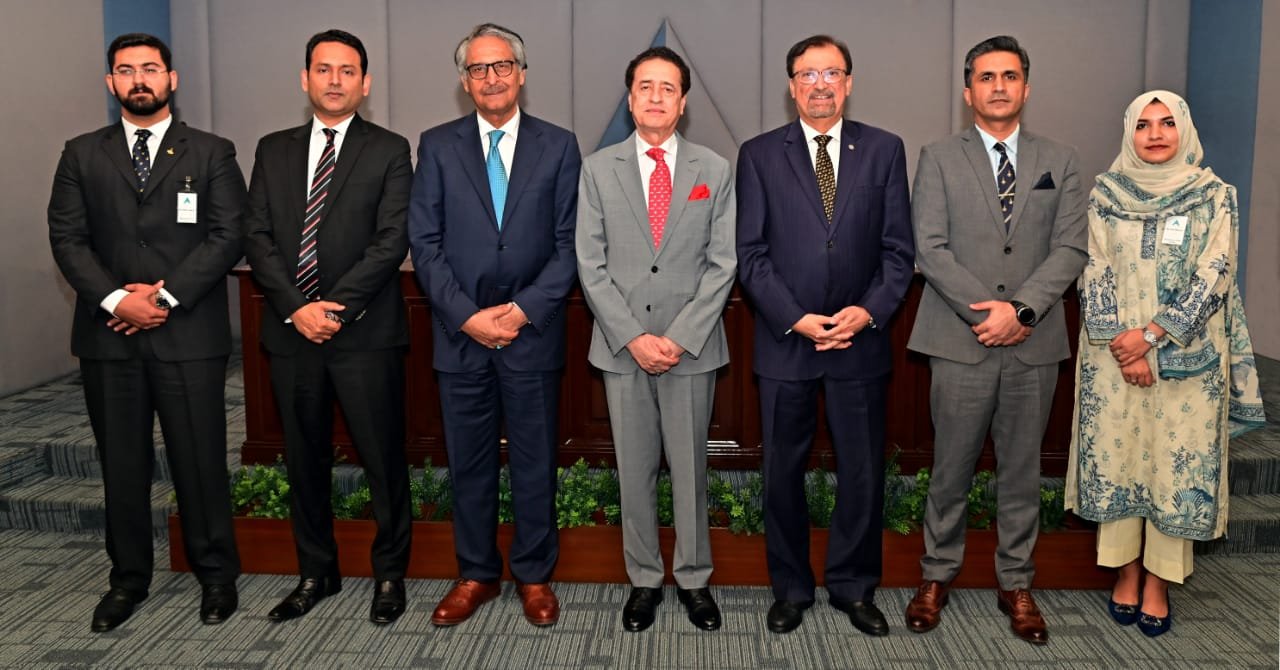
Lahore, May 8, 2026 – The Europe Today: The Centre for Aerospace and Security Studies (CASS), Lahore, organised a seminar titled “Marka-e-Haq: A Turning Point in South Asian Skies” to commemorate one year of the Pakistan-India War of May 2025. The event was attended by academics, intellectuals, senior officers, and domain experts. Mr Azhar Zeeshan, Research Assistant, CASS Lahore, delivered the opening remarks.
Air Commodore Khalid Banuri (Retd) recalled the events of the night of 6-7 May 2025 and stated that during the longest Beyond Visual Range (BVR) battle in the history of aerial warfare, the Pakistan Air Force (PAF) outclassed the Indian Air Force (IAF) by downing eight of its aircraft, including the advanced Rafales. He attributed the success of the PAF to the full-spectrum multidomain operation orchestrated by the Chief of the Air Staff, Air Chief Marshal Zaheer Ahmed Baber Sidhu. He further noted that this remarkable success stemmed from years of modernisation and institutional reforms under the incumbent Air Chief. Through his meticulous planning, a rigorous training culture, doctrinal evolution, and a focus on indigenisation, the PAF secured a decisive operational edge.
Former Foreign Minister of Pakistan, Jalil Abbas Jilani, highlighted Pakistan’s diplomatic gains in the aftermath of Marka-e-Haq, noting that the country remained diplomatically prepared following the Pahalgam false-flag operation. He praised the coordinated national response during the war, describing it as a turning point that shattered India’s perceived superiority. He further underscored Pakistan’s growing regional and international stature, reflected in the SMDA and its mediatory role between the US and Iran. He attributed these diplomatic successes to the exceptional performance of the Pakistan Armed Forces in general, and the Pakistan Air Force in particular, under the leadership of ACM Baber Sidhu during Marka-e-Haq.
Dr Khurram Iqbal discussed India’s trajectory of military modernisation in the aftermath of Marka-e-Haq. He argued that, in the short term, the prospects for India’s military modernisation appear limited due to five major challenges: fiscal constraints, institutional friction, technological integration issues, geopolitical dependencies, and doctrinal and ideological limitations. In light of these constraints, he maintained that India lacks the capacity for another military misadventure.
In his concluding remarks, Air Marshal Asim Suleiman (Retd), President, CASS Lahore, stated that Marka-e-Haq had emerged as a defining turning point in South Asian aerial warfare. It demonstrated that victory in modern war is determined not by numerical superiority but by leadership, doctrine, technological integration, and operational excellence. He highlighted that under the leadership of ACM Baber Sidhu, PAF successfully executed the world’s first practical demonstration of MDOs, integrating cyber, space, EW, and precision-strike capabilities into a seamless operational framework. He underscored that the war validated PAF’s transformation into a Next-Generation Air Force.
The seminar concluded with an interactive session, during which participants engaged the speakers on the military, diplomatic, and strategic dimensions of the war and its implications for South Asian security dynamics. The participants appreciated CASS Lahore’s initiative in hosting an engaging and thought-provoking discussion.