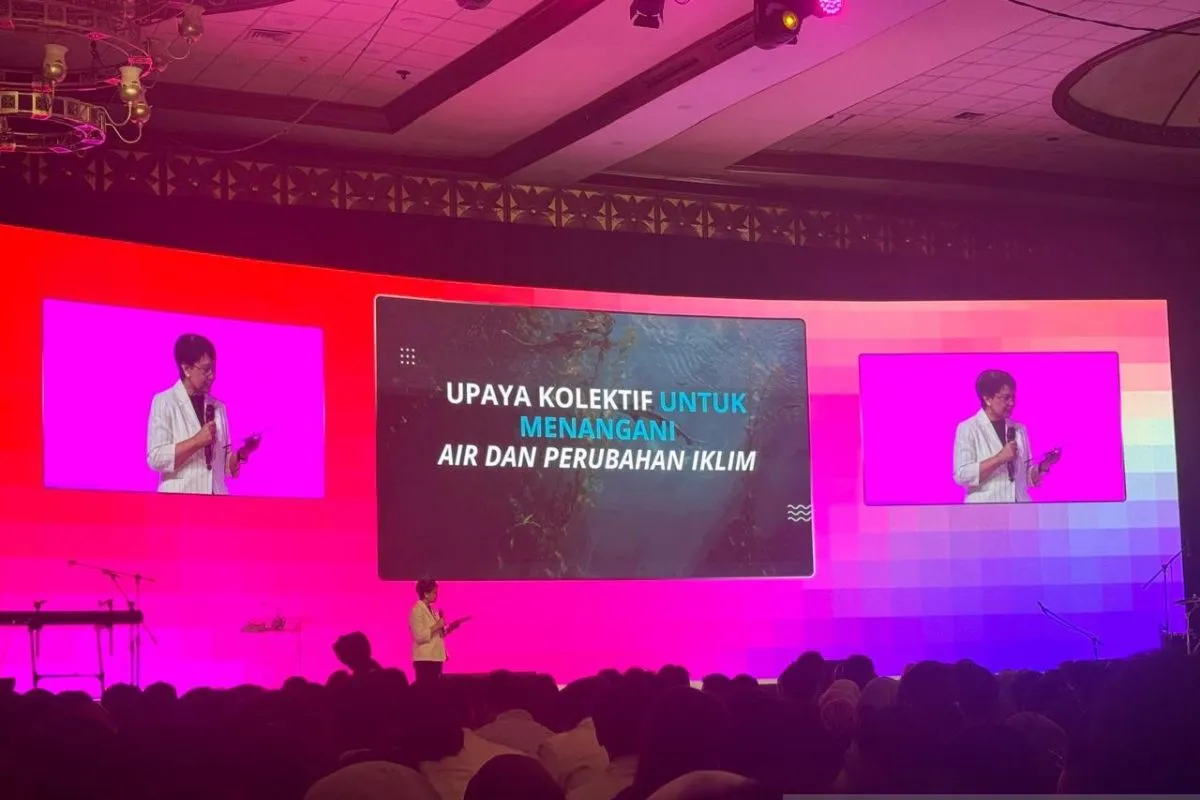
Jakarta, August 02, 2026 – The Europe Today: United Nations Secretary-General’s Special Envoy for Water Retno Marsudi has warned that climate change is acting as a “threat multiplier,” significantly worsening global water security challenges and underscoring the urgent need for accelerated action to achieve universal access to safe water and sanitation.
Speaking at the Indonesia Net Zero Summit (INZS) 2026 in Jakarta on Saturday, the former Indonesian foreign minister said access to water can no longer be viewed solely as a technical or sectoral issue, but must be addressed as a critical political and sustainable development priority.
“Climate change is a threat multiplier that can exacerbate all challenges faced in water issues,” Retno said, calling for stronger political commitment and structural reforms to address the growing crisis.
She emphasized the importance of accelerating progress toward Sustainable Development Goal (SDG) 6, which seeks to ensure the availability and sustainable management of clean water and sanitation for all by 2030.
According to Retno, Indonesia must significantly increase the pace of its efforts to meet the SDG 6 targets, requiring an eightfold acceleration in the provision of safely managed drinking water services, a sixfold increase in safe sanitation, and a doubling of access to basic hygiene services.
“If we do not do this, SDG 6 targets will only be achieved in 2049,” she cautioned.
Retno stressed that achieving these objectives will require broad collaboration among governments, civil society organizations, international partners, and the private sector. She pointed to a major financing imbalance in the water and sanitation sector, noting that public funding currently accounts for 86 percent of total investment, while private sector contributions remain at only 2 percent.
Highlighting the scale of the global challenge, Retno said more than 2.2 billion people—approximately one in four worldwide—still lack access to safely managed drinking water, while 3.5 billion people do not have adequate sanitation services. She added that nearly 4 billion people experience severe water scarcity, and renewable freshwater availability per capita has declined by around seven percent over the past decade.
Looking ahead, she warned that the pressure on global water resources will intensify as the world’s population is projected to reach 9.7 billion by 2050, driving water demand up by more than 25 percent alongside a 50 percent increase in global food requirements.
Retno noted that agriculture already accounts for 72 percent of additional freshwater use, posing significant risks to food security, public health, and economic stability if sustainable water management is not strengthened.
She also highlighted the growing impact of technological development on water consumption, warning that the expansion of artificial intelligence, digital infrastructure, and data centers is placing additional strain on already stressed water resources.
According to Retno, emerging digital infrastructure could increase regional water demand by as much as 129 percent, while around 40 percent of the world’s data centers are currently located in regions experiencing severe water stress.
Concluding her remarks, Retno emphasized that effective water governance must be integrated into broader climate action and net-zero emission strategies, stressing that sustainable water management is fundamental to achieving long-term environmental resilience, economic development, and global prosperity.