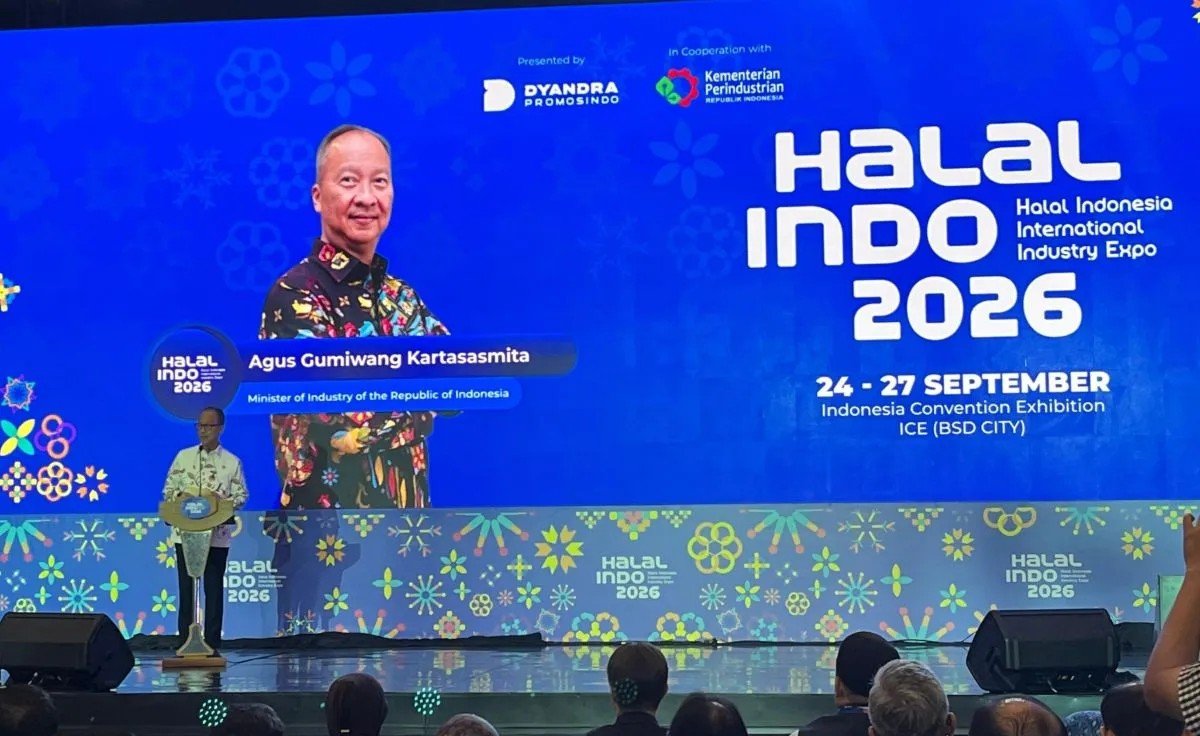
Jakarta, September 25, 2026 — The Europe Today: Indonesia’s Ministry of Industry is strengthening the country’s halal industry ecosystem, enhancing industrial competitiveness and expanding access to international markets as part of efforts to position Indonesia as a global halal industry hub.
Speaking at the Industrial Festival x Halal Indo 2026 in Tangerang District, Banten, Industry Minister Agus Gumiwang Kartasasmita said the global halal market continued to record strong growth, creating significant opportunities for Indonesia.
He noted that Muslim consumer spending across six Islamic economic sectors reached US$2.6 trillion in 2024 and is projected to increase to US$3.56 trillion by 2029.
Kartasasmita said Indonesia possessed a strong foundation to become a major player in the global halal industry, particularly due to its large domestic market.
Household consumption in Indonesia reached Rp5,974.9 trillion, equivalent to around US$333.8 billion, during the first half of 2026, supported by a Muslim population of approximately 252.8 million.
“With this strong foundation, Indonesia must transform from a mere consumer market into a major producer and key player in the global halal industry,” the minister said.
According to the State of the Global Islamic Economy Report (SGIER) 2025/26, Indonesia ranks fourth globally in the halal industry ecosystem. The country also holds strong positions across several key sectors, with halal food ranking third, modest fashion retaining the top position, and halal pharmaceuticals and cosmetics ranking fourth.
The minister said that by the first half of 2026, around 2.67 million industrial companies had obtained halal certification. A total of 5.49 million industrial products had also been certified halal through 2.76 million certificates issued.
Indonesia has also emerged as a significant destination for investment. In 2025, it was the third-largest recipient of foreign direct investment among member states of the Organization of Islamic Cooperation (OIC), attracting US$24.2 billion.
However, Kartasasmita pointed to the country’s trade imbalance in halal products as an area requiring further attention. Indonesia’s halal product exports to OIC countries amounted to US$12.51 billion in 2024, compared with imports of US$31.52 billion.
“This signals that we still have much homework to do, particularly in strengthening domestic production capacity to reduce import reliance. Yet, this is the momentum we must leverage for Indonesia to emerge as a global halal industry hub,” he said.
To strengthen the sector, the Ministry of Industry issued Minister of Industry Regulation No. 40/2025 on the Roadmap for Halal Industry Development 2025–2029.
The ministry is also preparing the 2026–2030 National Industrial Policy and revising the 2015–2035 Master Plan for National Industrial Development (RIPIN).
Kartasasmita emphasized that mandatory halal certification should go beyond regulatory compliance and serve as an instrument for strengthening industrial competitiveness, building consumer confidence and expanding access to international markets.
“We want to leverage mandatory halal certification not merely as a matter of compliance, but as a driver of competitiveness. Halal certification must be a part of an industrial strategy to build consumer trust and expand market access, including for exports,” he said.
The minister expressed confidence that a comprehensive strategy could enable Indonesia to develop its halal industry into a new source of economic strength and strengthen the country’s position in global markets.