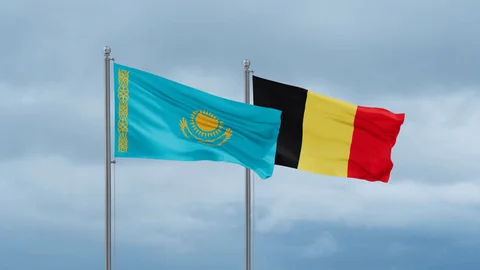
Belgium and Kazakhstan are entering a new phase in their bilateral relations, marked by high-level diplomatic exchanges and growing strategic alignment. President Kassym-Jomart Tokayev can maybe visit Brussels, alongside the planned state visit of the King of the Belgians to Kazakhstan in autumn, reflects the deepening importance of this partnership at both bilateral and European levels.
Belgium and Europe are showing a growing interest in Central Asia, a region that is increasingly seen as a key geopolitical and economic crossroads. In this context, Belgium is preparing to open its second embassy in the region, demonstrating its long-term commitment to strengthening diplomatic, economic, and political engagement.
Kazakhstan stands as the leading partner of both the European Union and Belgium in Central Asia. For many years, Kazakhstan hosted Belgium’s first embassy in the region, illustrating its central role as a gateway to Central Asia. Today, the country remains the primary economic and trade partner of Belgium in the region, concentrating the majority of Belgian exchanges and playing a pivotal role in the development of Trans-Caspian logistics routes, particularly the Middle Corridor.
Belgium recognized Kazakhstan’s independence in 1991, and diplomatic relations were formally established in 1992. Kazakhstan opened its embassy in Brussels in 1993, while Belgium established its embassy in Astana in 2006, further structuring bilateral relations and facilitating political and economic dialogue at all levels.
Strategic and Economic Partnership
Relations between Belgium and Central Asian countries—particularly Kazakhstan—are structured around several key axes:
Kazakhstan: Belgium’s Key Partner in Central Asia
Kazakhstan stands as Belgium’s primary economic and commercial partner in Central Asia. Historically, it hosted Belgium’s first embassy in the region, reflecting its strategic importance. Today, it accounts for the majority of Belgian trade in Central Asia and plays a pivotal role in regional logistics, especially through the Trans-Caspian International Transport Route, also known as the Middle Corridor.
Trade relations between the two countries continue to expand. According to Kazinform, bilateral trade turnover reached approximately $523.7 million in 2023, marking a 1.7% increase compared to 2022. Kazakhstan exported goods worth $220.7 million to Belgium, while imports from Belgium stood at $303 million. In the same year, Belgian foreign direct investment in Kazakhstan exceeded $1 billion, underscoring strong investor confidence.
Belgium is among the top 10 European investors in Kazakhstan, with around 100 Belgian companies operating in the country. These companies are active across key sectors such as logistics, agri-food, renewable energy, green technologies, infrastructure, and engineering. Additional areas of cooperation include metallurgy, petrochemicals, agri-tech, and the processing of critical raw materials—an area of increasing importance for Europe’s strategic autonomy.
Institutional frameworks further support this cooperation. The Benelux Chamber of Commerce in Kazakhstan plays a crucial role in facilitating business ties, supporting companies, and promoting investment opportunities in both directions.
TRANS-CASPIAN INTERNATIONAL TRANSPORT ROUTE
Kazakhstan’s strategic position along the Trans-Caspian International Transport Route (Middle Corridor) further enhances its attractiveness, making it a crucial partner for European connectivity between Asia and Europe.
Key areas of collaboration include:
- – metallurgy and petrochemicals
- – renewable energy and green transition
- -agri-tech and sustainable agriculture
- – processing of critical raw materials..
Trade relations are strong and stable. According to Kazinform, Kazakhstan–Belgium trade turnover exceeded $523 million in 2023, with exports from Kazakhstan reaching $220.7 million and imports from Belgium totaling $303 million. Belgian foreign direct investment in Kazakhstan exceeded $1 billion, highlighting the depth of economic ties.
Institutional and Business Framework
On March 14, 2025, the Belgian Ministry of Foreign Affairs hosted the “Team Belgium Global Gateway” roundtable, highlighting investment opportunities in Central Asia, with a strong focus on Kazakhstan. Organized in cooperation with AWEX, Flanders Investment & Trade (FIT), and hub.brussels, the event brought together more than 20 major Belgian companies.
Key speakers emphasized the strong interest of Belgian businesses in mutually beneficial investment projects in Kazakhstan. Belgium’s Ambassador to Kazakhstan, Henri Vantieghem, highlighted opportunities in transport, logistics, and telecommunications infrastructure.
Kazakhstan actively promotes foreign investment through a range of incentives, including tax benefits, administrative facilitation, and comprehensive support from the national agency Kazakh Invest. The Astana International Financial Centre (AIFC), which hosts over 3,500 registered companies, offers an advanced legal and financial framework based on international standards.
Belgian companies have been invited to participate in large-scale projects such as the development of Alatau city, expansion of the Middle Corridor, and renewable energy production aimed at export to the European Union.
Technological, Academic and Cultural Cooperation
Beyond trade, bilateral relations are expanding into technological, academic, and cultural domains. Belgium’s advanced aerospace industry, including companies like Aerospacelab, has attracted growing interest from Kazakhstan, particularly in satellite production and space cooperation.
Academic collaboration is also gaining momentum. Recent discussions between Ambassador Vassilenko and Ghent University leadership have focused on joint research initiatives, PhD co-supervision, and cooperation in fields such as biotechnology, agricultural sciences, artificial intelligence, and digitalization.
Cultural diplomacy continues to strengthen people-to-people ties. Events such as the Hanyraq Fest in Brussels have showcased Kazakhstan’s cultural heritage, while tourism initiatives have facilitated partnerships between Kazakh tour operators and Belgian travel companies, enhancing Kazakhstan’s visibility in the Benelux market.
Strategic Alignment on Global Issues
Belgium and Kazakhstan also cooperate on key global challenges, including nuclear non-proliferation and resource security. Kazakhstan plays a vital role as a major supplier of uranium and critical raw materials to the European Union, reinforcing its strategic relevance.
Conclusion
Belgium’s role as host of EU institutions and as a major diplomatic hub gives it unique importance in Kazakhstan’s European strategy. In turn, Kazakhstan leverages Brussels as a platform to strengthen its political, economic, and cultural ties with the European Union.
As high-level visits, economic cooperation, and institutional partnerships continue to intensify, Belgium–Kazakhstan relations are evolving into a mature and forward-looking strategic partnership—one that reflects broader shifts in Europe’s engagement with Central Asia and the growing importance of connectivity, sustainability, and geopolitical balance.
Bibliography
- Actualités-CCI. (2025, 9 avril). Le Kazakhstan présente son potentiel d’investissement à Bruxelles. https://actualites-cci.com/le-kazakhstan-presente-son-potentiel-dinvestissement-a-bruxelles/ [actualites-cci.com]
- Brussels Enterprises Commerce and Industry (BECI). (n.d.). The 3rd meeting of the Belgium-Kazakhstan Business Council. https://www.beci.be/en/event/the-3rd-meeting-of-the-belgium-kazakhstan-business-council-1841/register [beci.be]
- Qazinform. (n.d.). Kazakhstan-Belgium commodity turnover exceeds $523 million. https://qazinform.com/news/kazakhstan-belgium-commodity-turnover-exceeds-523-million-a31b23 [beci.be]
- Zajmi, X. (n.d.). Kazakhstan aims to be a “strategic partner” for Europe’s green transition. Euractiv. https://www.euractiv.com/news/kazakhstan-aims-to-be-a-strategic-partner-for-europes-green-transition/ [euractiv.com]

Historian and environmental management expert on Central Asia and researcher on Central Asia post-Soviet period. Journalist for EuReporter and EuReflect and Special Director of “The Gulf Observer” for Europe and Central Asia.