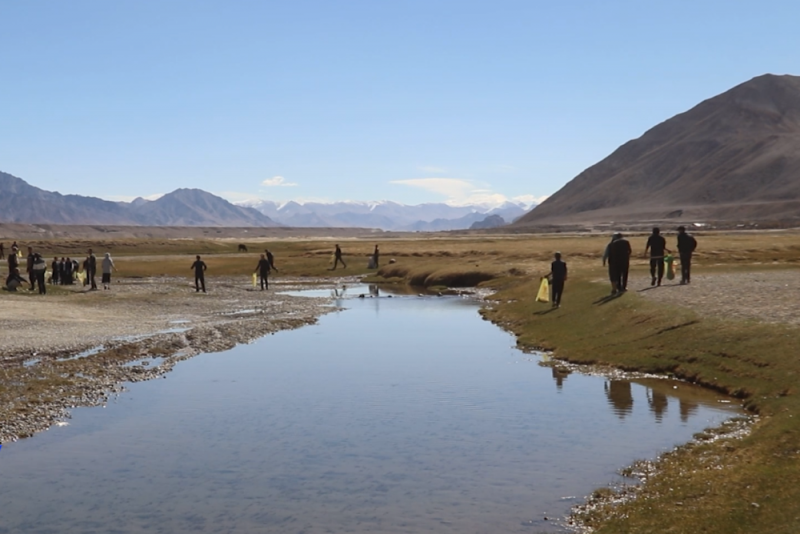
Murghob, May 22, 2026 – The Europe Today: Hundreds of teenagers and young volunteers in Tajikistan’s Murghob district participated in a two-day environmental campaign to clean the banks of the Aksu River and its tributaries from garbage and waste.
Head of the Environmental Protection Department of the Gorno-Badakhshan Autonomous Region, Shahtut Sabzaliev, said rising water levels in mountain rivers during the spring season carry surrounding waste into the Aksu River, which then flows through the Bartang and Gunt rivers into the Panj River, one of Tajikistan’s largest waterways.
He noted that seasonal rains and strong winds also sweep plastic waste into rivers, posing serious risks to both people and aquatic life.
According to official statistics, the Panj River stretches 921 kilometers, with more than four million residents across Central Asian countries living along its banks. Many communities rely directly on its water or obtain it through pumping systems.
Sabzaliev stressed that preserving the cleanliness and purity of river water originating from the pristine mountain glaciers depends largely on the responsibility of residents living upstream.
He added that the “Clean Shore” environmental campaign continues throughout all four seasons and involves school students, university students, and employees of regional institutions and organizations.
During the summer season, many residents, visitors, and tourists gather along riverbanks for recreation, but some leave behind waste such as plastic bags, bottles, and food scraps after picnics, he said.
Although environmental specialists regularly conduct awareness meetings and educational discussions with residents around lakes and rivers, Sabzaliev observed that environmental awareness among some citizens still remains insufficient.
During the “Clean Shore-2026” campaign, volunteers cleaned more than three kilometers of the Aksu River shoreline and nearby tributaries in a single day.
Over the two-day initiative, more than 3.5 cubic meters of waste were collected from the riverbanks and transported to the district’s main landfill site with the assistance of municipal sanitation workers.