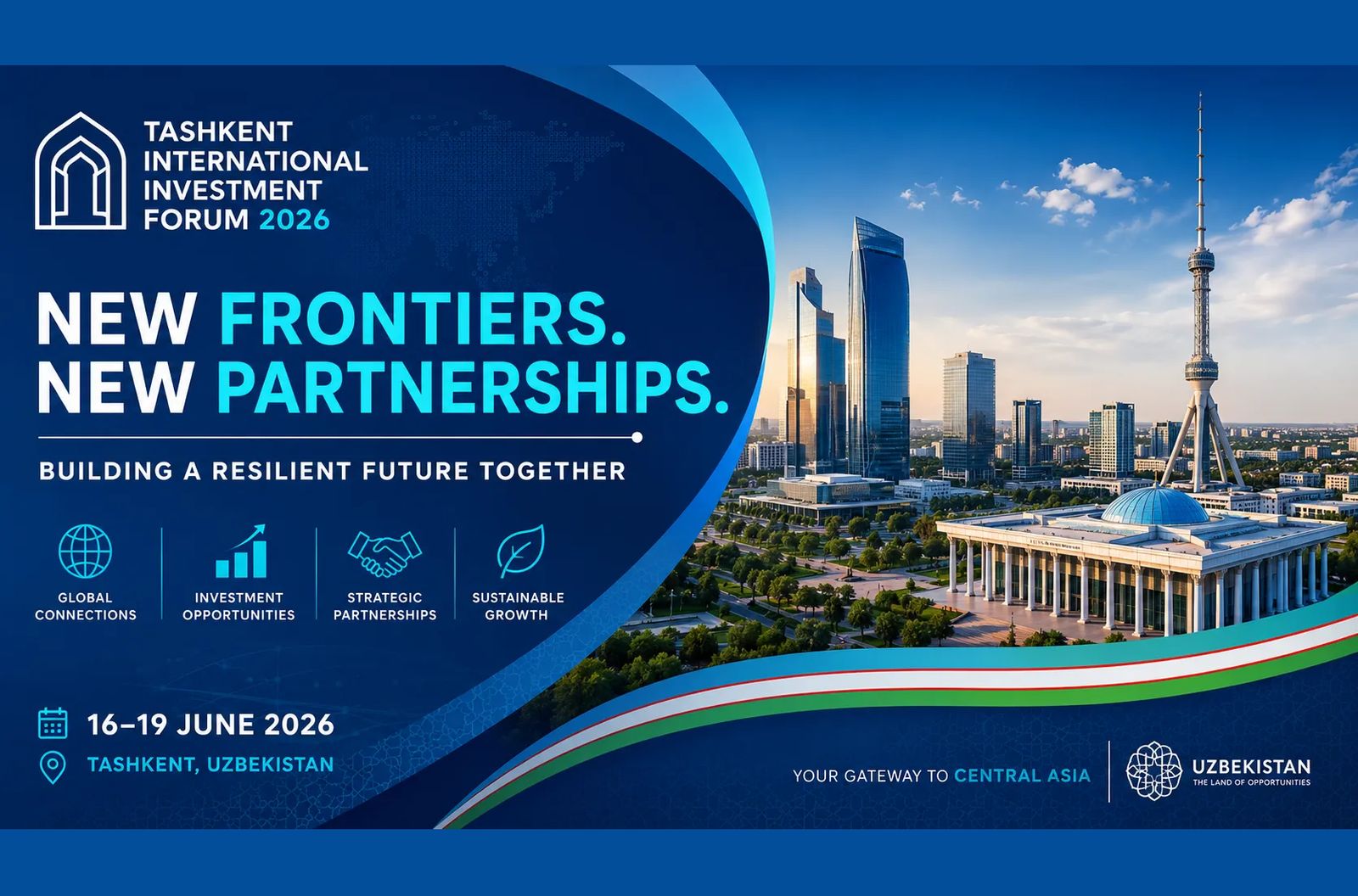
Central Asia’s rising economic power, Uzbekistan, is preparing to once again capture international attention with the 5th Tashkent International Investment Forum (TIIF 2026), scheduled to take place on June 16–19 in Tashkent. The forum will bring together global investors, government officials, international financial institutions, and multinational corporations on one platform. Thanks to large-scale economic reforms, privatization efforts, and investor-friendly policies implemented in recent years, Uzbekistan is becoming not only a regional but also a global investment destination.
Under the leadership of President Shavkat Mirziyoyev, Uzbekistan has accelerated its economic transformation process. Major investment projects in energy, infrastructure, logistics, industrial production, agriculture technologies, and the digital economy continue to attract growing international interest. This year’s forum theme, “Investment Resilience: New Frontiers, New Partnerships,” focuses on creating sustainable partnerships and secure investment models in an increasingly uncertain global economic environment.
Uzbekistan’s Economy Enters a New Era
Over the past few years, Uzbekistan has become one of the fastest-growing economies in Central Asia. Strong GDP growth, rising exports, and increasing foreign direct investment have positioned Tashkent at the center of regional economic discussions. The country’s young population, expanding domestic market, and government-backed reforms make it increasingly attractive for long-term investors.
The Uzbek government is also accelerating major privatization programs. State-owned companies in energy, transportation, mining, and infrastructure are gradually opening to international investors. Analysts believe these reforms are laying the foundation for Uzbekistan’s integration into global capital markets and increasing international confidence in the country’s economic future.
Economists emphasize that Uzbekistan’s strategic geographic location is another major advantage. Positioned between China, the Gulf region, Türkiye, and Europe, the country is becoming an important transit and trade corridor connecting East and West. As a result, TIIF 2026 is expected to serve not only as an investment forum but also as a strategic platform for shaping the future economic architecture of Eurasia.
Tashkent International Financial Centre Draws Global Attention
One of the most important topics of this year’s forum is the newly established Tashkent International Financial Centre (TIFC). Created through a presidential decree in 2026, the center is considered a cornerstone of Uzbekistan’s ambition to become an international financial hub.
The financial center operates under a legal framework based on English common law principles and includes an independent financial regulator and international arbitration system. Long-term tax incentives and investor protection mechanisms are also planned to attract global capital and multinational financial institutions.
Experts believe TIFC aims to compete with major regional financial centers such as Dubai, Astana, and Singapore. During the forum, topics including capital markets, investment security, fintech, sustainable finance, green energy investments, and digital transformation are expected to dominate discussions.
Particularly notable is the increasing interest from Gulf investors. Investment funds from the United Arab Emirates, Saudi Arabia, and Qatar are actively exploring opportunities in Uzbekistan’s energy, infrastructure, and logistics sectors. This growing attention is strengthening Tashkent’s position as one of Central Asia’s most strategic investment destinations.
Record Participation and Multi-Billion-Dollar Agreements Expected
The previous edition of the forum achieved significant milestones in terms of participation and investment volume. TIIF attracted thousands of participants from nearly 100 countries, including senior government officials, business leaders, and institutional investors. Billions of dollars in investment and trade agreements were signed, confirming the forum’s status as one of the largest investment platforms in Central Asia.
This year, participation is expected to grow even further. The forum agenda includes dozens of panel discussions, high-level B2B and B2G meetings, investment presentations, and private sector summits. In addition, the National Industrial and Investment Potential Exhibition at the CAEx Centre will showcase Uzbekistan’s industrial capabilities, manufacturing potential, and technology-driven projects.
Energy transition, green economy initiatives, transportation corridors, artificial intelligence, digital infrastructure, and sustainable development are expected to be among the key themes discussed during the event. Uzbekistan’s strengthening role within the China–Central Asia–Middle East trade corridor is also increasing international corporate interest in Tashkent.
Conclusion
The Tashkent International Investment Forum 2026 represents far more than a traditional economic event. It symbolizes Uzbekistan’s growing integration into the global economy and its ambition to become one of Eurasia’s leading investment and financial centers.
With its young population, strategic geographic location, rapidly developing economy, and reform-oriented policies, Uzbekistan is no longer simply trying to attract foreign investment — it is positioning itself as a key economic actor shaping the future of Central Asia and the broader Eurasian region. TIIF 2026 is expected to become the strongest international showcase of this transformation.