The bilateral relations between Russia and Türkiye are the trickiest of all such relations. The two states have been involved in a proxy war in Syria, Libya and the South Caucasus. Türkiye is a member of NATO, it is hosting the NATO 2026 summit in Ankara and it has provided combat drones to Ukraine since even before the full-scale invasion. It has not yet come onto board the Western sanctions regime, and has installed its first nuclear power station with Russian funds and technology; it is the main channel through which Russian pipeline gas can continue to flow to Europe.
This is not by chance and not a contradiction in terms. It’s a conscious approach, one that has been adopted over the past 12 years by two leaders who have decided to divide their differences on one file, and have developed a relationship on another. The method has resisted threats from events that could have rocked most partnerships such as the shoot down of a Russian aircraft in 2015 and the killing of a Russian ambassador in the Turkish capital Ankara in 2016.
My article explores the shared economic projects method that it has created, and the personal relationship between the two Presidents, Vladimir Putin and Recep Tayyip Erdoğan, in creating these projects. The treatment is scholarly in the appreciative sense: it’s real, it’s unusual, and the limits—more apparent over the last two years than at any time since 2016—are unusual.
The Personal Channel
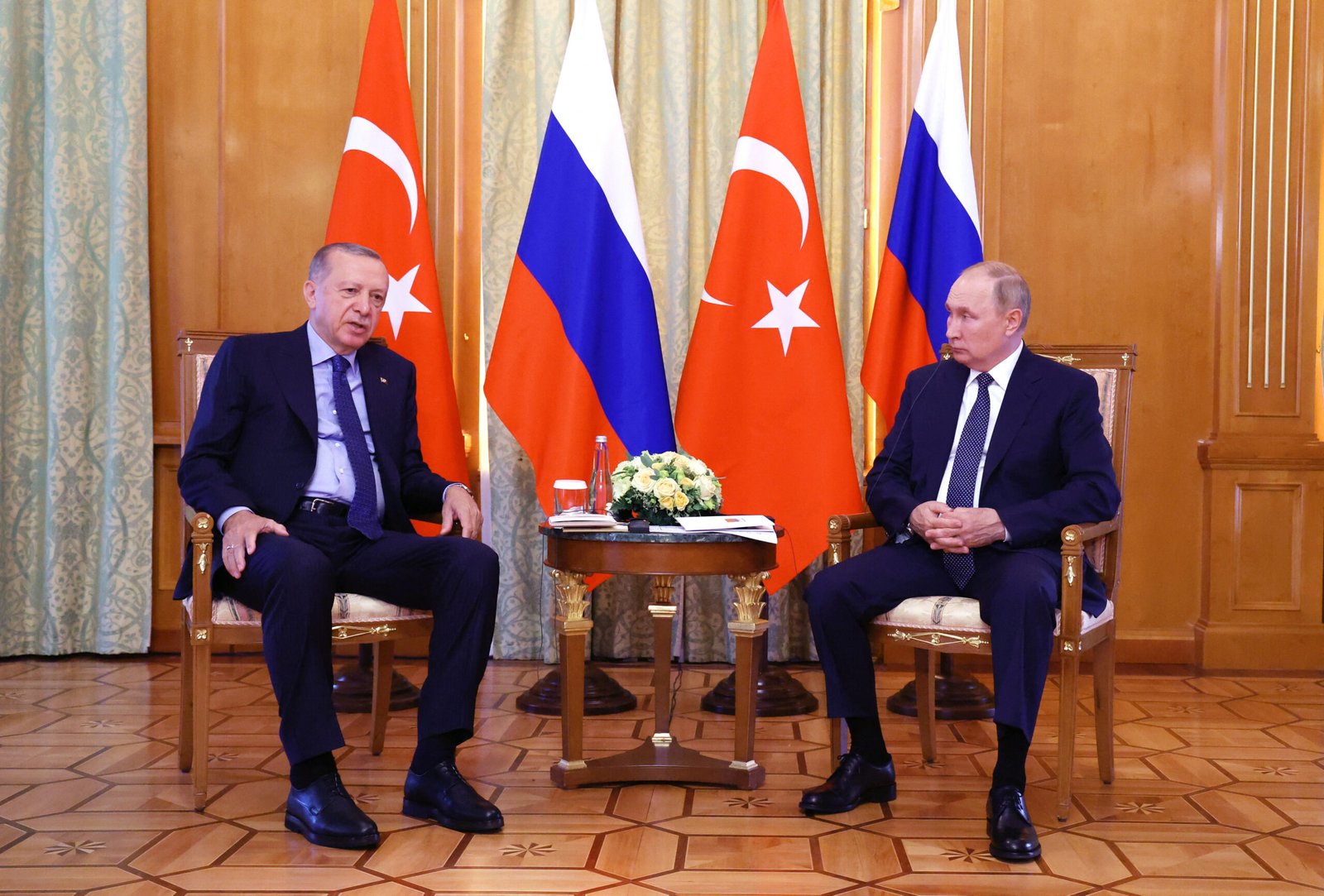
The two presidents meet and talk often, much more often than leaders of formally opposing security architectures do. The last meeting was on 1 September 2026 in Bishkek, on the sidelines of the Shanghai Cooperation Organisation summit, where Putin referred to Türkiye as a “privileged partner”, expressed his “confidence” Rosatom would start the first Akkuyu unit in the near future, and noted that major joint projects are advancing. During the same meeting, Erdoğan indicated that Türkiye is planning to further advance nuclear cooperation with Russia for more plants.
In numerous public remarks, Putin has attributed certain projects to Erdoğan’s personal efforts, such as TurkStream, which he has called “the product of the firmness of the Turkish president. The two have dealt with issues that have languished at the ministerial level through direct channels, ranging from gas payment issues to the terms of construction at Akkuyu after the withdrawal of Western suppliers.
It lets commercial work to proceed even if the politics get in the way by storing the politics in a separate file. It’s easy to undervalue that function, but not many relationships of similar difficulty have been able to do that.
Akkuyu: The Flagship
The Akkuyu nuclear power plant in Mersin province is the biggest individual Russian investment in Türkiye and one of the largest overseas nuclear plants. It is agreed intergovernmentally in 2010 and will consist of 4 units of VVER-1200 type, which are 1200 megawatts each and will provide approximately 10% of the Turkish electricity demand total capacity will be 4,800 MW. Its construction and operation is unique: Rosatom constructs, owns, and operates the plant, and owns a majority stake, while having the capital cost of about $20 billion. In April 2018, both presidents signed on via video link and inaugurated the construction work.
The project’s history has been a difficult one, the original targets of 2023 (on the eve of the republic’s centenary) and 2025 were not achieved. According to Rosatom’s director general, Akkuyu is one of the projects hardest hit by the sanctions, with payment channels being impassable and suppliers declining to supply equipment already contracted, including from Siemens, which refused to ship equipment, and about $2 billion in project funds being frozen abroad. Import substitution was implemented during the construction.
The situation is a lot better now. By mid-2026, construction on Unit 1 was completed, dummy fuel assemblies were loaded, reactor assembly was completed and cold hydrostatic testing was underway, while permission was granted to start commissioning work on Unit 2. On 6th September 2026, Turkish Energy Minister Alparslan Bayraktar announced that the first unit will commence operations by the end of this year, while it is being tested. A large percentage of the construction work has been done by Turkish firms and some hundred Turkish students have been educated in Russia to work at the plant.
Türkiye is assessing other locations at the Black Sea town of Sinop and in Thrace, and is also talking to South Korea, China, the United States and Russia, and Bayraktar confirmed that Ankara is seeking the most competitive bid. It’s not certain, though, that Russia will participate in that programme, as Erdoğan’s words in Bishkek show. And it’s not true that it’s a given, either.
TurkStream and the Gas Relationship
TurkStream began operations in January 2020 in Istanbul with both presidents in attendance, transporting Russian gas under the Black Sea to the Turkish coast where it travels to southeastern Europe. With the end of Ukrainian transit on 1st January 2025, it became the main transit route for Russian gas into Europe, making trans-Turkey’s pipeline route very strategically important.
The idea of the development of this idea to establish a gas trading hub in Türkiye was put forward by Putin himself in October 2022 and continued at the successive meetings. It’s not happened yet. By the end of 2025, there are signs that Gazprom has shelved the concept, as the move is driven by commercial considerations not political ones: Türkiye has been diversifying its gas supply with vigor. LNG accounted for 31 percent of the country’s gas consumption in 2024 and 44 percent in the first quarter of 2025, and in September 2025 Ankara inked a twenty-year LNG supply agreement with American company Mercuria valued at the sum of some $43 billion. Production in domestic Black Sea is being increased.
This is an example of logical relationship, Ankara buys from Russia because Russia has the best terms and tries to lessen its dependence on it whenever it can, and Moscow, with little choice as to the volumes involved, will accommodate.
Trade, Tourism and Economy
Trading is considerable and highly imbalanced. The most recent full year of Russian-made imports to Türkiye were around $42.4 billion, with energy imports accounting for about $29.8 billion, and Turkish exports to Russia were less than that at about $5 billion in the first three quarters of 2025. While the $100 billion trade goal that the two presidents established in 2022 is still far off, turnover has risen slightly — by 6.6 percent in 2024 and by about 3 percent through the first half of 2025 on Putin’s count.
The bond is not just hydrocarbons, but also built on other solid foundations. Russia is one of the biggest tourist groups, with millions of visitors coming to Türkiye annually, representing a substantial source of foreign currency. Turkish construction and contracting companies have long been working in Russia. Russia is one of the main suppliers of grain to Türkiye and the volumes of agriculture and food export have increased as a result of the Russian retail market gaps. Türkiye is also an important intermediary point in the reorienting of trade routes, gaining commercial and western attention.
Mediation as a Joint Economic Product
The Black Sea Grain Initiative of July 2022, brokered with the help of Turkey and the United Nations, paved the way for the resumption of Ukraine’s grain exports, and through the World Food Programme alone, several hundred thousand tonnes were shipped across. The Black Sea Grain Initiative of July 2022, facilitated by Türkiye and the United Nations, enabled the resumption of Ukraine’s grain exports and eased several hundred thousand tonnes through the WFP. The 2022 direct Russian–Ukrainian talks and three more in 2025 were held in Türkiye.
It was the personal connection between two presidents that was at the heart of the ability of Ankara to hold these talks at all, both sides trusted one another with no other capital could boast of such a relationship.
Constraints and Divergence
Four constraints have grown more prominent and belong in any accurate account.
The first is structural political divergence. The partnership is put under pressure by Türkiye’s NATO membership, arms deal with Ukraine, hosting of the NATO Summit in 2026 and its involvement in the European security agenda. The recent Western approval of the sale of the Eurofighter jets to Ankara is an example of this.
The second is intentional Turkish diversification, reflected in LNG contracts, domestic production and future nuclear sites that are being opened up for tender. Analysts describe a considered pivot in energy policy rather than a rupture.
The third is sanctions exposure. Periodically, under secondary sanctions pressure, Turkish banks have now limited Russian payments and the difficulties of payments have directly affected project work, including Akkuyu.
Asymmetry of the trade balance is the fourth. A relationship of 8:1, where the buyer sells about eight times that amount is politically at-risk in the country that sells, as they’ve admitted in Türkiye.
Additionally, there is a symbolic fact that should be noted: Although Putin keeps being invited to Türkiye in the past few years, he hasn’t come here personally to meet the President. The two leaders meet mostly on third territory.
Conclusion
So in my point of view, the partnership between Russia and Türkiye is an anachronism in the context of economic ties and – on the available evidence – a very effective one. Two presidents who have different views on Ukraine, Syria, Libya and the South Caucasus have managed to build a four-unit nuclear power station that is now coming into commission, and a subsea pipeline that has become Russia’s last viable, marketable route to Europe, and a trade relationship valued at more than $40 billion per year, and a tourism stream of millions, and a mediation process that generated a single viable wartime grain corridor. All of this was done not because of the disagreement of the politicians, but because of the agreement of the two leaders that the disagreement would be dealt in another compartment.
There are three part to my accurate analysis. The method is working—with delays, sanctions harming the project, frozen funds, and supplier withdrawals—the first Akkuyu unit will produce electricity before the end of 2026, providing Türkiye with the first nuclear capacity and Rosatom with the most challenging overseas delivery ever.
The method has limits that have become clearer since 2024 and the plan to build a gas hub has quietly languished. The $100 billion goal is not imminent. Pipeline gas is being replaced at a measurable rate by LNG. There is, indeed, a French willingness to consider alternative suppliers to nuclear power in future tenders. Türkiye is actually doing what a sovereign middle power should do; Russian planning based on the permanent preference is misguided.
So lastly, the durability of the method is more on the shoulders of two people than either likes. So far, the compartments have been maintained because Putin and Erdoğan have wanted to keep them separate, despite a series of events that have broken most ties. Institutions have developed around that choice, but haven’t eclipsed it. The question yet to be answered is whether the partnership will outlast its architects, and a decade of otherwise impressive construction has yet to provide an answer.
Copyright © 2026 by Muhammad Ali Pasha. All rights reserved. Reproduction or distribution of this content, in whole or in part, without prior written permission is prohibited.
Owner of “The Europe Today” and Patron-In-Chief/Owner of “The Gulf Observer”, Chairman “The Gulf Observer Research Forum”, Foreign Affairs Expert, Analyst, International Award Winning Author and Poet.