Governments do not usually rewrite five-year economic plans around infrastructure that has not been built. Azerbaijan has just done exactly that.
On 2 September, President Ilham Aliyev signed a decree amending the State Programme for the Socio-Economic Development of the Nakhchivan Autonomous Republic for 2023–2027 — a document originally approved in June 2023 with eleven priority areas, few of which assumed the exclave would ever have a direct land link to the rest of the country. The amended version assumes precisely that.
The revision has drawn attention among regional analysts for what it implies rather than what it funds. In an interview with AZERTAC, Azerbaijan’s state news agency, Mr. Muhammad Ali Pasha — Chairman of The Gulf Observer Research Forum and Patron-in-Chief of The Gulf Observer and The Europe Today — described the amendment as evidence of a shift in official thinking about a territory long treated as a strategic burden. Nakhchivan, he argued, has been “a geographical enigma”: home to roughly 460,000 people, bordered by Armenia, Iran and Türkiye, and reachable from Baku overland only by a detour of some 677 kilometres through Iran or well over 1,200 kilometres via Georgia and Türkiye.
A plan written in intent, not in manat
What the amended programme contains is instructive: targeted logistical support arrangements for exporters, tax and freight concessions intended to drive use of the future corridor, and an expanded entrepreneurship framework to activate once the route opens. What it largely lacks is hard numbers.
That imbalance is the point. This is pre-positioning rather than budgeting — an attempt to ensure that the legal and commercial scaffolding exists before the first train runs, so that Nakhchivan’s producers are not left waiting years for enabling legislation after the rails are laid. Baku has learned from the reconstruction of Karabakh and East Zangezur that sequencing policy behind concrete is expensive.
Azerbaijan has done its part. That is the problem.
On the ground, the asymmetry is stark.
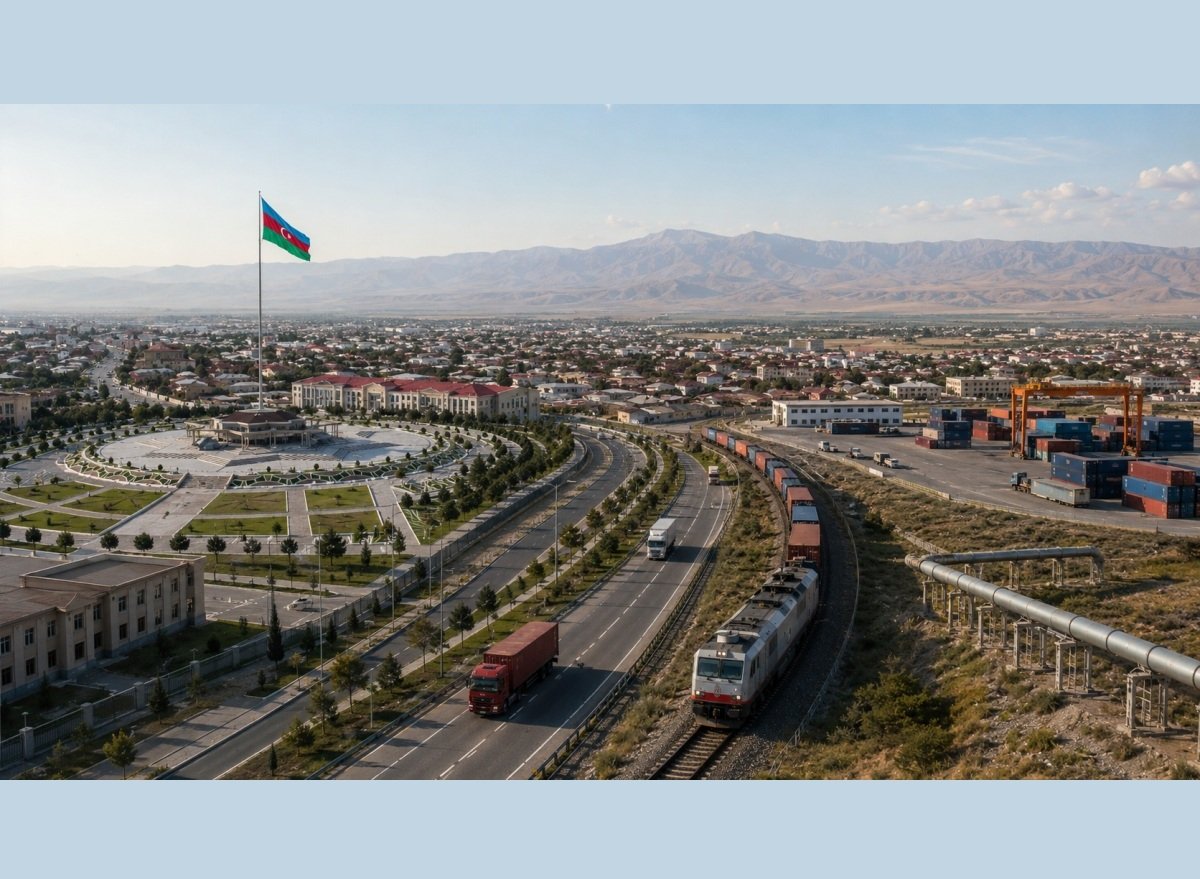
The 123.6-kilometre Horadiz–Jabrayil–Zangilan–Aghband highway, incorporating three tunnels totalling some 12 kilometres, is essentially finished; Aliyev described it in August as practically ready. The parallel 110-kilometre Horadiz–Aghband railway — designed for up to 15 million tonnes of freight and 5.5 million passengers a year — stood at around 73 percent completion in August, with Azerbaijan Railways targeting the Armenian border in 2027 and commissioning of the line by the end of this year. Work has begun on the first seven-kilometre stretch running toward Ordubad along the Armenian frontier, and roughly 190 kilometres of track inside Nakhchivan itself is being rehabilitated or built new. On the Turkish side, Ankara has started the 224-kilometre Kars–Iğdır–Aralık–Dilucu railway, a four-year undertaking that would connect the exclave to the Turkish network.
Every one of those segments lies within Azerbaijani or Turkish jurisdiction. The 42-kilometre section that actually closes the gap does not.
That stretch — the Trump Route for International Peace and Prosperity, or TRIPP, created under the Washington declaration of 8 August 2025 — crosses sovereign Armenian territory in Syunik province, with the United States granted exclusive development rights and an Armenian–American joint venture appointed to build it. A US–Armenian implementation framework was published in January 2026, including guarantees that infrastructure on Armenian soil remains under Armenian sovereignty; Yerevan has been negotiating the term of the development concession, with 49 and 99 years both under discussion. Construction there has not started. Prime Minister Nikol Pashinyan has pointed to late 2026; Aliyev has indicated late 2026 or early 2027, while noting that Azerbaijan sees no reason to accelerate its own works while the Armenian section remains unready.
So the corridor’s completion date is not an Azerbaijani variable. It is an Armenian, American and — given Moscow’s and Tehran’s discomfort with a route that reduces their leverage over South Caucasus transit — a broader geopolitical one.
It is also worth registering that the two sides do not agree on what the project is called or what it means. Baku continues to speak of the Zangezur corridor; Yerevan rejects that framing, treats TRIPP as a component of its own “Crossroads of Peace” agenda, and has been careful to anchor the arrangement in explicit sovereignty guarantees. Those are not cosmetic differences. They are the terms on which transit control will eventually be administered, and they remain unresolved.
The cargo question nobody likes to raise
Beyond the politics sits a commercial issue that has sunk more than one corridor: throughput.
A transport route is worth only what moves along it. The Middle Corridor across the Caspian handled roughly 4.5 million tonnes in 2024 — a fraction of the 15-million-tonne design capacity of the Horadiz–Aghband line alone. Regional corridors have a consistent history of underperforming their nameplate figures, because transit volumes depend on decisions made in Beijing, Ankara, Brussels and Moscow rather than by the transit state.
This is where the amended programme starts to look less like boosterism and more like strategy. If Nakhchivan itself produces goods that need moving, the corridor acquires a floor of guaranteed cargo that does not depend on Eurasian freight flows behaving as forecast. Logistics subsidies, freight discounts and an enterprise push are the instruments for manufacturing that floor. On this reading, the exclave’s industrialisation is not a social programme attached to a transport project — it is the transport project’s insurance policy.
Two markets instead of one
The longer-term prize is structural. Nakhchivan shares an 11-kilometre border with Türkiye, receives Turkish gas through the Iğdır pipeline commissioned in 2024 in place of Iranian supply, and hosts a decade’s worth of Turkish investment from joint universities to energy interconnection.
Complete the corridor and a producer in Nakhchivan can reach mainland Azerbaijan and eastern Anatolia with comparable ease — two market routes rather than one, and a plausible basis for something more formal: a preferential trade area or specialised industrial border zone functioning as a hinge between the Turkish and Azerbaijani economies. Nothing in the September decree commits Baku to that step, and it would require tariff and customs decisions that carry implications for Azerbaijan’s wider trade policy. But the model is familiar from the free zones China has used to pull manufacturing toward transit chokepoints, and the logic travels.
What to watch
Three markers will indicate whether the amended programme was foresight or wishful drafting.
First, whether ground is broken on the Armenian section within the next six months, and on what concession terms. Second, whether the Horadiz–Aghband line is actually commissioned by year-end and reaches the border in 2027 as Azerbaijan Railways projects. Third, whether the enabling measures the decree promises — the logistics support, the freight concessions — are translated into published regulation rather than left as intent.
The corridor may still take longer than Baku’s timetable suggests, for reasons that sit outside Azerbaijan’s control. The narrower and more answerable question is whether Nakhchivan will be in a position to use the route from the day it opens. On the evidence of this decree, that is the outcome Baku is spending its planning capital on.